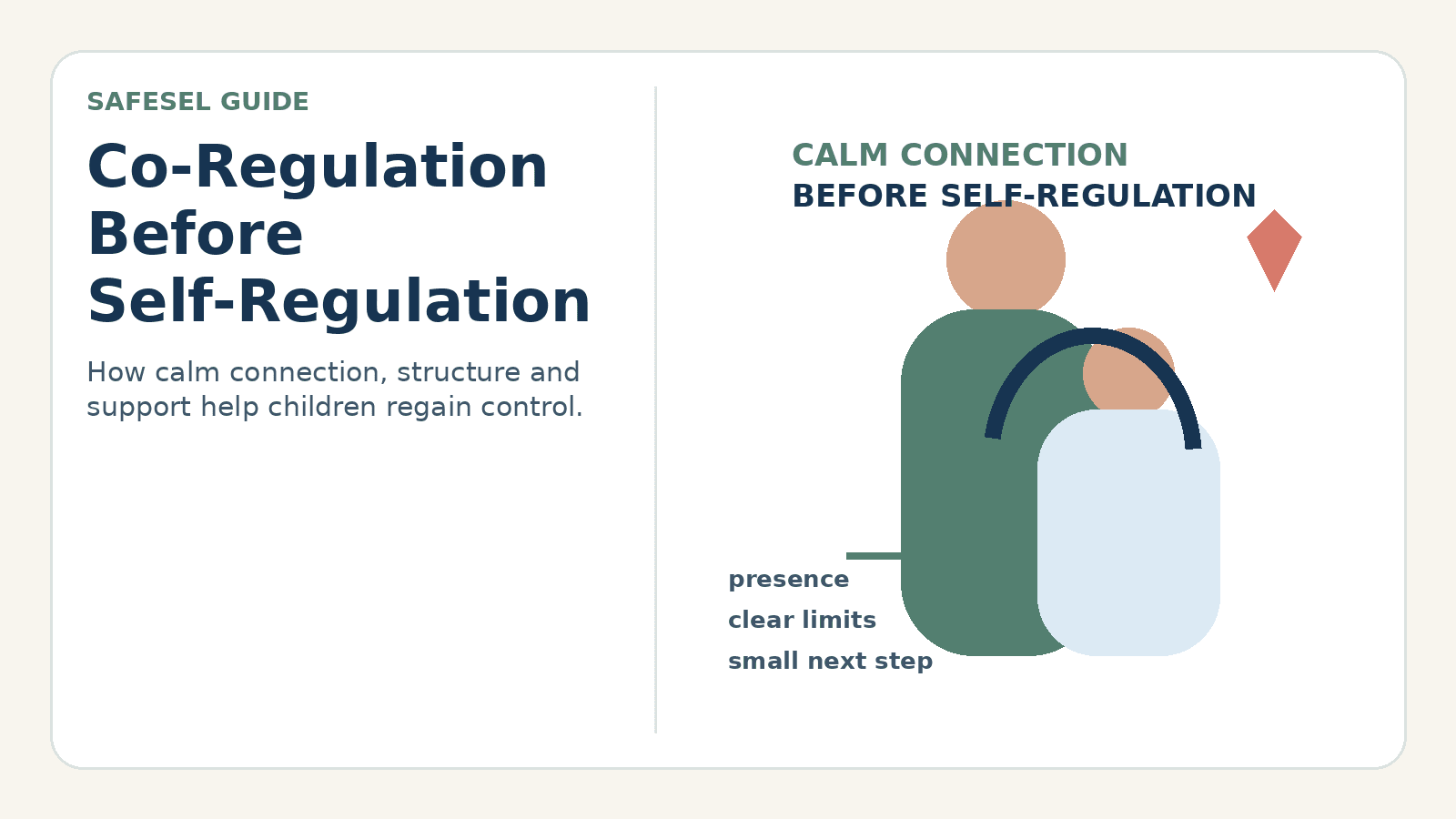
Co-regulation before self-regulation means that children often need support from another person while learning to manage feelings, attention and actions. It does not mean an adult can make every feeling disappear. A supportive relationship, a workable environment and opportunities to learn skills all matter. The amount and kind of help can change with the child, the task and the day.
Parents need practical options as well as definitions. A child may manage a familiar routine independently in the morning and need considerable help after a tiring school day. Needing support again is not proof that earlier progress has disappeared or that the adult has caused dependence.
Stage 1: Regulate together
Begin with safety and the immediate demand. If the child is distressed by several instructions, pause the nonessential ones and state the next necessary action briefly. If the room is overwhelming, consider an available quieter place. Offer company or space according to what the child finds helpful; do not assume a hug, eye contact or deep breathing will be welcome.
Co regulation strategies can be ordinary and specific: sitting nearby, pointing to a familiar plan, helping find a missing shoe or reducing the amount of language. These examples are options to adapt, not a set of steps every child must complete. The adult’s job is to make support accessible, not to insist that the child display calmness.
A limit can remain clear while support changes. ‘I will help keep everyone safe. We can talk when there is more space’ is different from giving a long explanation during escalating distress. If there is a risk of harm, follow the appropriate safety plan and obtain help rather than trying to manage an unsafe situation with a script.
Stage 2: Reflect together
Wait until the child can use a short conversation. Ask about one part of the event: ‘Was it the noise, not knowing what came next, or something else?’ Leave room for an answer you did not expect. The child can draw, point or decline an extended discussion. A detailed account is not a prerequisite for receiving support.
Include what adults did. Perhaps the warning was unclear or the task involved too many steps. If you shouted, acknowledge it without making the child responsible for comforting you. Reflection should help decide what to try next, not reconstruct an argument to prove who was right.
Stage 3: Practise increasing independence
Choose one familiar action the child wants or needs to use: asking for a pause, checking the first picture in a routine, or putting materials in an agreed place. Model it during a manageable moment and let the child try with help. Avoid removing several supports at once to test independence.
Examples of self regulation might include noticing rising frustration and asking for assistance. That still involves another person. Independence is not measured by never needing anyone; it can mean using available support more deliberately. Disability accommodations and communication access should not become rewards that are withdrawn after a successful day.
Co regulation examples during an ordinary transition
Illustrative example: Ben becomes upset when it is time to leave for school. His parent discovers that locating shoes while hearing repeated instructions is the hardest part. Together they choose a visible place for the shoes and a short picture sequence. At first the parent stays beside him and points to the first picture. Later Ben uses the picture himself and asks for help when something is missing.
This is a practical example, not a treatment promise or a fixed progression. It shows how changing the environment and making the next action clear can work alongside emotional support. A different child may need different help, and persistent distress may need assessment.
Support for parents matters too
Coping skills for parents should be realistic enough to use during a busy day. If another responsible adult is available, agree on a handover before anyone reaches their limit. If you need a brief pause, ensure the child remains safely supervised. A complicated calm-down routine that you cannot use is less helpful than one feasible adjustment.
Parents do not need to be perfectly composed to repair a difficult interaction. Return, acknowledge what happened and explain the next step. If overwhelm is persistent, seek support for yourself as well as the child rather than interpreting every difficult moment as a parenting failure.
When additional support is appropriate
Look for changes in safety, communication, recovery and access to everyday activities, not only fewer protests. Seek appropriate health or mental health advice when difficulties persist, worsen or substantially disrupt daily life. Co-regulation is a supportive process, not a substitute for individualized care or a solution to an unsafe environment.
ACF: Co-Regulation From Birth Through Young Adulthood
Sources and further reading
- Treating Children's Mental Health with Therapy — Centers for Disease Control and Prevention (2026)
- Child and Adolescent Mental Health — National Institute of Mental Health
- Helping Little People Manage Big Feelings — American Academy of Pediatrics — HealthyChildren.org
- 4 Play Activities to Help Children Manage Emotions — American Academy of Pediatrics — HealthyChildren.org
- Why Kids Act Out: Tips to Help Your Child Cope With Stress — American Academy of Pediatrics — HealthyChildren.org