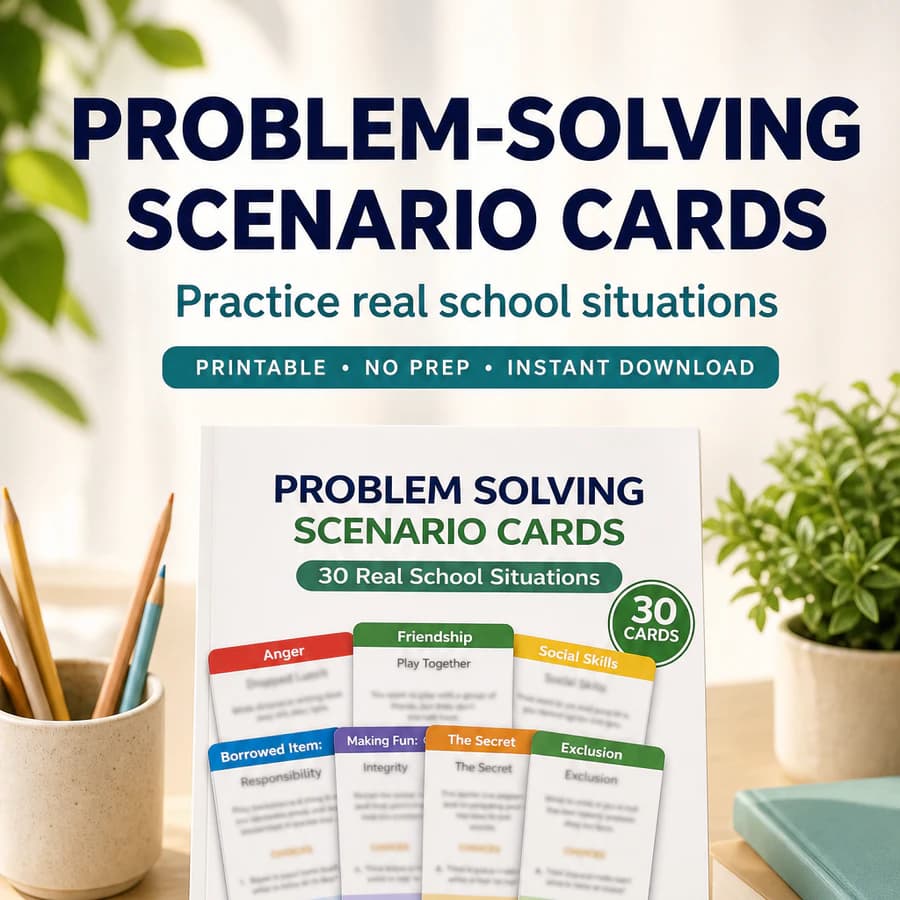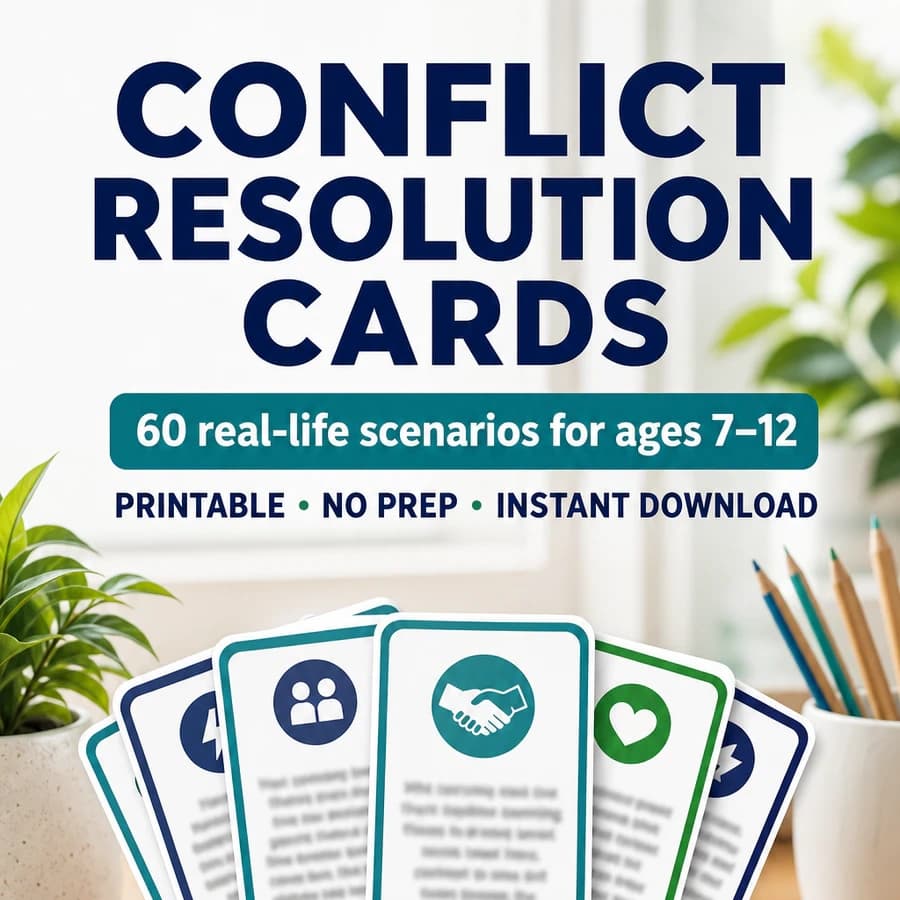
Social situations are often ambiguous. Cards are most valuable when they teach children to gather information, consider perspectives, set boundaries, and generate options—not memorize a single socially approved script.
Quick answer: Look for realistic situations, missing-information questions, more than one plausible perspective, and several safe response options. Avoid cards that blame one child for every peer problem.
What Good Scenarios Include
Useful sets cover joining play, changing rules, teasing, mistakes, boundaries, exclusion, repair, online communication for older children, and seeking adult help. Characters should vary in culture, family, disability, communication style, and interests without stereotypes.
Each card should prompt questions such as:
- What do we know versus assume?
- What might each person need?
- What could be unsafe or unfair?
- What are two possible next steps?
- When should an adult help?
Red Flags
Avoid examples where the “right” answer is always compliance, eye contact, sharing, forgiving, or staying in an unwanted interaction. Social skills include saying no, leaving, checking meaning, and reporting harm.
Assess Practical Value
Preview card size, readability, printing demands, facilitation notes, and whether scenarios are genuinely distinct. A smaller, well-sequenced set can be more useful than one hundred repetitive prompts.
Use the guidance in a real situation
When addressing friendship scenario cards, choose one recent, specific example that fits the pattern; write down the event, the first observable sign of difficulty, the adult response, and what happened next so that a broad label does not replace the details needed for a useful decision.
Use “What Good Scenarios Include” as the first action from the guide and define who will try it, where it will happen, and how long the first attempt will last; keep other parts of the routine stable so the result is interpretable.
Language and access
- In a conversation about friendship scenario cards, an adult might say “Would it be easier to talk, point, draw, or write one part?”
- In a conversation about friendship scenario cards, an adult might say “We only need the section that helps with today’s goal.”
When applying “What Good Scenarios Include,” accept an accessible response format unless the format itself is the skill being taught; reduce unnecessary writing, public disclosure, sensory load, and rapid verbal demands.
Review what changed
To review friendship scenario cards, track whether the tool clarified communication, supported rehearsal, or changed one real-world action without becoming the main source of conflict; compare several similar opportunities before concluding that the plan worked or failed, and alter only one major variable at a time.
In this guide to friendship scenario cards, requiring every box to be completed can turn a support into a compliance test; select only the pages needed for the current goal and offer a spoken, visual, typed, or assisted response when appropriate.
When to seek additional help
Seek individualized assessment when difficulty remains persistent, worsening, unsafe, or substantially affects learning, sleep, health, relationships, or daily life despite trying “What Good Scenarios Include”; educational guidance cannot determine a diagnosis or replace appropriate professional care.
Use this guide as a starting point for friendship scenario cards, not as a fixed script; a useful plan remains specific enough to repeat, flexible enough to preserve access, and clear about which signs require a different level of support.
Before increasing difficulty in work on friendship scenario cards, compare the current attempt with the original example and ask whether “What Good Scenarios Include” became easier, needed less prompting, or worked in one additional setting; record the support that was present, because a better result with support is useful evidence and does not need to be dismissed as dependence, and note what the child could do before and after that support was added.
Sources and further reading
- Problems With Peers: How to Help Your Child Navigate Social Challenges — American Academy of Pediatrics — HealthyChildren.org
- What Parents Can Do to Support Friendships — American Academy of Pediatrics — HealthyChildren.org
- What Is the CASEL Framework? — CASEL