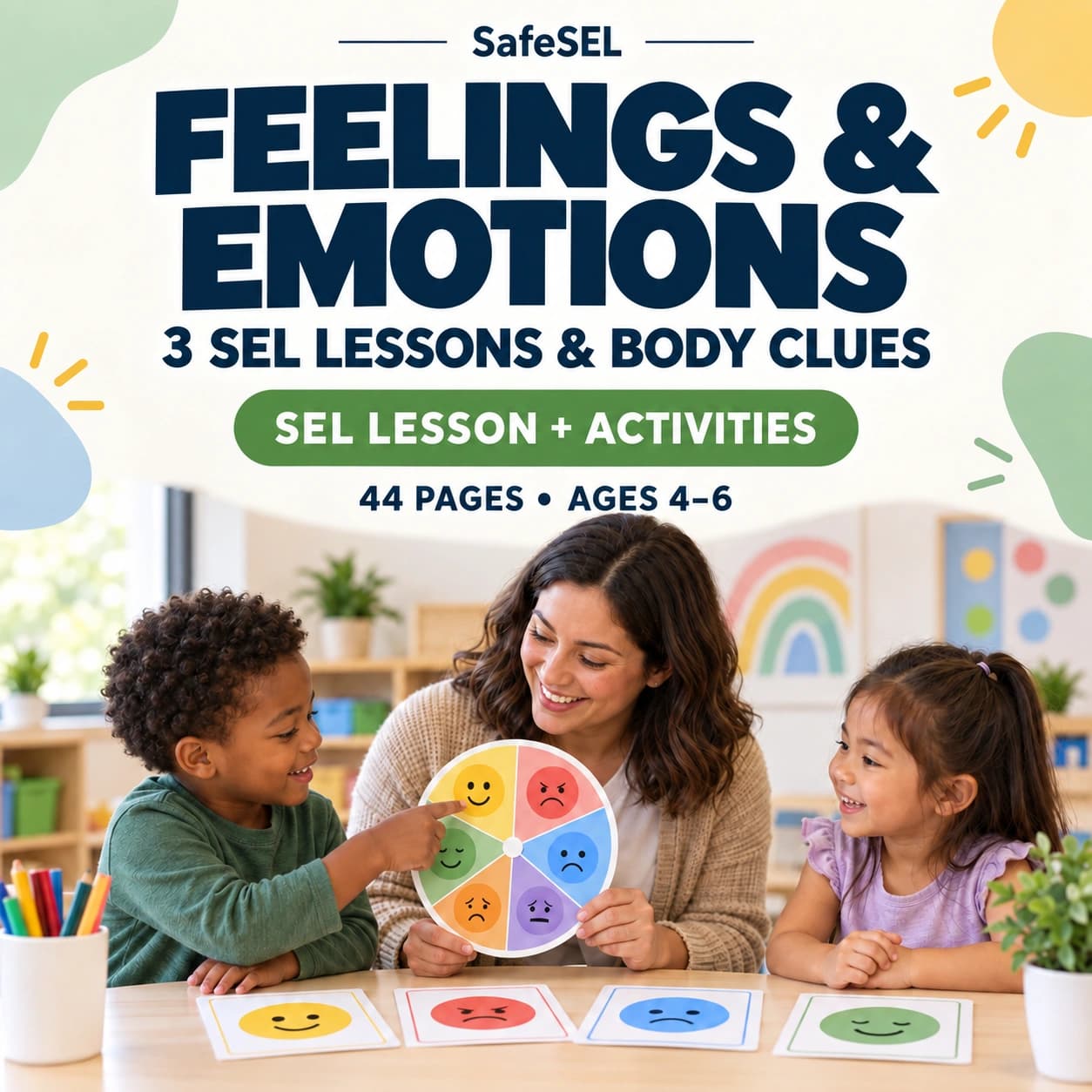
Young children learn emotion language through repeated interaction, play, stories, facial and body cues, and adult modeling. A printable is most useful when it creates a short shared activity—not when it expects independent written insight.
Quick answer: Select matching, sorting, drawing, movement, and simple scenario activities with one instruction at a time. Use them for five to ten minutes while the child is regulated.
Useful Activity Types
- match a face or body posture to several possible feeling words;
- sort situations by intensity without insisting on one universal answer;
- draw where a feeling is noticed in the body;
- choose what a character might need;
- practise one help-seeking phrase;
- create a three-card “first, coping, return” sequence.
The adult should say that people can feel differently in the same situation. Avoid teaching children to judge emotion only from a face; context and direct communication matter.
Design Features to Check
Look for large print, clear contrast, limited choices per page, uncluttered illustrations, and options to point, act, or draw. Check whether the activity works in grayscale and whether cutting or preparation is realistic. “Ages 4–6” does not guarantee accessibility, so preview the actual language.
How to Use the Printable
Model first: “My shoulders feel tight; I might be frustrated.” Invite rather than test: “Which word could fit this character?” Stop if the child becomes distressed or the activity turns into correction. Reuse the same small set of words across real moments and books.
Use the guidance in a real situation
When addressing printable feelings activities for children ages 4–6, choose one recent, specific example that fits the pattern; write down the event, the first observable sign of difficulty, the adult response, and what happened next so that a broad label does not replace the details needed for a useful decision.
Use “Useful Activity Types” as the first action from the guide and define who will try it, where it will happen, and how long the first attempt will last; keep other parts of the routine stable so the result is interpretable.
Language and access
- In a conversation about printable feelings activities for children ages 4–6, an adult might say “Would it be easier to talk, point, draw, or write one part?”
- In a conversation about printable feelings activities for children ages 4–6, an adult might say “We only need the section that helps with today’s goal.”
When applying “Useful Activity Types,” accept an accessible response format unless the format itself is the skill being taught; reduce unnecessary writing, public disclosure, sensory load, and rapid verbal demands.
Review what changed
To review printable feelings activities for children ages 4–6, track whether the tool clarified communication, supported rehearsal, or changed one real-world action without becoming the main source of conflict; compare several similar opportunities before concluding that the plan worked or failed, and alter only one major variable at a time.
In this guide to printable feelings activities for children ages 4–6, requiring every box to be completed can turn a support into a compliance test; select only the pages needed for the current goal and offer a spoken, visual, typed, or assisted response when appropriate.
When to seek additional help
Seek individualized assessment when difficulty remains persistent, worsening, unsafe, or substantially affects learning, sleep, health, relationships, or daily life despite trying “Useful Activity Types”; educational guidance cannot determine a diagnosis or replace appropriate professional care.
Use this guide as a starting point for printable feelings activities for children ages 4–6, not as a fixed script; a useful plan remains specific enough to repeat, flexible enough to preserve access, and clear about which signs require a different level of support.
Before increasing difficulty in work on printable feelings activities for children ages 4–6, compare the current attempt with the original example and ask whether “Useful Activity Types” became easier, needed less prompting, or worked in one additional setting; record the support that was present, because a better result with support is useful evidence and does not need to be dismissed as dependence, and note what the child could do before and after that support was added.
Sources and further reading
- Treating Children's Mental Health with Therapy — Centers for Disease Control and Prevention
- Help Your Child Manage Anxiety: Tips for Home & School — American Academy of Pediatrics — HealthyChildren.org
- Enhancing and Practicing Executive Function Skills with Children from Infancy to Adolescence — Center on the Developing Child at Harvard University