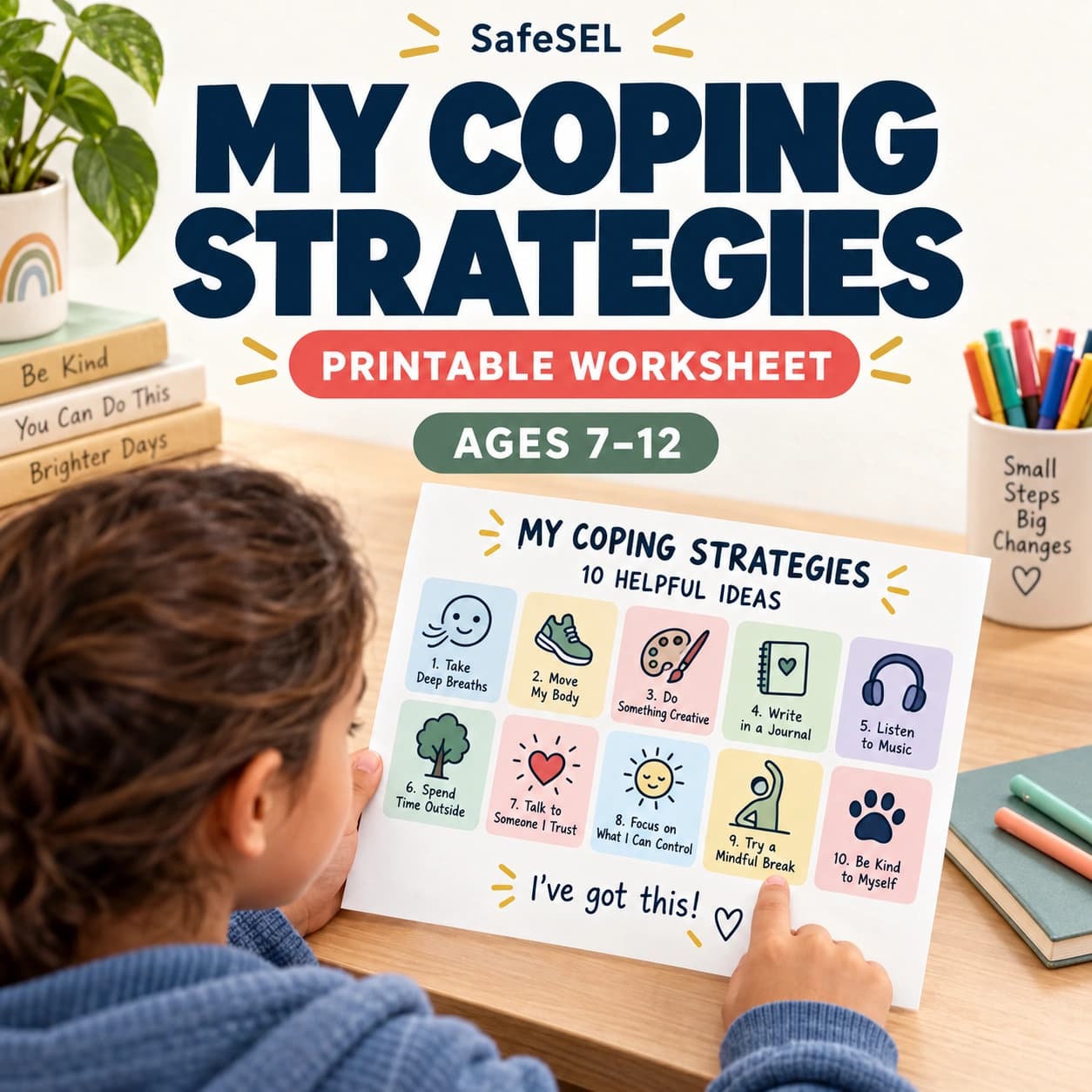
A child can list ten coping skills on a worksheet and still be unable to use one during a noisy transition. Knowing the names of strategies is different from recognizing a cue, choosing a response and using it where the problem happens. When a skill does not transfer, look for the missing connection before adding another worksheet.
Why a coping skill works in the lesson but not at recess
Consider a child who can name a break strategy during a quiet lesson but cannot use it during a noisy disagreement. The real situation adds time pressure, an audience and the need to notice an early cue. Repeating the worksheet may not address any of those barriers. Practise the help request with a familiar adult near the setting, then agree on the discreet prompt that adult will use.
Check transfer in small steps: did the child recognize the moment, find the tool, start it with support and return to something useful? A coping skill may be understood but not yet accessible under those conditions. Change the cue, timing or environment before concluding that the child needs a bigger collection of techniques.
Build a small coping card set that fits the setting
Find the point where the skill becomes unavailable
Consider a child who practices asking for a break in a quiet session but leaves class without speaking. The difficulty could be noticing rising stress, remembering the words, finding the teacher, or believing a request will be accepted. Repeating the instruction to use coping skills does not tell you which barrier needs attention.
Walk through a recent situation when the child is available for a low-pressure conversation. Ask what happened just before leaving and which part of the plan felt possible. Their account, adult observations and the classroom conditions may differ; keep those differences visible instead of deciding immediately that the child refused to try.
Teach one cue-skill link
Choose an early, recognizable signal and connect it with one action. For example: when the instructions feel too fast, place an agreed help card on the desk. Practice that small sequence during an ordinary lesson, not only after distress has escalated. The first goal is a usable request, not completing a complicated calming routine perfectly.
Avoid requiring the child to identify an exact emotion before they can access help. A simple signal such as 'too much' can be enough. Reading, speech, memory and sensory demands all affect whether a strategy is available; choose a response the child can realistically produce.
Practice where the skill will be needed
Rehearse with the actual materials, location and adults whenever possible. A break request learned with one trusted adult may need another supported practice with the classroom teacher. Introduce manageable variations rather than moving directly from a quiet rehearsal into the hardest situation of the week.
Agree what happens after the request. Who acknowledges it, where can the child go, and how will returning be supported? A strategy may fail because adults respond inconsistently or the proposed space is unavailable, not because the child lacks motivation. Resolve those practical obstacles before asking for more independence.
Use prompts that can become smaller
Adult support might begin with a brief reminder and pointing to the card. Later, the adult may only point; eventually the child may notice the cue without a prompt. Change one support at a time and restore help if the situation becomes harder. There is no fixed number of successful attempts that makes every child ready.
Do not remove communication aids or disability accommodations to prove independence. Needing less prompting for a learned action is different from no longer needing access support. A child can become more skilled while still benefiting from a predictable routine or an agreed quieter space.
Review what happened after the strategy
Record the situation, prompt, response and what followed. Did the child request help earlier, remain safer, or return to a manageable task? Looking calm is not the only meaningful outcome. If a break repeatedly becomes the end of all participation, review the task, the return plan and any underlying difficulties together.
A useful next step is a small trial: keep the same cue and response across a few comparable opportunities, then discuss what helped. A low pressure rehearsal can reveal a missing practical detail without turning every difficult moment into a test. Avoid changing all the strategies at once; you will not know which change mattered.
When to seek a wider review
Persistent distress, unsafe behavior or worsening daily functioning warrants discussion with the relevant school staff, caregivers and, where appropriate, a qualified mental health professional. A coping plan should not ask a child to tolerate bullying, untreated pain or inaccessible demands. Address the source of harm rather than only teaching a response to it.
The examples here are practical teaching suggestions, not a validated treatment protocol or a promise that one strategy will transfer everywhere. The ACF co-regulation brief supports the broader importance of relationships, structure and coaching; it does not establish the cause of an individual child's difficulty.
Related resources and background reading
How Co-Regulation Supports Developing Self-Regulation
ACF: Co-Regulation From Birth Through Young Adulthood
Sources and further reading
- What Is the CASEL Framework? — CASEL (2020)
- Child and Adolescent Mental Health — National Institute of Mental Health
- Helping Little People Manage Big Feelings — American Academy of Pediatrics — HealthyChildren.org
- Why Kids Act Out: Tips to Help Your Child Cope With Stress — American Academy of Pediatrics — HealthyChildren.org