Avoidance and anxiety in children can reinforce each other: leaving a feared situation brings relief, and the child may become more likely to leave next time. That possible pattern is not a reason to treat every refusal as anxiety. A child may be avoiding pain, bullying, inaccessible work or an overwhelming environment. Understand what they are moving away from before deciding what support makes sense.
The useful question is not ‘How do I stop all avoidance?’ It is ‘What makes this situation hard, and is there a safe, worthwhile way to participate?’ Sometimes the environment needs to change. Sometimes an achievable approach step is useful. Sometimes the first step is professional assessment.
Parents need a workable explanation of the difficulty, not an instruction to push through every refusal. Trauma reminders, sensory demands and previous harmful experiences may require a different response from a routine practice step.
Describe the pattern without blame
Write down one recent example in ordinary language: the child saw the homework, said they could not do it, and left; the task was then put away. Record what the child said was difficult and whether the same work is manageable with help. That description does not establish why the child left. A learning barrier, exhaustion and fear of mistakes can look similar from the outside.
Notice exceptions. A child who participates with a familiar adult but not in a loud group may face a different demand in each setting. Use this contrast to ask better questions, not to conclude that the difficulty is fake because it does not occur everywhere.
Check safety and access before planning practice
Investigate reports of harm and physical symptoms rather than explaining them away. Ask whether instructions are understandable, whether communication support is available and whether the environment is tolerable. Removing an unnecessary barrier is not the same as preventing a child from ever experiencing discomfort.
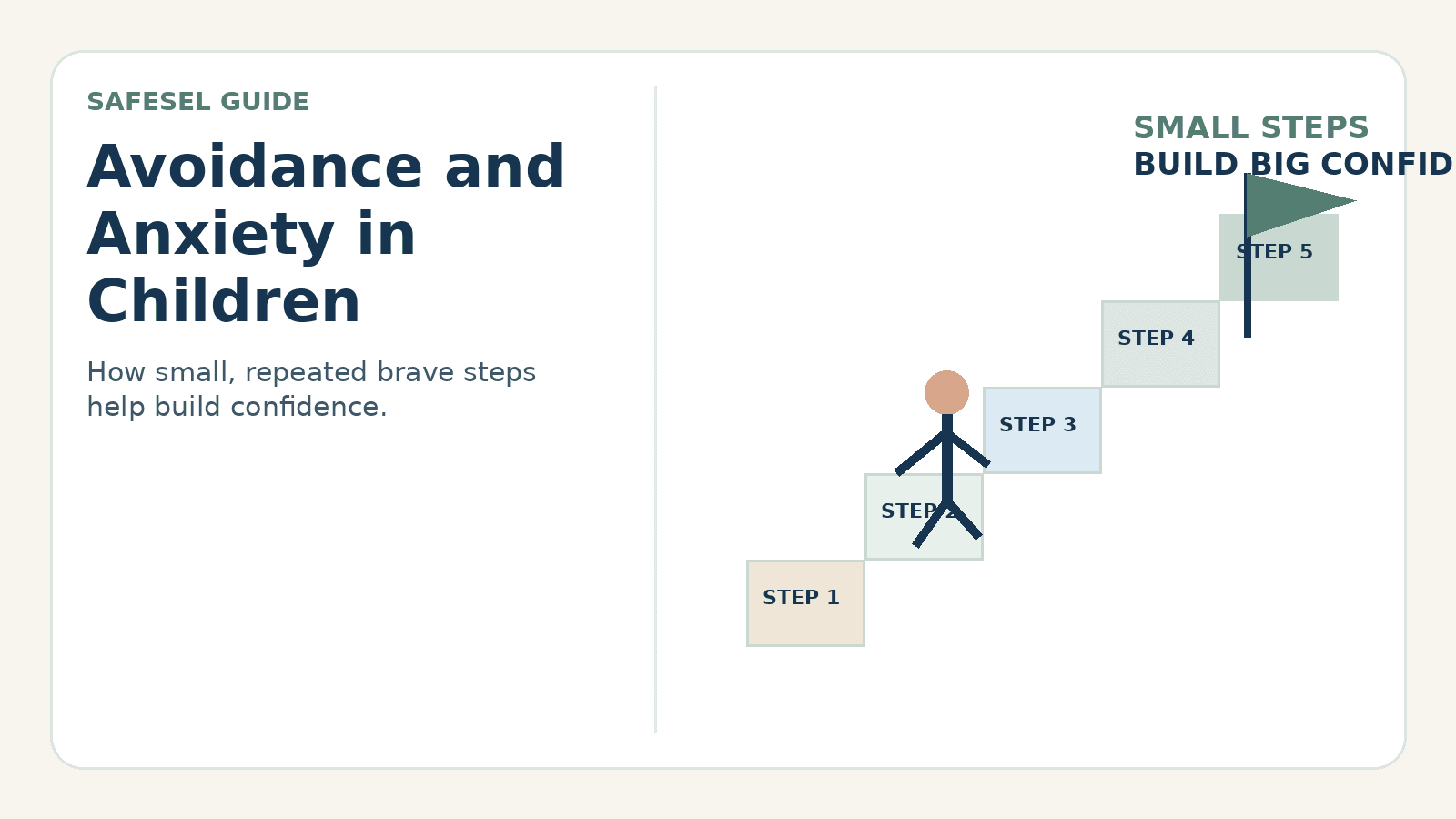
Necessary disability accommodations and medical support should not be removed as an experiment. Where trauma, severe anxiety, school absence or complex needs are involved, coordinate with the relevant professionals. A printable practice ladder does not establish which situations are safe or suitable.
Choose one small approach step
For an ordinary, safe situation, discuss a step the child understands and can help shape. A child worried about asking a library question might first decide the question with an adult and approach the desk together. That is more specific than ‘Be brave.’ Agree what the adult will do and what support remains available.
Do not promise that nothing uncomfortable will happen. A more honest message is ‘We can prepare what to ask, and I will be beside you.’ Avoid a surprise increase in difficulty once the child has agreed to the smaller step.
Rate difficulty in a way the child understands
Some children can use a simple low, medium or high rating; others prefer pictures or a description. The rating helps you discuss the task, not prove readiness or decide whether the child deserves support. Ask what makes one version harder than another. Speaking to a familiar person and speaking in a crowded room are not interchangeable challenges.
Repeat before increasing, while reviewing the fit
If the step is useful and appropriate, another manageable opportunity may help the child learn what to expect. Review together rather than automatically making it harder after one success. If distress escalates, the situation changes or the child reports a problem, reassess the plan. Do not keep repeating an unsuitable task simply because it appears on a ladder.
An individualized treatment plan may use a more specific approach to practice and support. Follow that plan with the clinician rather than combining generic advice into a home treatment program.
Praise approach behaviour without rewarding silence
Name what the child did: ‘You asked the question even though you were unsure.’ Do not make ‘You did not cry’ the main success. Communicating a need, trying an agreed action and noticing an inaccessible demand can all provide useful information. Avoid comparing the child with siblings or calling a difficult attempt a failure.
A realistic example of progress
Illustrative example: Mia avoids asking for a replacement pencil because she expects to be told off. Her teacher checks that she can request supplies without criticism and agrees on a simple signal. Mia uses the signal, then later tries a short spoken request when she wants to. The support is reviewed with her; it is not abruptly withdrawn as a test.
This example is not a prescribed sequence for every child. Its useful features are checking the environment, clarifying the request and agreeing on support. The aim is participation that is safe and accessible, not eliminating every sign of anxiety.
When additional support is appropriate
Persistent, worsening anxiety or difficulties affecting school, sleep, health and relationships warrant appropriate mental health or medical advice. Seek immediate help for urgent safety concerns. Parents do not need to exhaust worksheets or increase practice difficulty before asking for assessment.
NHS: Anxiety disorders in children
Sources and further reading
- Anxiety and Depression in Children — Centers for Disease Control and Prevention (2026)
- Child and Adolescent Mental Health — National Institute of Mental Health
- Help Your Child Manage Anxiety: Tips for Home & School — American Academy of Pediatrics — HealthyChildren.org
- School Avoidance: Tips for Concerned Parents — American Academy of Pediatrics — HealthyChildren.org
- Treating Children's Mental Health with Therapy — Centers for Disease Control and Prevention