A worried child may ask the same question many times: “Are you sure I will be okay?”, “What if you are late?”, or “Can you promise nobody will laugh at me?” It is natural for an adult to answer quickly and confidently. Reassurance often works in the moment. The child relaxes, the conversation ends, and everyone feels relieved.
The difficulty is that the relief may not last. When anxiety returns, the child learns to ask again. Over time, certainty from another person can become part of the anxiety cycle rather than a path out of it.
How the reassurance cycle works
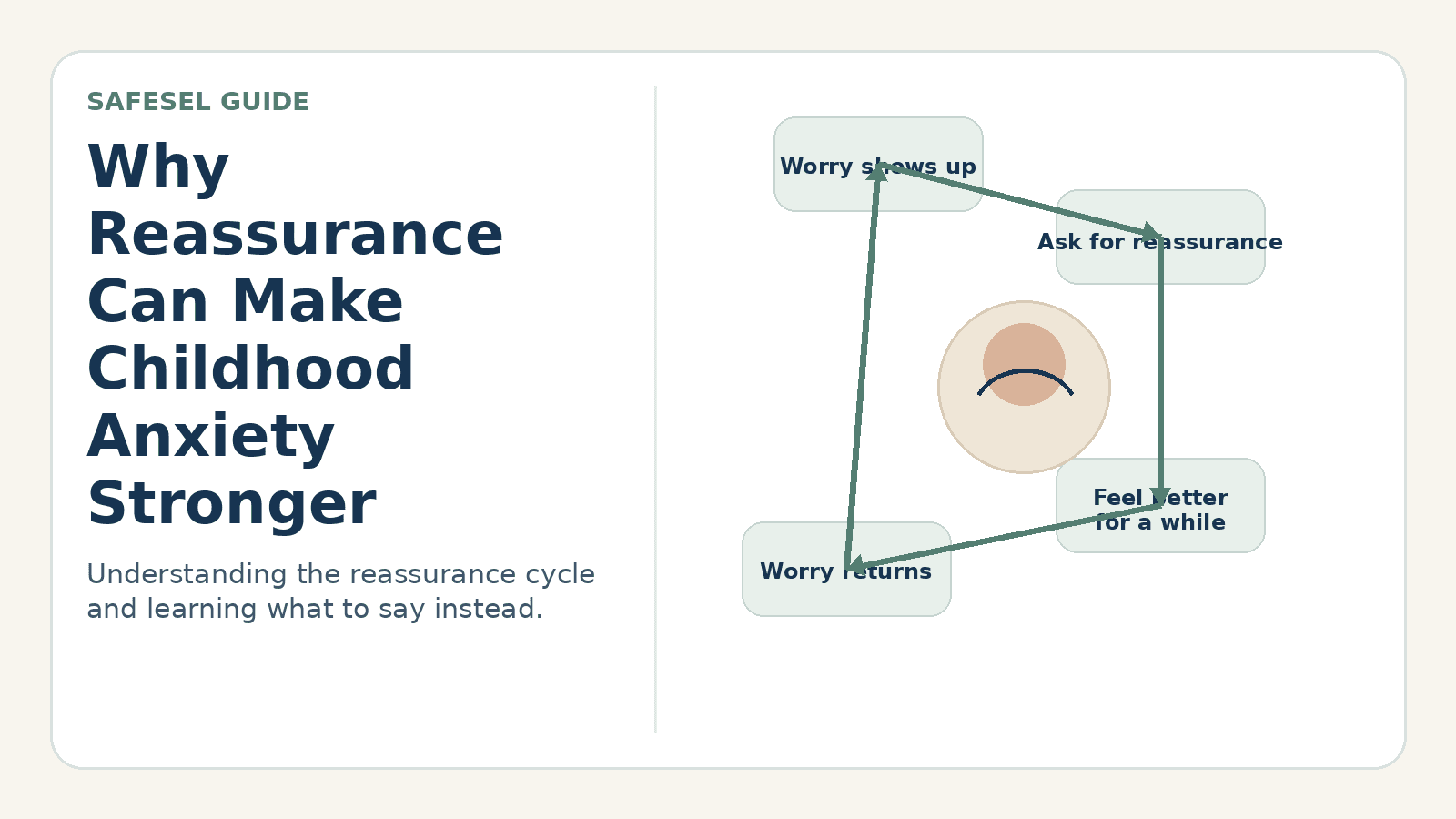
- A trigger appears, such as a school presentation, bedtime worry or unfamiliar situation.
- The child feels anxious and imagines a threatening outcome.
- The child asks an adult for certainty.
- The adult reassures the child and anxiety drops briefly.
- The brain learns that reassurance was necessary for relief, so the child asks again next time.
This does not mean reassurance is always harmful. Children need warmth, information, comfort and a reliable relationship. The concern is repeated certainty-seeking that becomes a ritual: the answer is never enough, the wording must be exact, or the same question returns minutes later.
Validation is not the same as confirming danger
Validation communicates that the child’s experience makes sense. It does not require the adult to agree that the feared outcome is likely or to guarantee safety.
“I can see that this feels really uncertain. We can handle the feeling without knowing exactly what will happen.”
A response like this supports the child emotionally while leaving room for uncertainty. By contrast, “I promise nothing bad will happen” may create a new problem: the child begins to depend on the promise.
Five alternatives to repeated reassurance
1. Name the pattern gently
Try: “I notice anxiety is asking for the same answer again. I think we already answered that question.” The tone matters. The goal is not to shame the child, but to help them recognise the pattern.
2. Validate before redirecting
Try: “It makes sense that you want to feel certain. This is a hard waiting moment.” Validation often makes redirection easier because the child does not have to fight to prove that the feeling is real.
3. Return the question to the child’s skills
Ask: “What did you tell yourself last time?”, “What is the most likely outcome?”, or “What can you do if the worry shows up?” These questions shift attention from certainty to coping.
4. Use a consistent response
When adults give a new, longer explanation each time, anxiety may learn that another question will produce more information. A short, predictable response is often more useful: “We have answered that. Now let’s use your coping plan.”
5. Praise brave action, not the absence of anxiety
Notice the child’s effort: “You went into class even though you felt unsure,” or “You let the question pass without asking again.” This reinforces tolerance and action rather than perfect calm.
Instead of saying… try saying…
- Instead of “I promise you will be fine,” try “I believe you can handle the feeling and ask for help if you need it.”
- Instead of “There is nothing to worry about,” try “Your brain is sending a worry signal. Let’s check what we know.”
- Instead of answering the same question again, try “What answer did we agree on before?”
- Instead of “Stop worrying,” try “You do not have to make the worry disappear before taking the next step.”
Apply anxiety tips without turning them into a new certainty ritual
With worry and anxiety, even a helpful coping question can become something the child must repeat until it feels exactly right. If ‘What is the most likely outcome?’ leads to another long search for certainty, do not keep producing more evidence. Name the pattern gently and return to the support plan, with professional guidance where OCD or persistent impairment is involved.
Choose anxiety resources that distinguish ordinary information-seeking from a repeated ritual. A new question about pickup arrangements deserves an accurate answer; a disclosure of harm requires attention. Reducing repeated reassurance must not mean withholding affection, ignoring changed circumstances or assuming that every concern is unfounded.
When to seek additional support
Professional support may be useful when reassurance-seeking takes up large parts of the day, disrupts sleep or school, causes repeated family conflict, or occurs alongside severe avoidance, panic, compulsive rituals or significant distress. A clinician can help determine whether the pattern reflects anxiety, obsessive-compulsive symptoms or another difficulty and can tailor guidance to the child.
Sources and further reading
- Anxiety and Depression in Children — Centers for Disease Control and Prevention (2026)
- Child and Adolescent Mental Health — National Institute of Mental Health
- Help Your Child Manage Anxiety: Tips for Home & School — American Academy of Pediatrics — HealthyChildren.org
- School Avoidance: Tips for Concerned Parents — American Academy of Pediatrics — HealthyChildren.org
- Treating Children's Mental Health with Therapy — Centers for Disease Control and Prevention