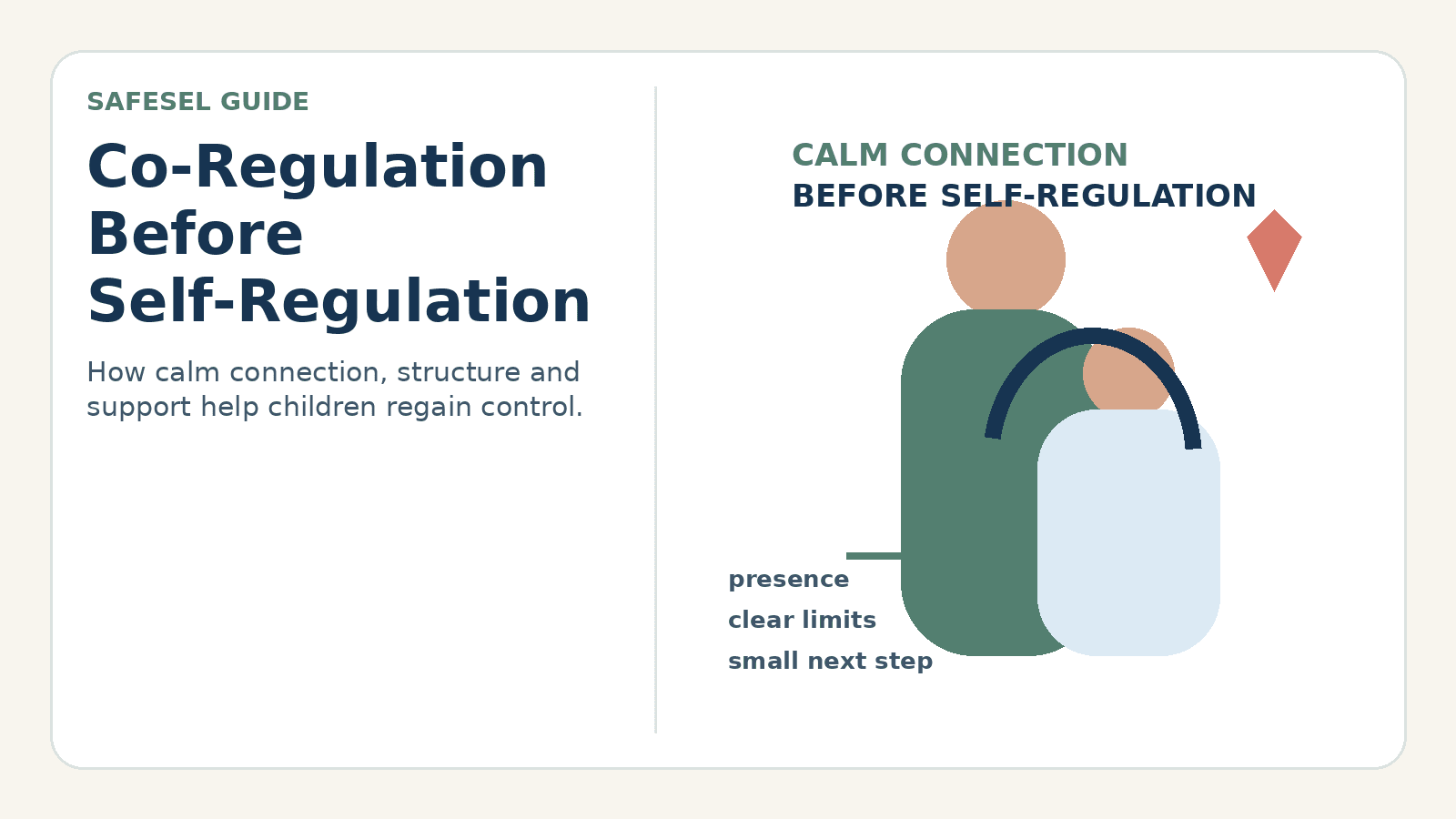
Co-regulation is the responsive support through which adults help children manage arousal, attention, emotion, and action. It does not end when children learn coping words; its form changes with development, context, and individual need.
In brief: Younger children need more external structure and modeling. Older children benefit from collaboration, privacy, and increasing ownership—but still need reliable adult support under high stress.
Ages 4–6
Use proximity, simple language, predictable routines, and concrete choices. The adult may do much of the organizing: slow the pace, reduce stimulation, and model one action.
Ages 7–9
Help the child notice patterns and choose between familiar options. Build short plans together and rehearse return steps. Adults still cue timing and reduce task demand when necessary.
Ages 10–12
Offer privacy and ask before coaching when safety allows. Collaborate on anticipatory plans, help the child evaluate what worked, and avoid babyish materials. Independence should mean access to support by choice—not abandonment.
Age bands overlap. Disability, language, trauma, sleep, sensory load, relationships, and the intensity of the situation change what support is needed. The goal is flexible participation with decreasing support where appropriate, not a timetable for self-sufficiency.
Use the guidance in a real situation
When addressing co-regulation across ages 4–12, choose one recent, specific example that fits the pattern; write down the event, the first observable sign of difficulty, the adult response, and what happened next so that a broad label does not replace the details needed for a useful decision.
Use “Ages 4–6” as the first action from the guide and define who will try it, where it will happen, and how long the first attempt will last; keep other parts of the routine stable so the result is interpretable.
Language and access
- In a conversation about co-regulation across ages 4–12, an adult might say “I am here. We can make the next step smaller.”
- In a conversation about co-regulation across ages 4–12, an adult might say “Show me whether you need less talking, more space, or help starting.”
When applying “Ages 4–6,” accept an accessible response format unless the format itself is the skill being taught; reduce unnecessary writing, public disclosure, sensory load, and rapid verbal demands.
Review what changed
To review co-regulation across ages 4–12, track earlier recognition of body cues, safer communication, use of one practiced support, shorter recovery, and return with less adult direction; compare several similar opportunities before concluding that the plan worked or failed, and alter only one major variable at a time.
In this guide to co-regulation across ages 4–12, do not interpret shutdown, tears, movement, or refusal from appearance alone; language processing, fatigue, pain, sensory load, fear, and task difficulty can produce similar outward behavior.
When to seek additional help
Seek individualized assessment when difficulty remains persistent, worsening, unsafe, or substantially affects learning, sleep, health, relationships, or daily life despite trying “Ages 4–6”; educational guidance cannot determine a diagnosis or replace appropriate professional care.
Use this guide as a starting point for co-regulation across ages 4–12, not as a fixed script; a useful plan remains specific enough to repeat, flexible enough to preserve access, and clear about which signs require a different level of support.
Before increasing difficulty in work on co-regulation across ages 4–12, compare the current attempt with the original example and ask whether “Ages 4–6” became easier, needed less prompting, or worked in one additional setting; record the support that was present, because a better result with support is useful evidence and does not need to be dismissed as dependence, and note what the child could do before and after that support was added.
Before closing the plan, record whether “Ages 4–6” became easier to use with the agreed support and what should remain unchanged next time.
Sources and further reading
- Helping Little People Manage Big Feelings — American Academy of Pediatrics — HealthyChildren.org
- 4 Play Activities to Help Children Manage Emotions — American Academy of Pediatrics — HealthyChildren.org
- Why Kids Act Out: Tips to Help Your Child Cope With Stress — American Academy of Pediatrics — HealthyChildren.org