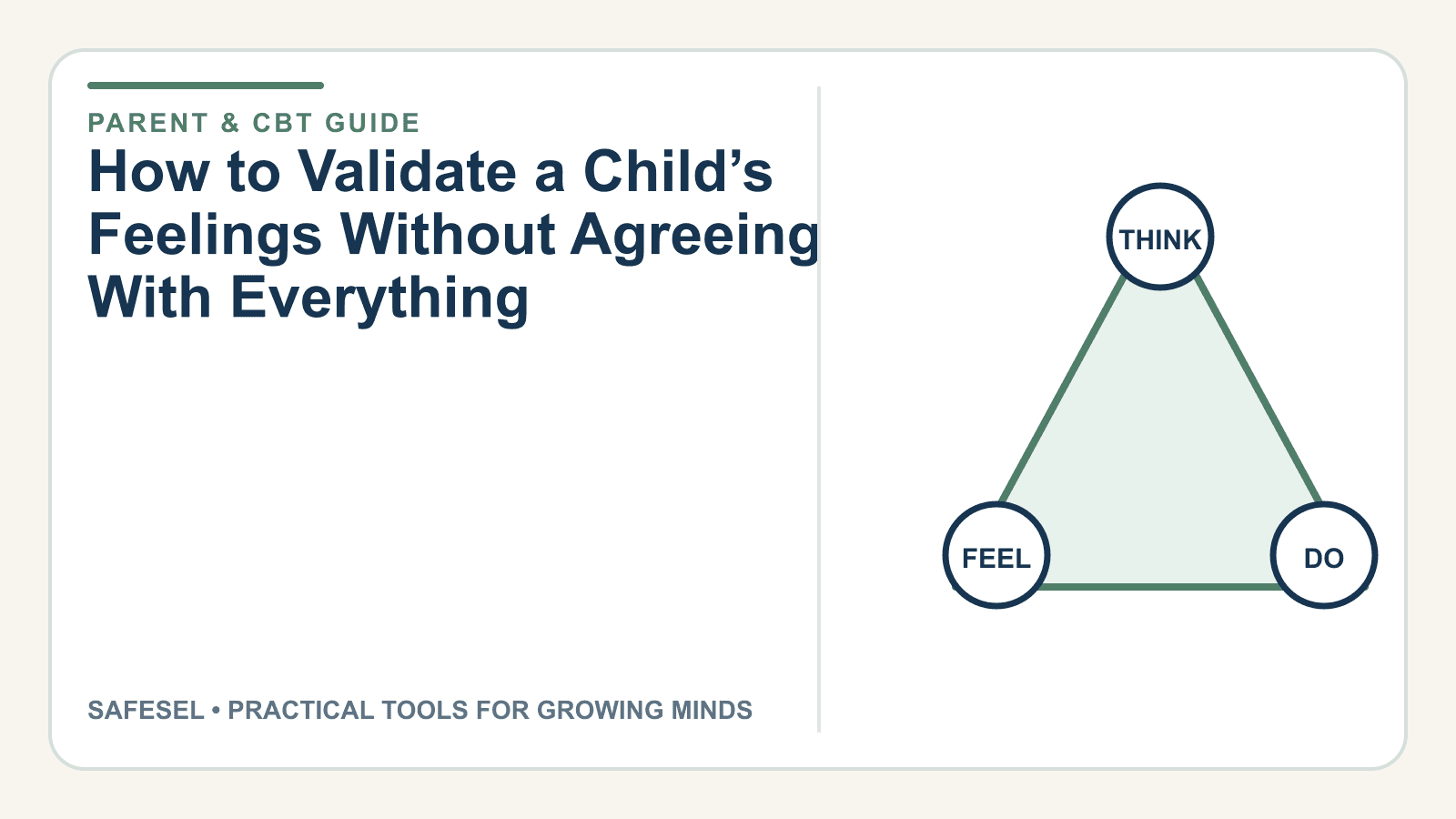
Emotion coaching is a way of responding that helps children notice, name and manage feelings while adults continue to provide safety and limits. It does not mean discussing every emotion at length, agreeing with every interpretation or allowing unsafe behavior. The parent’s task is to connect with the child’s experience, decide what the moment requires and teach skills at a time the child can use them.
Children develop regulation through repeated interactions, not one perfect conversation. Sometimes coaching means naming a feeling. Sometimes it means using very few words, blocking unsafe behavior and returning to reflection later. Development, temperament, communication and context all matter.
In brief: Notice the emotion, connect before correcting, name the experience tentatively, maintain necessary limits and guide one manageable next step. During intense dysregulation, prioritize safety and co-regulation; teach and problem-solve afterward.
What Emotion Coaching Is—and Is Not
Emotion coaching treats feelings as information and opportunities for learning. The adult helps the child link situation, body signals, thoughts, urges and actions. Over time, the child builds emotional vocabulary and more options for responding.
It is not:
- making the feeling disappear immediately;
- asking the child to explain while overwhelmed;
- confirming every belief that accompanies the feeling;
- removing consequences or boundaries;
- turning each family moment into therapy;
- diagnosing the child from behavior;
- requiring calmness before the child receives care.
Validation and limit-setting can happen together: “You are furious that screen time ended. I will not let you throw the controller.”
How Emotional Skills Develop
Self-regulation develops gradually through relationships, practice and maturation. Younger children rely heavily on adults to organize the environment and help their bodies settle. Older children may use more language and independent strategies, but still need support when stress exceeds their current capacity.
Ages 4–6
Use short feeling words, visual choices and concrete body observations. Offer one or two actions. A long explanation during a tantrum is usually too demanding.
Ages 7–9
Children can begin mapping triggers, thoughts and choices. They benefit from rehearsal, stories and specific scripts, but may still interpret correction globally: “I made a mistake” becomes “I am bad.”
Ages 10–12
Invite collaboration and respect privacy. Older children may reject language that feels childish or scripted. They can discuss mixed feelings and consequences, but reflection should still wait until readiness returns.
The Six-Part Emotion Coaching Sequence
1. Notice the signal
Observe without assigning motive:
- “Your shoulders tightened when I mentioned homework.”
- “You stopped talking after your friend walked away.”
- “Your voice became louder when the plan changed.”
“You are trying to get attention” is an interpretation, not an observation.
2. Regulate your own response
Children do not need a perfectly calm parent. They do need an adult who can avoid adding threat. Slow your voice, reduce unnecessary language and position yourself safely. If you are too activated, pause when the child is safe and return.
3. Connect and name tentatively
Use language that allows correction:
- “I wonder if that felt embarrassing.”
- “You may be disappointed and angry.”
- “I might be missing it—what word fits better?”
If the child rejects the label, do not argue. “Not angry. I’ll stay with you while we figure it out.”
4. Separate feelings from actions
All feelings can be acknowledged; not all actions are safe or acceptable.
- “It is okay to be jealous. It is not okay to delete your sister’s work.”
- “You can disagree. You may not call him names.”
- “You wanted to escape the task. We still need a smaller way to begin.”
Clear limits reduce uncertainty. Keep them specific and enforceable.
5. Guide one next step
Match the step to arousal.
At lower intensity: identify the problem, consider perspectives or choose a coping skill.
At medium intensity: reduce choices and support a brief regulation action.
At high intensity: prioritize safety, space, steady presence and minimal language. Reflection comes later.
6. Revisit, repair and practice
After calm returns, ask what happened, what the child needed, what impact the action had and what to try next. Repair may include checking on someone, replacing an item, restating a message or practicing an alternative.
What To Do at Different Levels of Arousal
Can talk and consider choices
Adult focus: understanding and problem-solving Example response: “What did you expect, and what happened instead?”
Upset but able to follow one sentence
Adult focus: validation plus one action Example response: “You are frustrated. Sit beside me or take water, then we’ll choose the first step.”
Overwhelmed or unsafe
Adult focus: safety and co-regulation Example response: “I will keep everyone safe. Fewer words now; talking later.”
Do not use the table as a diagnostic scale. The same child’s capacity changes by situation.
Everyday Example: A Limit at Home
Six-year-old Mia is told that tablet time is over. She screams, “You’re the worst,” and throws a cushion.
An unhelpful response is a lecture about gratitude while Mia is screaming. Another unhelpful response is returning the tablet solely to stop the distress.
An emotion-coaching response might be:
“You wanted more time and stopping feels awful. The tablet stays off. Cushions stay on the couch. You can stomp on the mat or sit beside me.”
Later: “Your body went from disappointed to out of control quickly. Tomorrow we’ll use a five-minute warning and you’ll choose the last activity. If you throw something, the device still stays away while we reset.”
The plan adjusts support without making the limit depend on the absence of emotion.
Everyday Example: Friendship Hurt
Eleven-year-old Amara says, “Nobody likes me,” after not being invited to a weekend event.
Immediate fixing—“You have lots of friends”—may miss the specific hurt. Agreeing that the peers are cruel may confirm a conclusion without context.
Try:
“Being left out of this plan hurts. I can see why your mind jumped to ‘nobody likes me.’ Do you want me to listen first, or help you decide whether there is something to ask your friend tomorrow?”
Later, Amara can distinguish the event from the global conclusion and choose whether to seek information, set a boundary or connect elsewhere.
Helpful Phrases
- “Your feeling makes sense; we still need a safe action.”
- “I am going to use fewer words until your body can listen.”
- “I believe that this is hard, even though I see the situation differently.”
- “Would you like help naming it or just company?”
- “The limit is staying. I can help you through the disappointment.”
- “What needs repair now, and what skill needs practice later?”
Validation vs. Agreement
Validation recognizes emotion and perspective. Agreement endorses a claim. They are not identical.
Child: “The teacher hates me because she corrected my answer.”
Validation: “Being corrected in front of others felt embarrassing, and now you are worried about what the teacher thinks.”
Agreement would be: “Yes, she hates you.” Reassurance might be: “Of course she doesn’t; stop worrying.” A coached response leaves room to investigate: “What happened before and after the correction? What could you ask privately?”
See the focused guide to emotion validation for children.
Boundaries Without Emotional Suppression
A boundary should describe the action and adult response:
- “I will not let you hit. I am moving back.”
- “If the insults continue, the conversation pauses.”
- “Homework begins with one problem; you can choose pen or keyboard.”
Avoid “Go away until you can be happy” or “You may return when you stop crying.” These statements make emotional appearance the condition for connection.
At the same time, emotion coaching should not require another person to remain in an unsafe interaction. Adults and siblings may need distance and support.
Common Emotion-Coaching Mistakes
Naming too much
Long interpretations can feel intrusive. Use one tentative sentence, then pause.
Coaching too early
A child in peak dysregulation may not be able to use reflective questions. Co-regulate first.
Treating every behavior as hidden sadness
Anger may coexist with sadness, shame, fear, sensory overload or frustration, but do not impose a deeper feeling without evidence.
Offering too many strategies
Three breathing cards, a sensory menu and six questions can overwhelm. Select one familiar option.
Making validation performative
Repeating “I hear you” while ignoring the actual concern does not build trust. Accurate listening and follow-through matter.
Forgetting the environment
If routines are unpredictable, expectations unclear or a task inaccessible, the solution is not only a better script for the child.
A One-Week Practice Plan
Choose one recurring, low-to-medium intensity moment.
- Day 1: observe the first body and behavior signals.
- Day 2: use one tentative feeling label.
- Day 3: pair validation with one specific limit.
- Day 4: offer two acceptable next actions.
- Day 5: revisit the event briefly after calm.
- Weekend: ask the child which adult response helped and adjust the plan.
Do not score the child. Review the adult process and whether the interaction became clearer, safer or more usable.
Emotion Coaching During Sibling Conflict
When two children are activated, coaching both perspectives immediately may become a courtroom. Begin with safety and separation if needed. Avoid deciding intent before hearing enough information.
Try: “Both of you are upset, and I will not let the pushing continue. We are creating space first. I will hear each account when voices can be safe.”
Later, help each child describe the event, feeling, impact and needed repair. Do not require identical feelings or force immediate forgiveness. The goal is responsibility and future skill, not a scripted reconciliation.
Emotion Coaching When the Parent Is Also Upset
Parents may be angry, frightened or embarrassed. Pretending otherwise can make the response brittle. Use a brief adult pause when the child is safe:
“I am too frustrated to speak helpfully. I am taking two minutes, and then I will return.”
If you yell or shame the child, repair directly: name your action, acknowledge the impact and state what you will try next time. Avoid making the child reassure you. Repair does not erase the original limit; it models accountability.
Coordinating Across Caregivers
Children become confused when one adult discusses feelings for twenty minutes, another demands immediate compliance and a third removes every expectation. Caregivers do not need identical personalities, but they benefit from shared language:
- the safety limit;
- the one or two regulation options;
- when discussion pauses;
- how repair happens;
- what behavior requires additional support.
Practice the plan outside conflict. If adults disagree, discuss it privately rather than asking the child to choose whose approach is correct.
Signs the Approach Is Helping
Useful changes may include the child noticing an earlier body signal, accepting a tentative feeling word, using a safer action, returning to a task or participating in repair. The child may still experience strong emotion.
Also assess the adult side: Are limits shorter and clearer? Are fewer questions asked during peak distress? Does the family revisit incidents without repeating the conflict? Emotion coaching is a relational process, so progress is not measured only by the child’s behavior.
When Emotion Coaching May Not Be Enough
Some problems require changes to the environment, academic support, medical care, safety intervention or individualized treatment. Do not use validation to persuade a child to tolerate bullying, abuse, discrimination or overwhelming demands.
If a child has a treatment or school plan, align home strategies with relevant professionals. Printable handouts can support consistency but cannot replace assessment.
When to Seek Additional Support
Consult a pediatrician or appropriately qualified professional when emotional reactions are severe, persistent or worsening; functioning at home or school declines; the child loses previously held skills; ordinary activities become impossible; aggression or destruction creates danger; or caregivers cannot maintain safety. Use urgent local services for immediate risk.
Sources and further reading
- Helping Little People Manage Big Feelings — American Academy of Pediatrics — HealthyChildren.org
- 4 Play Activities to Help Children Manage Emotions — American Academy of Pediatrics — HealthyChildren.org
- Why Kids Act Out: Tips to Help Your Child Cope With Stress — American Academy of Pediatrics — HealthyChildren.org