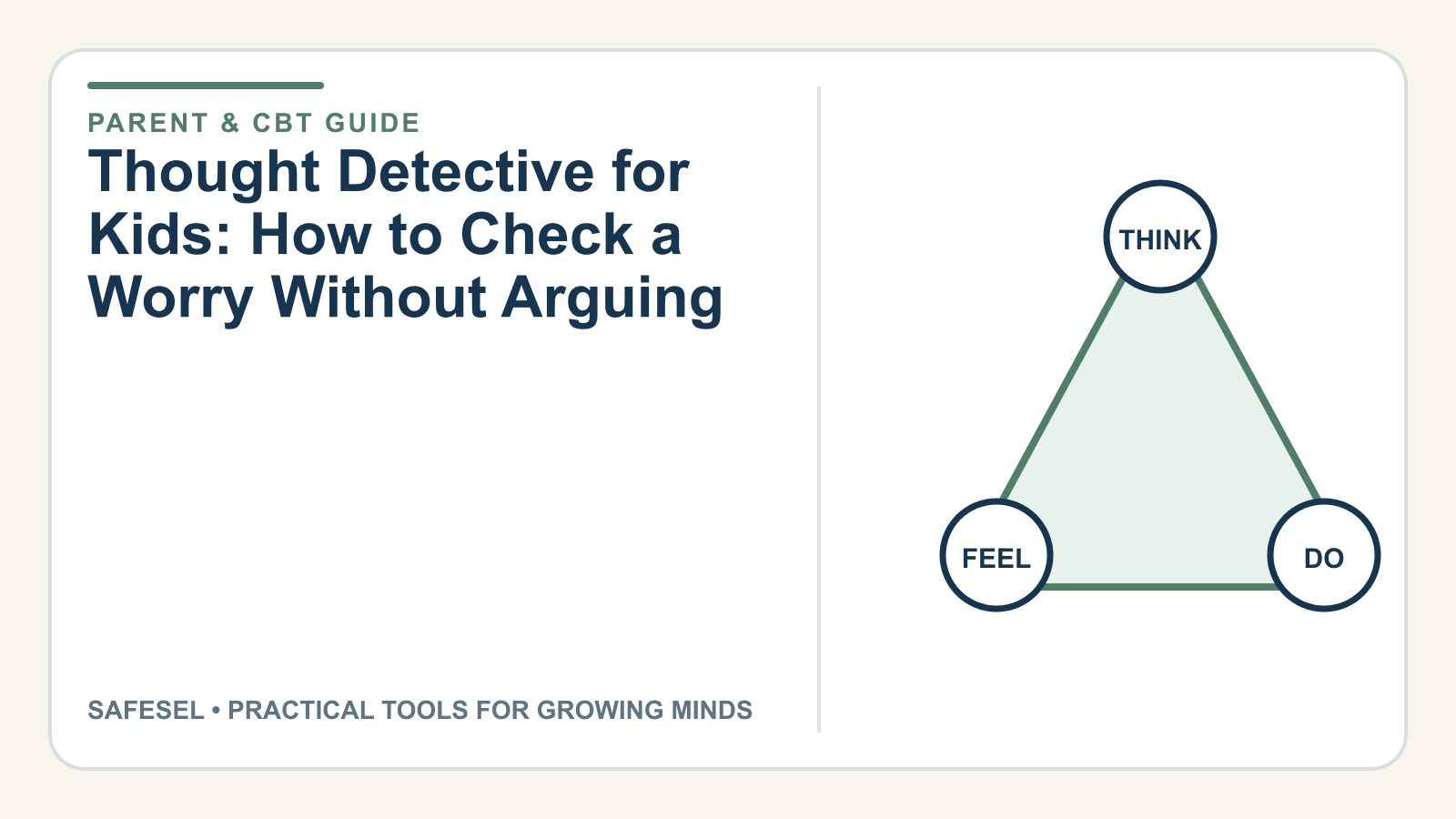
Helping a child check an anxious thought means examining one prediction together, not proving that the child has no reason to worry. Start when the child can take part. If there is immediate danger, a report of bullying or an unmet physical need, respond to that first. A worksheet is not a way to argue a child out of reporting a problem.
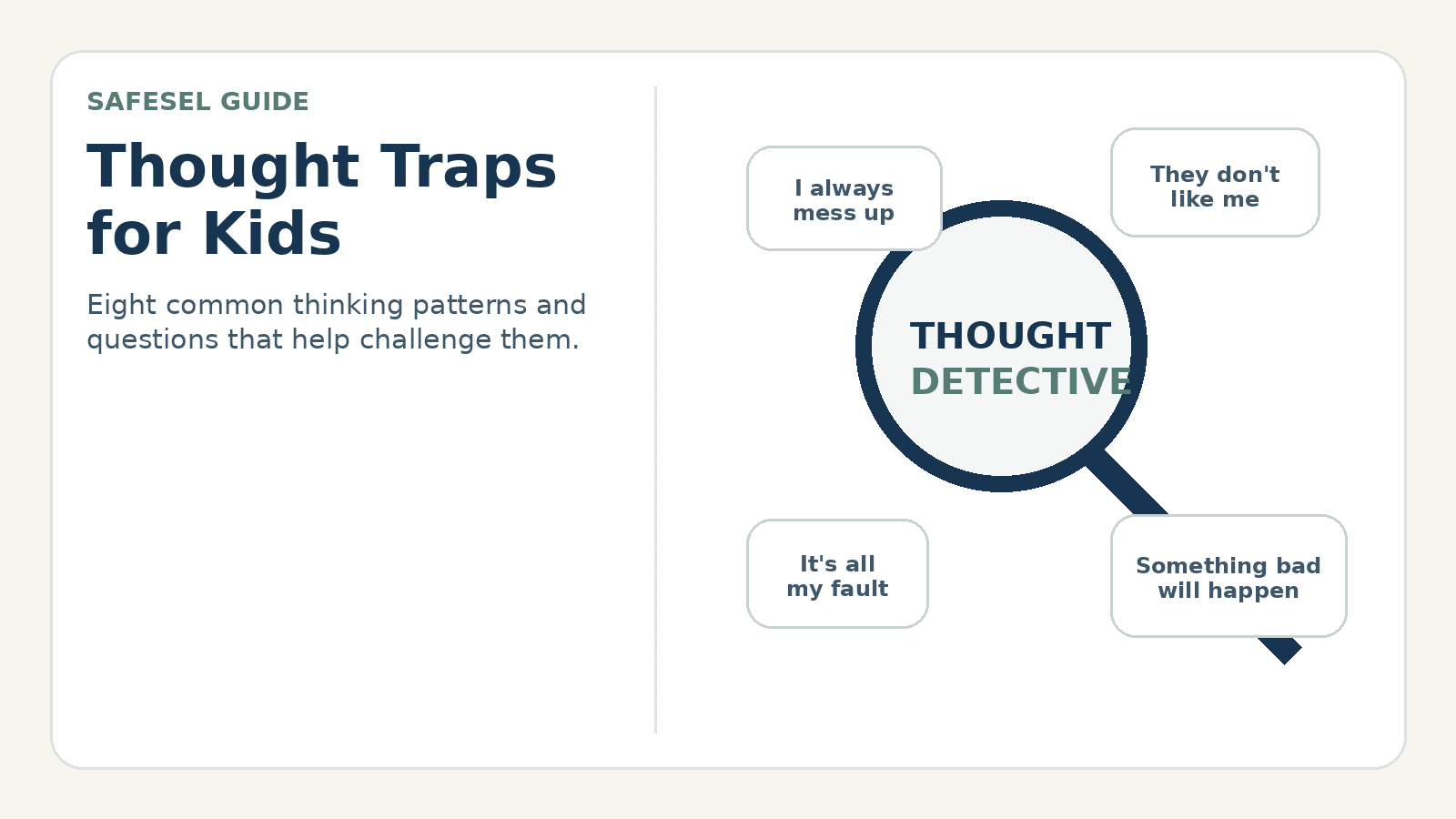
The distinction that matters is between an event and its meaning. ‘My teacher asked to speak to me’ is an event. ‘I must be in trouble’ is an interpretation. Both can feel equally certain in the moment, so make room to describe each without judging the child for having the thought.
Trauma reminders can make a situation feel threatening even when an adult does not immediately understand the connection. Do not demand details or try to disprove the child’s reaction. Seek appropriate support and follow any existing care plan.
1. Put the prediction into one sentence
Ask, ‘What are you worried might happen?’ Use the child’s words rather than supplying a more dramatic fear. ‘I will forget my answer’ gives you something specific to explore; ‘School is bad’ needs gentle clarification. Accept a picture, a spoken answer or a short phrase. Completing a written form is not the goal.
If questions are adding pressure, pause. You can say, ‘We do not have to solve this right now.’ A child who is already overwhelmed may need practical help, quieter surroundings or familiar support before reflecting on a thought.
2. Separate facts from guesses
Make two small columns: what happened and what is still unknown. For ‘My teacher wants to talk, so I am in trouble,’ the known fact is the request to talk. The reason is unknown unless the teacher has said it. Do not place the child’s feelings in the ‘wrong’ column: feeling frightened is real even when the explanation is uncertain.
Ask whether there is information you have missed. If the teacher publicly threatened a punishment, the concern has evidence behind it. The task then becomes understanding what happened and arranging appropriate support, not finding a cheerful alternative.
3. Consider a second explanation
Invite a plausible possibility, not an elaborate list. The teacher might want to check unfinished work or ask a question. Say ‘might,’ because neither of you knows yet. One alternative can loosen a conclusion without requiring the child to believe that the best outcome is certain.
Avoid turning this into repeated reassurance: ‘Tell me again why nothing bad can happen.’ More and more explanations may become a search for certainty rather than a useful conversation. If the child has an OCD treatment plan, use the clinician’s guidance about reassurance and checking rather than adding your own thought-checking routine.
4. Choose a balanced thought
A balanced thought should be accurate enough for the child to use. ‘I do not know why she wants to talk. I can ask’ works better than ‘My teacher is definitely happy with me.’ Ask whether the words sound believable. Let the child change them rather than insisting on the adult’s preferred sentence.
The child may still feel anxious after choosing the sentence. That does not automatically mean it failed. Look for a little more flexibility or a clearer action, rather than demanding an immediate change in feeling.
5. Test it with one manageable action
Agree on an ordinary, safe next step. In this example, the child could ask the teacher what the conversation is about, with appropriate adult support if needed. Do not create a surprise challenge or withhold support to see whether the child can cope. Difficult clinical exposure work belongs within an individualized professional plan.
Afterward, briefly compare the prediction with what happened. Perhaps the teacher wanted a missing worksheet. Record that particular result without concluding ‘You never need to worry.’ If the conversation was difficult, discuss what helped and what should change next time.
A short conversation is often enough
Illustrative exchange: ‘I think I am in trouble.’ ‘What did the teacher say?’ ‘Just that she wants to talk.’ ‘So the request is a fact, and the reason is unknown. What could help you find out?’ This keeps the adult alongside the child rather than cross-examining them.
For a younger child, use a fictional character first. For a child who dislikes writing, record their words for them or talk without a sheet. Keep private experiences private; a classroom exercise should not require personal disclosure.
When additional support is appropriate
Seek appropriate mental health support when worry persists, worsens or disrupts daily life. A thought record can support a conversation but cannot diagnose a condition, resolve an unsafe environment or replace treatment. General CBT thought-record guidance informs this approach; the child examples are educational adaptations, not a validated treatment protocol.
NHS: Thought record — general CBT guidance
Sources and further reading
- Treating Children's Mental Health with Therapy — Centers for Disease Control and Prevention (2026)
- Child and Adolescent Mental Health — National Institute of Mental Health
- What Is the CASEL Framework? — CASEL
- Enhancing and Practicing Executive Function Skills with Children from Infancy to Adolescence — Center on the Developing Child at Harvard University
- Communication Skills Start at Home — American Academy of Pediatrics — HealthyChildren.org