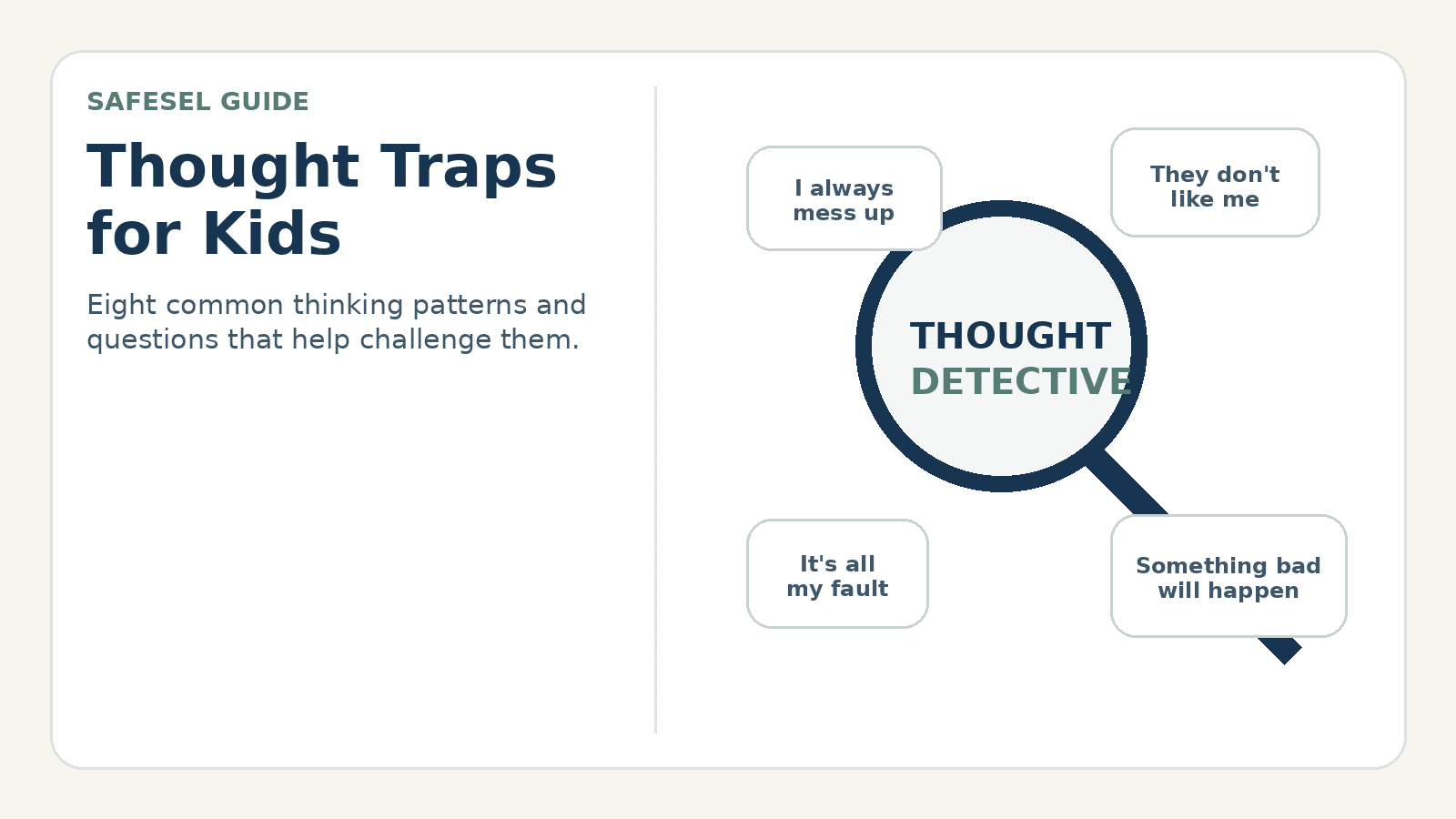
Thought traps are recurring interpretation patterns, not evidence that a child is thinking badly; the goal is to notice a thought, check it against available information and consider another workable view.
Thought traps for kids are patterns in how a situation is interpreted, not actions to practise or labels for a child. A child might predict a disaster, assume what a friend thinks or treat one mistake as proof of failure. The aim is to examine the thought fairly and choose a useful response—not to insist that difficult feelings are wrong.
Start with the child’s actual words. ‘I feel worried’ describes an emotion; ‘Everyone will laugh at me’ predicts an event. A prediction can be understandable without being certain. The eight patterns below are a teaching framework, not a diagnostic checklist or a requirement to classify every thought.
1. Catastrophizing
This means jumping to a disastrous outcome or treating it as more certain than the evidence supports. Example: ‘If I forget one line, the whole presentation will be ruined.’ Ask: ‘What might happen if you forget, and what could you do next?’ A believable response is ‘I can look at my card or ask for a moment,’ not ‘Nothing will go wrong.’
2. Mind reading
Mind reading assumes another person’s thoughts are known. ‘He did not sit beside me, so he dislikes me’ leaves out other explanations. Ask what the person actually said, what remains unknown and whether a respectful check is possible. Do not replace the child’s guess with an equally unsupported adult guess that everyone likes them.
3. All-or-nothing thinking
Here the options become perfect or terrible, success or failure. A child who gets one answer wrong may call the entire task a failure. Look at the parts separately: which answers worked, which need revision and what was learned? This preserves room for improvement without pretending the error did not happen.
4. Fortune telling
Fortune telling treats a future prediction as settled: ‘I will have nobody to play with tomorrow.’ Ask what is known about tomorrow and what action remains available. Planning to approach one familiar child is different from demanding a promise of a good recess. Some predictions are realistic; checking facts may show that adults need to change the situation.
5. Overgeneralising
One event becomes an always-or-never rule: ‘I lost this game, so I never win anything.’ Help make the statement specific to the event. ‘I lost today’s game and I’m disappointed’ is more accurate. You can notice exceptions without turning the conversation into an argument over the word ‘never.’
6. Discounting the positive
A child dismisses evidence that does not fit a negative conclusion: ‘That answer was right only because it was easy.’ Ask what they actually did to get it right. Effort, practice or asking a useful question can count even when the task was manageable. Avoid replacing dismissal with exaggerated praise the child cannot believe.
7. Emotional reasoning
A feeling is treated as proof: ‘I feel embarrassed, so everyone must think I’m ridiculous.’ Acknowledge the feeling and separate it from the conclusion. ‘The embarrassment is real. What did anyone actually say or do?’ This is not permission to dismiss fear when a child reports a threat or unsafe situation.
8. Labelling
A whole identity is reduced to one judgment: ‘I’m stupid’ after a mistake or ‘I’m a bad friend’ after an argument. Describe the action and what can change. ‘I interrupted and can let my friend finish’ gives a route to repair. A global label does not tell the child what to do next.
Work through one example, not eight labels at once
Illustrative example: Noah’s friend walks past without answering. Noah thinks, ‘He hates me; tomorrow everyone will ignore me.’ First record the event: the friend walked past. Then record what is unknown, such as whether he heard. A balanced thought might be ‘I don’t know why he passed me. I can say hello later.’ If the friend has repeatedly threatened or excluded Noah, adults should investigate that pattern instead of treating it as a thought error.
Use a thought worksheet only when the child can engage with it. Let them speak, point, draw or dictate. One useful question and a practical next step can be enough. A repeated demand to produce the correct balanced thought can become another source of pressure.
What progress looks like
Look for more precise descriptions, room for a second explanation and actions based on available evidence. Feeling less worried may follow, but immediate relief is not the only measure. Do not make naming a cognitive distortion the goal or use it to win a disagreement.
The definitions draw on general CBT guidance; the examples here are educational adaptations, not proof that a worksheet treats a condition. Persistent anxiety, intrusive thoughts or difficulties affecting everyday functioning warrant qualified mental-health support. In OCD, repeated checking for certainty can itself become part of the problem; follow the child’s treatment plan rather than adding endless evidence checks.
NHS: Unhelpful Thinking Styles
Thought detective worksheets: choosing useful skills
Sources and further reading
- Treating Children's Mental Health with Therapy — Centers for Disease Control and Prevention (2026)
- Child and Adolescent Mental Health — National Institute of Mental Health
- What Is the CASEL Framework? — CASEL
- Enhancing and Practicing Executive Function Skills with Children from Infancy to Adolescence — Center on the Developing Child at Harvard University
- Communication Skills Start at Home — American Academy of Pediatrics — HealthyChildren.org