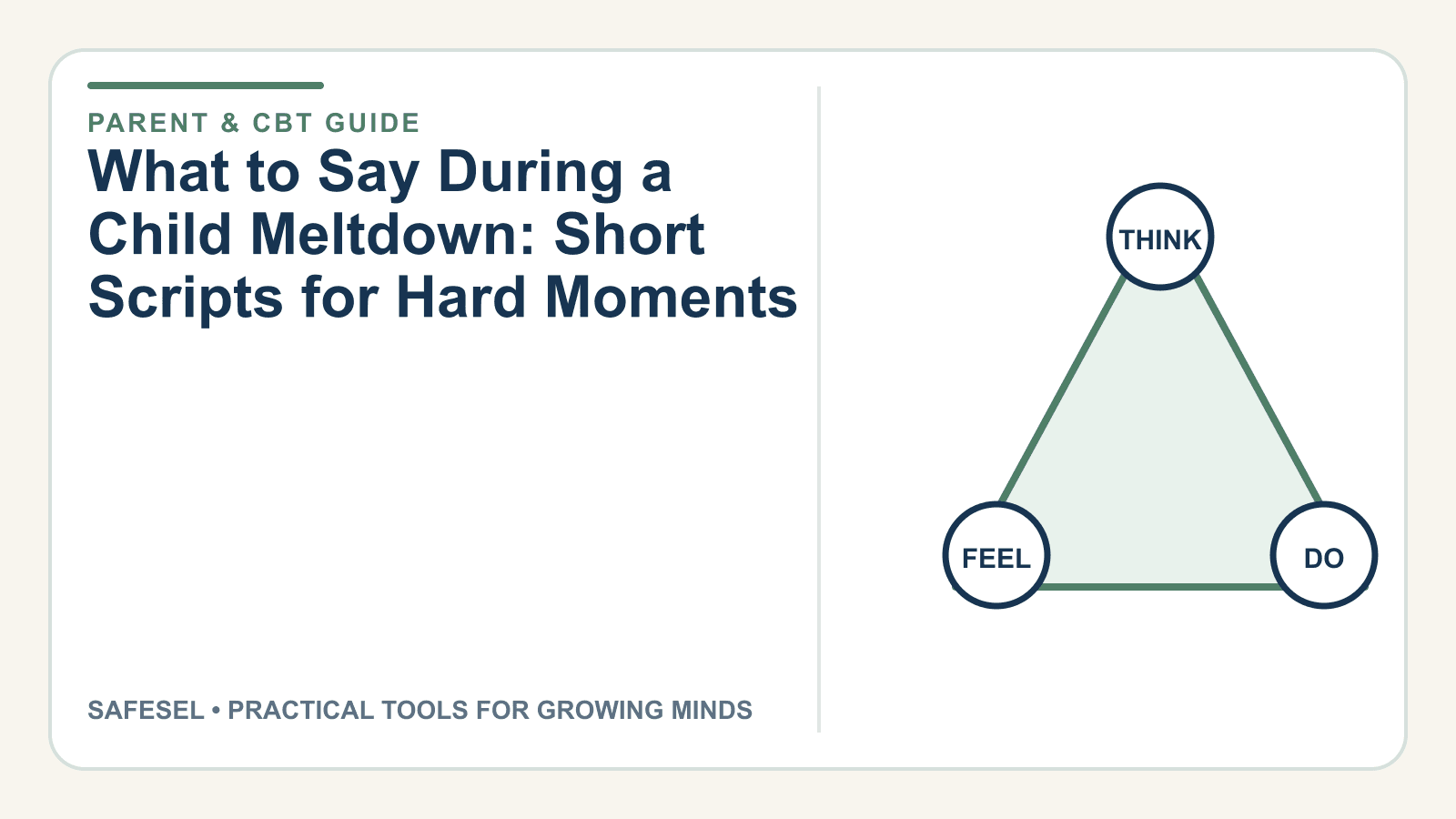
What to Say During a Child Meltdown: Short Scripts for Hard Moments addresses what to say during a child meltdown as a situation adults can observe, support, and review—not as a label for the child; anger is an emotion; aggression is behavior; the immediate job is safety and lower stimulation; reflection, responsibility, and repair belong after the child can think and communicate again.
A useful first attempt with “Choose the safety sentence” does not need to solve the whole difficulty. When addressing what to say during a child meltdown, make that action clear enough to try once, notice what helped, and revise the plan from the child’s actual response.
Start with what actually happens
When addressing what to say during a child meltdown, choose two recent examples and one occasion when the difficulty was smaller. While considering “Choose the safety sentence,” note what happened immediately beforehand, what the child did or communicated, how adults responded, and what allowed recovery or re-entry; the contrast can help distinguish a missing skill from overload, unclear expectations, avoidance, or an environmental barrier.
Begin with “Choose the safety sentence.” Treat it as a low-risk first action, not proof that one explanation is correct. Decide in advance what would count as useful evidence for keeping, reducing, or changing this support for what to say during a child meltdown.
A practical sequence
1. Choose the safety sentence
Make “Choose the safety sentence” concrete before the difficult moment: decide what the adult will block, which words will be used, where other children will go, and when additional help is required; apply this step specifically while what to say during a child meltdown.
2. Communicate presence
Keep “Communicate presence” brief enough to use under stress; accept speech, pointing, writing, drawing, or an agreed signal when the communication goal does not require a particular format; apply this step specifically while what to say during a child meltdown.
3. Offer one accessible choice
For “Offer one accessible choice,” offer no more than two options that are both genuinely available; a choice should reduce unnecessary struggle without disguising a demand as optional; apply this step specifically while what to say during a child meltdown.
4. Pause
Decide what “Pause” will look like in this setting; agree who starts, what support is available, and what small result would provide useful information even when the whole step is not completed; apply this step specifically while what to say during a child meltdown.
5. Signal later review
Review “Signal later review” after several comparable opportunities; change one part of the plan at a time so the family or team can tell whether timing, cue, support, or task size altered the outcome; apply this step specifically while what to say during a child meltdown.
What this can sound like
- “You are allowed to be angry. I will not let anyone be hurt.”
- “We will use fewer words now and talk when it is safer.”
- “What is one action that would help repair the impact?”
After introducing “Communicate presence” for what to say during a child meltdown, use the shortest sentence that directs attention to the next useful action; questions requiring a detailed explanation should wait until the child has enough regulation and language access to answer.
What can make the plan backfire
Before relying on “Choose the safety sentence,” consider this caution: lecturing during escalation, crowding the child, or demanding an instant apology can intensify risk; a calming plan must never replace an appropriate response to threats, injury, or repeated aggression.
When using “Choose the safety sentence” to address what to say during a child meltdown, avoid turning the child’s response into a test of character, motivation, gratitude, or maturity; if the proposed route becomes the main conflict, change the format or reduce the step before abandoning the underlying safety or participation goal.
How to review progress
While reviewing what to say during a child meltdown, track earlier communication, fewer unsafe actions, shorter recovery, use of a planned exit, and follow-through on a specific repair. A brief record of “Choose the safety sentence” can use three levels—independent, prompted, or not yet accessible—plus one sentence about the setting and the support available.
After practising “Signal later review,” review the pattern on an agreed date rather than redesigning the plan after each hard moment; keep what improved access, revise what did not, and increase difficulty only after the current step is reasonably reliable.
Developmental and accessibility adjustments
Adapt the route used for what to say during a child meltdown to language, disability, sensory processing, attention, culture, privacy, and communication style. When practising “Communicate presence,” pictures, modeling, movement, assistive communication, a typed response, or extra processing time may remove a format barrier without lowering the core goal.
When addressing what to say during a child meltdown, do not require eye contact, private disclosure, extensive writing, or a particular emotional display as proof of learning. Evaluate “Choose the safety sentence” by whether it improves safety, participation, communication, or recovery in the setting where this difficulty occurs.
When additional support is appropriate
Seek qualified support when difficulty remains persistent, worsening, unsafe, or significantly interferes with school, sleep, health, relationships, or everyday functioning despite trying “Choose the safety sentence” and “Communicate presence”; sudden or severe changes also warrant appropriate medical or mental-health assessment.
If you want the same ideas organized into a concise home-use resource, see the When Your Child Has Big Emotions parent guide.
Sources and further reading
- Treating Children's Mental Health with Therapy — Centers for Disease Control and Prevention (2026)
- Child and Adolescent Mental Health — National Institute of Mental Health
- Helping Little People Manage Big Feelings — American Academy of Pediatrics — HealthyChildren.org
- 4 Play Activities to Help Children Manage Emotions — American Academy of Pediatrics — HealthyChildren.org
- Why Kids Act Out: Tips to Help Your Child Cope With Stress — American Academy of Pediatrics — HealthyChildren.org