A child may repeat the same worry question because the answer brings a short burst of relief, but the uncertainty soon returns. The question can sound like a request for information—“Are you sure I won’t get sick?” or “Will you definitely pick me up?”—even when the child already remembers your answer. What they may be seeking in that moment is certainty and a reduction in distress.
Answering patiently is not a parenting mistake. Repeated answers can, however, become part of a reassurance cycle when the child increasingly relies on another person to feel safe. The more useful long-term goal is not to refuse comfort. It is to combine warmth with a consistent response that helps the child notice the worry, tolerate some uncertainty and use a skill they have practiced when calm.
In brief: Answer the factual part once, acknowledge that the worry still feels uncomfortable, and guide the child back to a previously practiced coping step. Do not turn the moment into a debate or demand that the child prove the worry is irrational.
What Repeated Reassurance-Seeking May Look Like
The pattern is not always obvious. A child might:
- ask the same question several times using slightly different wording;
- ask one adult, then check the answer with another adult;
- return to the question after appearing satisfied;
- request promises about events no one can fully guarantee;
- ask you to review work repeatedly before submitting it;
- need confirmation before ordinary separations, bedtime or school activities;
- become more distressed when an adult says, “I already answered that.”
For example, Maya, age nine, asks whether her mother will arrive at dismissal. Her mother says yes and explains the pickup plan. Two minutes later, Maya asks, “But what if traffic is bad?” After another answer, she asks whether the teacher knows what to do if her mother is late. Each question is understandable. Together, they suggest that more information is not resolving the underlying uncertainty.
In another family, eleven-year-old Noah asks his father to check a homework answer. After his father confirms it, Noah asks, “Did you read the whole question?” and then, “Are you completely sure the teacher will accept it?” The immediate topic is homework, but the process is a repeated search for certainty about making a mistake.
Repeated questions alone do not establish that a child has an anxiety disorder. Children repeat themselves for many reasons, including unclear explanations, language-processing differences, memory difficulties, a need for predictability or a habit that has developed within a particular routine. Consider the child’s age, context and overall functioning rather than interpreting one behavior in isolation.
Why Another Answer Helps—But Only Briefly
Reassurance can reduce discomfort quickly. That relief is real, which is why both the child and adult are likely to repeat the exchange. The child learns, “When the worry rises, I need someone to make it go away.” The adult learns, “If I give one more explanation, we may finally be able to move on.”
The difficulty is that many worry questions ask for certainty that adults cannot honestly provide. A parent can describe the school pickup plan but cannot promise that a delay is impossible. A teacher can explain how a presentation will work but cannot guarantee that the student will not feel embarrassed. When adults keep adding guarantees, the child may begin to treat certainty—not coping—as the condition for participation.
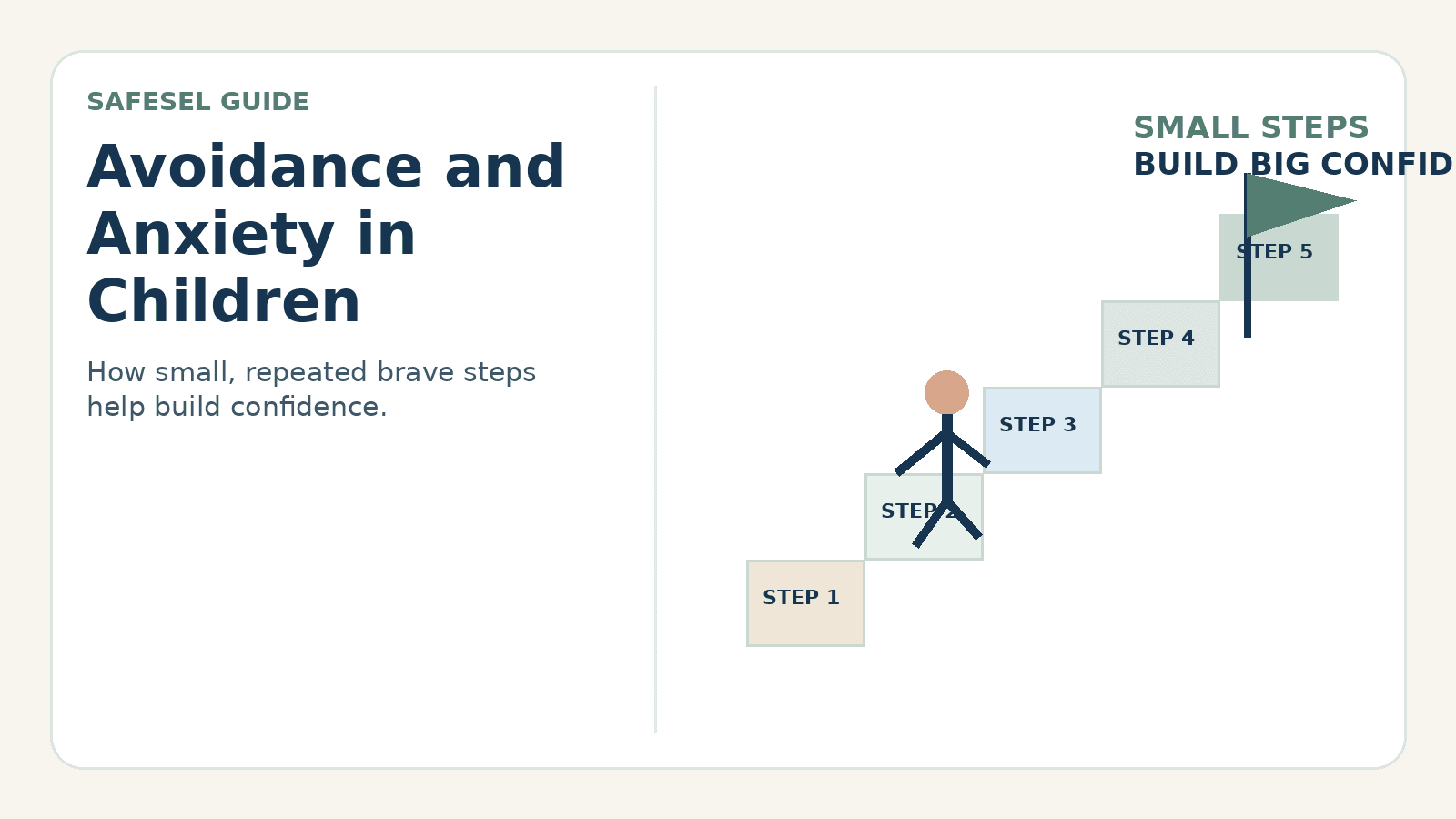
This is related to the broader avoidance and anxiety cycle. Avoiding a feared situation and repeatedly seeking certainty can both reduce distress in the short term while limiting opportunities to discover, “I can handle this feeling and respond if something unexpected happens.”
This does not mean reassurance is harmful in every form. Children need accurate information, connection and help making sense of unfamiliar situations. The distinction is between useful orientation and an open-ended ritual that must be repeated until the child feels completely certain.
What Adults Often Try That Can Make the Cycle Longer
Giving increasingly detailed guarantees
An adult may provide five reasons the feared event will not happen. The child then finds a sixth possibility. The conversation becomes a courtroom in which the adult must defeat every “what if.” Anxiety is unusually good at producing another question.
Arguing with the feeling
Statements such as “There is nothing to worry about” or “That makes no sense” focus on disproving the child’s experience. Even when the feared outcome is unlikely, the feeling is already present.
Removing reassurance abruptly
Moving from repeated comforting to “I am never answering that again” can feel punitive and may produce more distress. A gradual, predictable response is usually easier to understand and practice.
Asking the child to explain during peak distress
Questions such as “Why do you keep doing this?” often require more reflection than the child can manage in the moment. Save problem-solving for a calmer time.
What To Do When the Same Worry Question Returns
1. Check whether the child needs new information
Before treating the question as reassurance-seeking, make sure something has not changed. Give a short, concrete answer if the child genuinely does not know the plan.
You might say: “Pickup is at three. If I am delayed, you will stay with Ms. Lee in the office.”
Avoid adding multiple speculative details. The aim is clarity, not perfect certainty.
2. Name the process without criticizing it
When the question returns, gently distinguish the worry from a new information need.
- “I notice the worry is asking for the same answer again.”
- “You remember the plan, and your body still does not feel settled.”
- “This sounds like a certainty question rather than a new-information question.”
This language externalizes the pattern without calling the child manipulative or attention-seeking.
3. Validate the discomfort, not the prediction
Validation does not require agreeing that the feared event is likely.
Less helpful: “I promise nothing will go wrong.”
More helpful: “Not knowing exactly how it will go feels uncomfortable. We can make room for that feeling and use the plan.”
The goal is not to eliminate the feeling before the child continues. It is to communicate that the feeling can be present and manageable.
4. Use one consistent bridge back to coping
Choose a brief response that all caregivers can use. For example:
- “You have the information.”
- “The worry wants more certainty.”
- “What is your next coping step?”
The coping step might be checking a written plan, taking one slow exhale, rating the worry from zero to five, using a coping statement or returning attention to the current task. A worksheet such as a worry-thought record can support later practice, but it should not become another object the child must complete repeatedly for certainty.
5. Reduce repetition gradually when needed
If the family has been answering the question many times, set a small first goal rather than demanding an immediate stop. You might agree that the parent will answer once and give one reminder of the plan. After that, the adult will validate and prompt the child’s chosen skill.
Keep the response calm and brief. Long explanations can unintentionally reward the repeated question with an extended certainty conversation.
6. Notice effort, not the absence of worry
Reinforce the child’s action:
- “You wanted to ask again, and you checked your plan instead.”
- “The worry was still there, and you went into class.”
- “You used your own answer before asking me.”
This shifts the marker of success from “I felt completely sure” to “I handled uncertainty with support.”
Helpful Phrases to Use
Natural language matters more than a perfect script. Try:
- “I have answered the information part. I can help you with the feeling part now.”
- “I cannot promise every detail, but I can remind you of the plan.”
- “What does the worry want me to guarantee?”
- “What do you already know, and what can you do if the plan changes?”
- “You do not have to feel certain before taking the next step.”
- “Would you like one calm reminder or help choosing a coping action?”
Avoid turning these phrases into a rigid performance. Some children need fewer words, visual support or more time before they can respond.
What to Practice Later, When the Child Is Calm
Draw two columns labeled New Information and The Worry Wants Certainty. Read several example questions together and decide where each belongs. Then build a short response plan:
- What facts do I already know?
- What is outside anyone’s control?
- What can I do if the uncomfortable possibility happens?
- What is one action I can take now?
For Noah’s homework worry, the plan might be: read the direction once, use a two-item checking list, ask one specific question if something is unclear, and submit the work without seeking a guarantee about the grade.
For Maya’s pickup worry, it might be: read the pickup card, name the backup adult, take two slow breaths and enter the classroom even if the worry is still at a three out of five.
Short, planned worry time can also help some children postpone repetitive worry conversations without dismissing the concern.
When This Approach May Not Be Appropriate
Do not assume every repeated question is an anxiety ritual. Pause and reconsider when:
- instructions or plans have genuinely been inconsistent;
- the child has not understood the language being used;
- memory, attention or processing differences may make repetition necessary;
- the child is asking about a real safety concern;
- a routine has changed and new information is needed;
- the adult’s response has become shaming, angry or coercive.
The strategy should also be adapted within an individualized treatment plan. If a clinician is supporting the child with anxiety or obsessive-compulsive symptoms, caregivers should coordinate changes to reassurance with that professional rather than creating a competing plan.
When to Seek Additional Support
Consider speaking with a pediatrician or appropriately qualified mental health professional when worries or reassurance-seeking are persistent, cause marked distress, take up substantial time, interfere with sleep, school, friendships or family routines, or prevent the child from joining ordinary activities. Professional evaluation is also appropriate when repetitive questions occur alongside unwanted intrusive thoughts or repeated actions that the child feels driven to perform.
The AACAP overview of anxiety in children and CDC guidance on childhood anxiety both emphasize looking at severity and interference with everyday functioning. A single behavior is not enough to make a diagnosis.
Sources and further reading
- Help Your Child Manage Anxiety: Tips for Home & School — American Academy of Pediatrics — HealthyChildren.org
- School Avoidance: Tips for Concerned Parents — American Academy of Pediatrics — HealthyChildren.org
- Treating Children's Mental Health with Therapy — Centers for Disease Control and Prevention