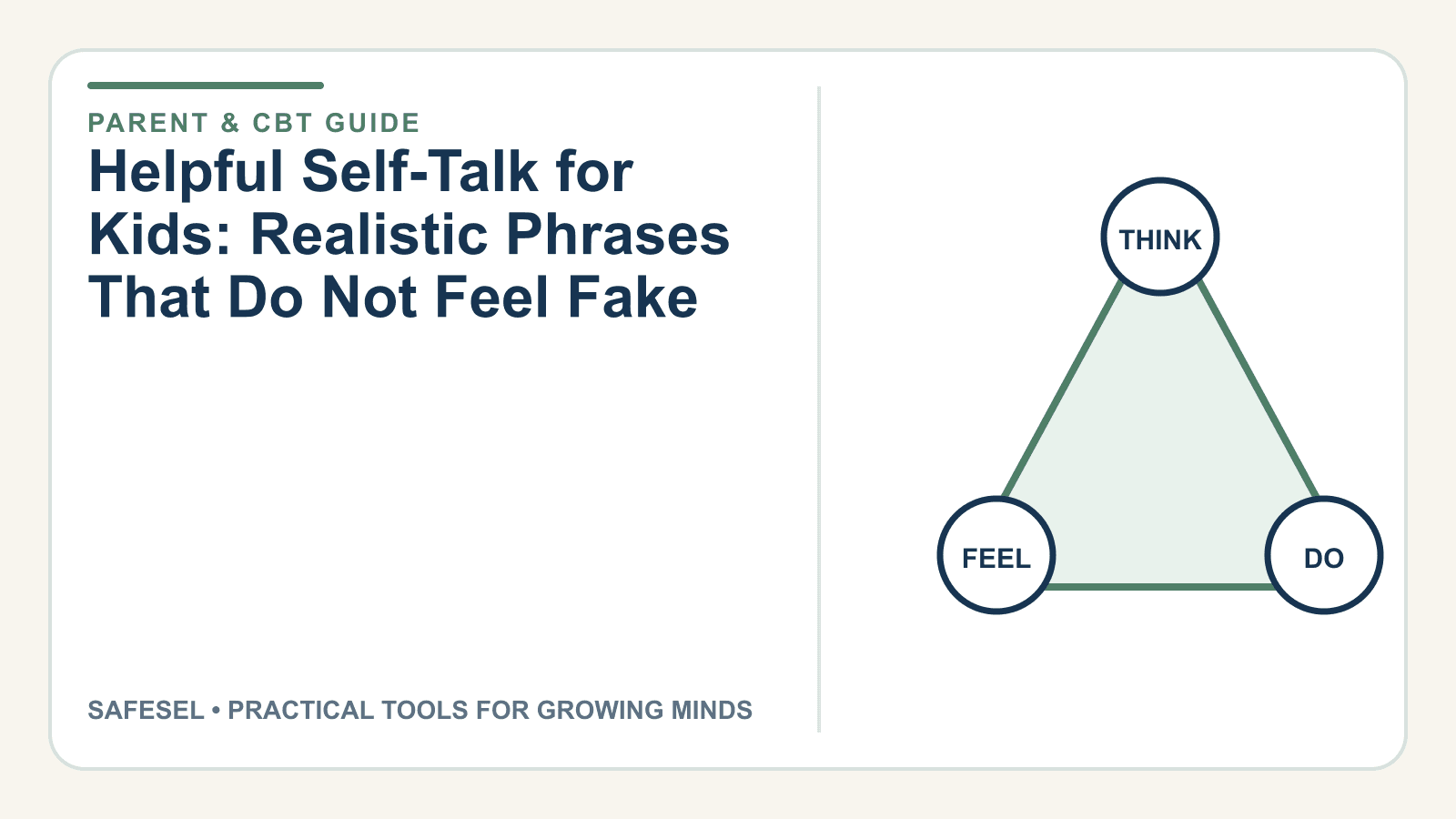
If a balanced thought feels fake, it is probably too positive, too certain, or too far from the child’s experience. CBT thought work is not replacing a frightening sentence with a cheerful slogan. It is examining what is known, unknown, and useful.
In brief: Lower the claim. Move from “Everything will be fine” to “I do not know exactly what will happen, and I have one step I can take.”
Validate the Objection
Say: “You are right that we cannot prove that sentence.” This strengthens credibility. Do not demand that the child repeat words they do not believe.
Build a Believable Ladder
Start with the anxious prediction: “Everyone will laugh.” Identify facts, assumptions, and missing information. Then test statements of increasing balance:
- “Some people may notice my mistake.”
- “I cannot know everyone’s reaction.”
- “I can use my note card and finish the first sentence.”
The best statement may acknowledge discomfort rather than promise success.
Connect Thought Work to Action
A balanced thought becomes meaningful when paired with a small experiment: ask one question, present to one trusted person, submit work after one check, or remain in the situation for an agreed step. Review what happened without declaring the child’s fear irrational.
Example: “Nobody Likes Me”
Do not replace the thought with “Everyone likes me.” Separate the evidence: one friend did not answer, two classmates spoke with the child that day, and the reasons for the unanswered message are unknown. A more credible statement might be: “I feel rejected, and one unanswered message does not tell me what everyone thinks.”
The action could be waiting until tomorrow, sending no additional messages tonight, and speaking to another friend or trusted adult. The point is not to prove popularity; it is to reduce all-or-nothing certainty and choose a proportionate response.
A Five-Part Thought Check
- What is the exact prediction?
- What facts support it?
- What facts do not fit it?
- What remains unknown?
- What action is useful even without certainty?
Avoid grading the child on whether they produce the “right” balanced thought. If the adult supplies every answer, the worksheet becomes compliance rather than collaborative inquiry.
Know When to Pause
Do not conduct thought challenging during peak distress, after a genuine safety violation, or when the child needs practical protection, comfort, academic help, or sensory support. Thought work is one tool, not a universal response.
When to Seek Support
CBT for significant anxiety should be guided by a qualified professional and adapted to development and individual needs. Seek help when fear or rituals substantially interfere with daily life.
Use the guidance in a real situation
When responding when a child says a balanced thought feels fake, choose one recent, specific example that fits the pattern; write down the event, the first observable sign of difficulty, the adult response, and what happened next so that a broad label does not replace the details needed for a useful decision.
Use “Validate the Objection” as the first action from the guide and define who will try it, where it will happen, and how long the first attempt will last; keep other parts of the routine stable so the result is interpretable.
Language and access
- In a conversation about responding when a child says a balanced thought feels fake, an adult might say “What happened, and what did your mind predict?”
- In a conversation about responding when a child says a balanced thought feels fake, an adult might say “What do we know, what are we guessing, and what could we check?”
When applying “Validate the Objection,” accept an accessible response format unless the format itself is the skill being taught; reduce unnecessary writing, public disclosure, sensory load, and rapid verbal demands.
Review what changed
To review responding when a child says a balanced thought feels fake, track more precise descriptions of thoughts, generation of a second plausible explanation, willingness to test a prediction, and choices guided by evidence rather than certainty; compare several similar opportunities before concluding that the plan worked or failed, and alter only one major variable at a time.
In this guide to responding when a child says a balanced thought feels fake, do not argue a child out of a fear, require a positive statement they do not believe, or use a worksheet while arousal blocks reflection; check facts, uncertainty, safety, communication, and access before challenging an interpretation.
When to seek additional help
Seek individualized assessment when difficulty remains persistent, worsening, unsafe, or substantially affects learning, sleep, health, relationships, or daily life despite trying “Validate the Objection”; educational guidance cannot determine a diagnosis or replace appropriate professional care.
Use this guide as a starting point for responding when a child says a balanced thought feels fake, not as a fixed script; a useful plan remains specific enough to repeat, flexible enough to preserve access, and clear about which signs require a different level of support.
Before increasing difficulty in work on responding when a child says a balanced thought feels fake, compare the current attempt with the original example and ask whether “Validate the Objection” became easier, needed less prompting, or worked in one additional setting; record the support that was present, because a better result with support is useful evidence and does not need to be dismissed as dependence, and note what the child could do before and after that support was added.
Sources and further reading
- What Is the CASEL Framework? — CASEL
- Enhancing and Practicing Executive Function Skills with Children from Infancy to Adolescence — Center on the Developing Child at Harvard University
- Communication Skills Start at Home — American Academy of Pediatrics — HealthyChildren.org