CBT thought work with children is not an exercise in replacing every uncomfortable thought with a positive one. Its purpose is to help a child notice the relationship between a situation, interpretation, feeling and action; evaluate a prediction with curiosity; and develop a response that is both more useful and believable.
Invalidation occurs when the adult rushes to correct the thought before understanding the child’s experience. A child who hears “That won’t happen” may learn that the goal is to stop reporting fear. A collaborative sequence begins with the feeling and context, asks permission to examine the thought, and leaves room for uncertainty.
In brief: Validate the emotional experience without confirming an untested prediction. Begin thought work only when the child is regulated enough to reflect, use concrete language, and end with a small behavioral test rather than a forced positive statement.
Clarify the Aim
The aim is not to prove the child wrong. It is to increase flexibility and choice. A useful outcome might be:
- “I noticed that ‘everyone will laugh’ was a prediction.”
- “I found information the worry left out.”
- “I made a plan for the part I cannot guarantee.”
- “I tried one step and observed what happened.”
CBT may be part of evidence-based treatment for childhood anxiety, but a worksheet or isolated questioning technique is not equivalent to a complete intervention. Clinical formulation, developmental fit, therapeutic alliance, caregiver involvement and behavioral practice matter.
Check Readiness Before Challenging a Thought
A child may be ready when they can stay with a brief conversation, identify a specific situation and consider more than one idea. Readiness is lower when the child is highly activated, feels interrogated or is still trying to establish whether the adult understands what happened.
Ask:
- Is there a specific thought rather than a general feeling?
- Does the child understand the words fact, guess and prediction?
- Can the child tolerate uncertainty for this topic?
- Is the feared situation actually safe enough to approach?
- Does the adult have sufficient context to avoid reframing a real problem?
If a student says peers repeatedly threaten them, the first task is not to challenge “School is unsafe.” Assess and address safety.
Validation Is Not Agreement
Validation communicates that the child’s internal response makes sense in context. It does not require agreeing that the feared prediction is certain.
Child: “If I make one mistake, everyone will think I’m stupid.”
Invalidating response: “That is ridiculous. Nobody thinks that.”
Prediction-confirming response: “Yes, children can be cruel, so you should avoid presenting.”
Balanced response: “The possibility of being judged feels threatening, especially because this presentation matters to you. Would it be okay if we look at what your mind predicts and what support you would have if a mistake happened?”
What To Do: A Six-Step Readiness Ladder
1. Understand the feeling and context
Begin with description:
- “What happened right before the feeling changed?”
- “What part felt most important?”
- “What did you want to protect yourself from?”
Do not ask ten questions. Reflect what you heard and correct misunderstandings.
2. Map the thought without editing it
Write the child’s words accurately. If the child says, “Everyone will hate me,” do not immediately soften it to “Some people may dislike my idea.” The original wording shows the prediction you are examining.
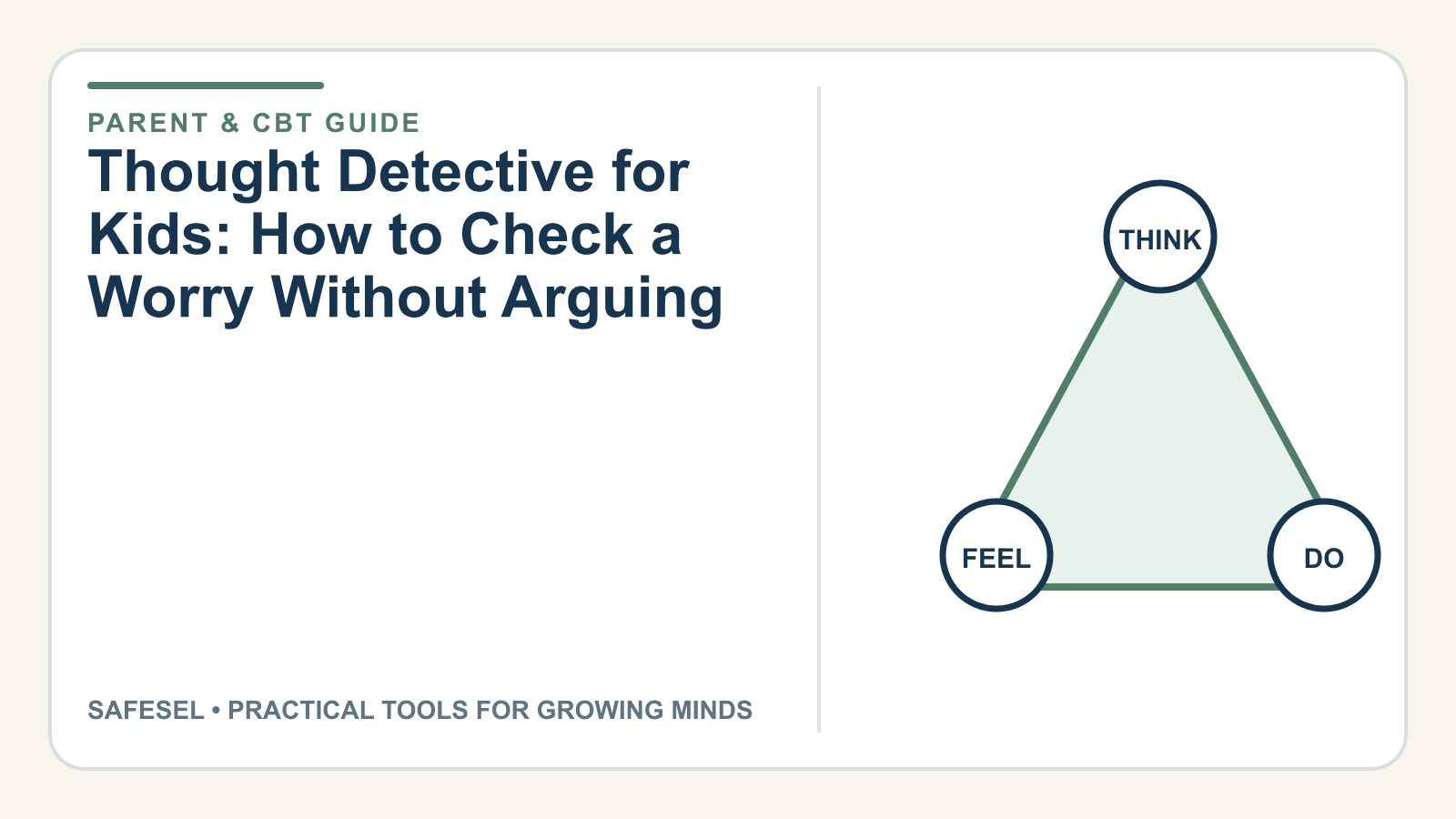
Link it to the thoughts–feelings–actions triangle: “When that sentence shows up, what feeling and action follow?”
3. Ask permission to investigate
- “Would you like help checking whether the thought is giving the full picture?”
- “Can we treat this as a prediction and collect information?”
- “Would drawing it or talking be easier?”
Permission does not remove professional structure, but it reduces the experience of being corrected.
4. Examine information on both sides
Avoid cross-examination. Use a small number of questions:
- “What makes the thought feel convincing?”
- “Has anything happened that does not completely fit it?”
- “Are we using words like always, everyone or definitely?”
- “What would we say to another child in the same situation?”
- “What information do we not have yet?”
Include evidence that supports the child’s concern. Balanced thinking is not selective optimism.
5. Develop a believable alternative
A useful alternative acknowledges uncertainty and coping:
- Too positive: “My presentation will be amazing.”
- More believable: “I may lose my place. I can use my note card and continue.”
- Too positive: “Nobody is upset with me.”
- More believable: “My friend looked annoyed, but I do not know what they think yet. I can ask once and give them space.”
Ask the child to rate believability. If the new thought feels fake, revise it rather than insisting.
6. Test through action
Behavior provides information that discussion cannot. Choose a small, ethical experiment:
- answer one prepared question in a small group;
- submit homework after one planned check;
- ask the teacher for clarification rather than guessing;
- greet one peer and observe the response.
Define what will be observed. The experiment is not a trap designed to prove the therapist right.
Adaptations for Ages 7–9
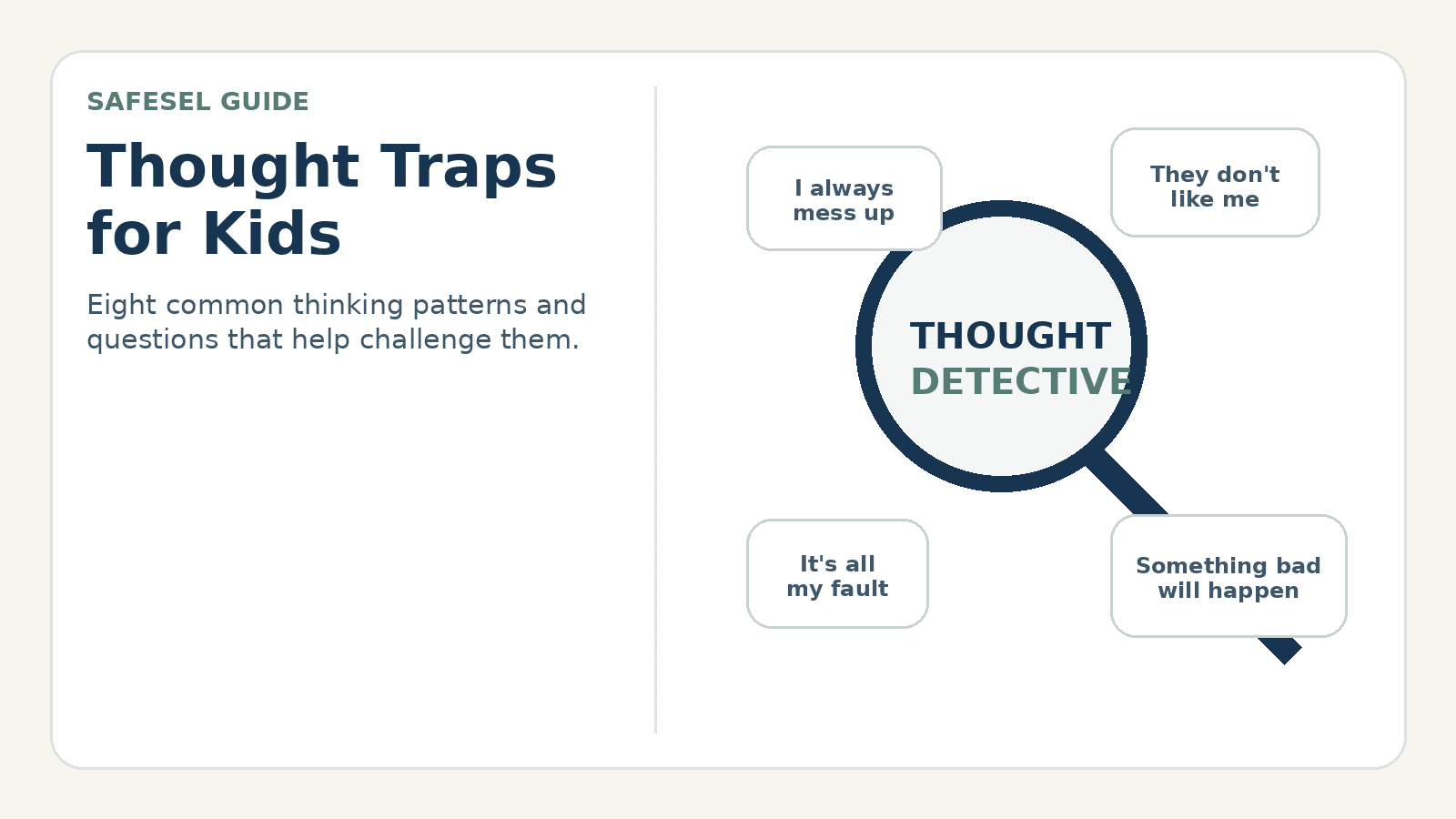
Use concrete metaphors such as a detective checking clues. Keep one situation per page. Let the child draw the prediction and possible outcome. Use external examples before personally sensitive material.
Avoid implying that thoughts are villains to eliminate. A worry thought may be trying to protect the child while overestimating danger.
Adaptations for Ages 10–12
Older children often notice when adults are steering toward a preferred answer. Name the process transparently and allow mixed conclusions. Introduce probability carefully; numerical estimates are not necessary for every child.
Discuss social consequences realistically. “Some classmates may notice a mistake” may be true. The work is to distinguish noticing from catastrophic meaning and develop coping.
Difficult Responses
“The balanced thought is fake.” Agree that it should not be used yet. Ask which phrase feels untrue and build a smaller statement.
“You don’t understand.” Return to context. Summarize and ask what you missed before continuing.
The child gives the expected answer immediately. Check ownership: “That sounds like a therapist answer. What do you actually believe?”
The child becomes distressed. Pause cognitive work. Regulation and relationship take priority.
Common Facilitator Errors
- beginning with “What is the evidence?” before emotional understanding;
- treating every negative thought as distorted;
- using a worksheet as an interrogation script;
- confusing reassurance with restructuring;
- selecting a positive statement the child does not believe;
- ignoring real discrimination, bullying or learning difficulty;
- ending with insight but no real-world practice;
- presenting CBT as a way to stop all anxiety.
Observe Progress
Progress may include identifying thoughts with less prompting, generating more than one interpretation, creating believable coping statements and approaching previously avoided situations. Symptom ratings can provide information, but functional participation and the child’s own goals are also important.
Example: From Validation to a Behavioral Test
Twelve-year-old Rowan predicts, “If I ask for help, the teacher will think I wasn’t listening.” The therapist first explores the embarrassment and Rowan’s previous experience of being corrected publicly. They map the urge to stay silent and copy a peer.
Rather than replacing the thought with “The teacher will be nice,” they develop: “I do not know how the teacher will react. I can ask one specific question privately and observe what happens.” Rowan rehearses the question, chooses a low-pressure class and records the response. The experiment may support a new conclusion, or it may reveal that a different adult or school support is needed.
The value comes from gathering information and increasing choice, not proving that the original prediction was foolish.
Documentation and Collaboration
Document the child’s wording, the evidence considered, the alternative statement and the agreed action. Avoid recording a therapist-generated balanced thought as though the child endorsed it. When caregivers or school staff support practice, share the prompt and goal with appropriate consent rather than asking them to debate the child’s thoughts.
If adults repeatedly reassure, correct or complete the cognitive exercise for the child, the intervention may lose its collaborative function. Coach supporters to ask one question, allow processing time and reinforce approach behavior.
Limits and Clinical Context
Thought work should sit within an individualized formulation. Consider developmental, cultural, neurodevelopmental, family and school factors. Coordinate with caregivers and other professionals appropriately. Do not use a printable resource to diagnose or to replace indicated treatment.
Sources and further reading
- Treating Children's Mental Health with Therapy — Centers for Disease Control and Prevention
- Help Your Child Manage Anxiety: Tips for Home & School — American Academy of Pediatrics — HealthyChildren.org
- Enhancing and Practicing Executive Function Skills with Children from Infancy to Adolescence — Center on the Developing Child at Harvard University