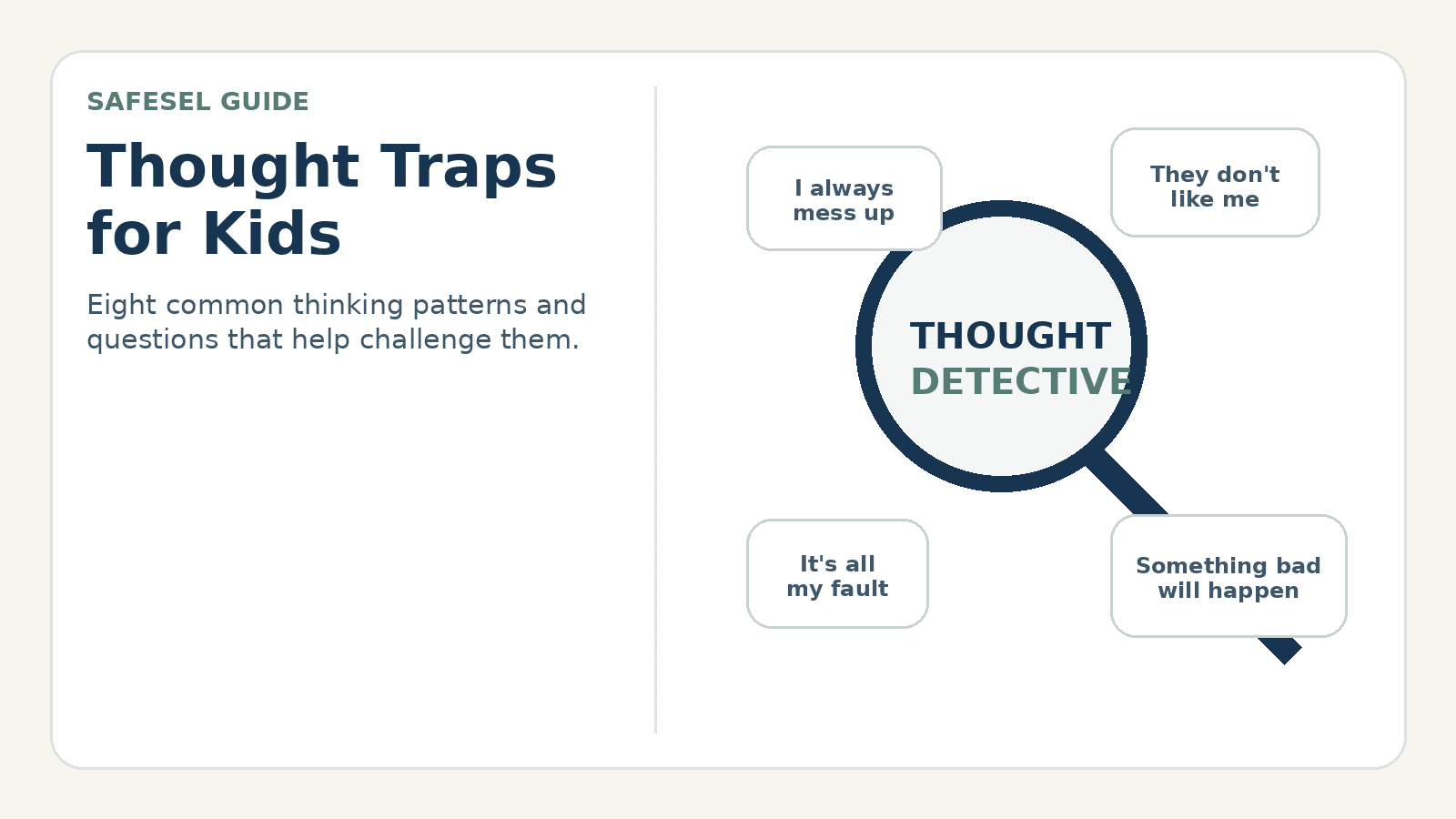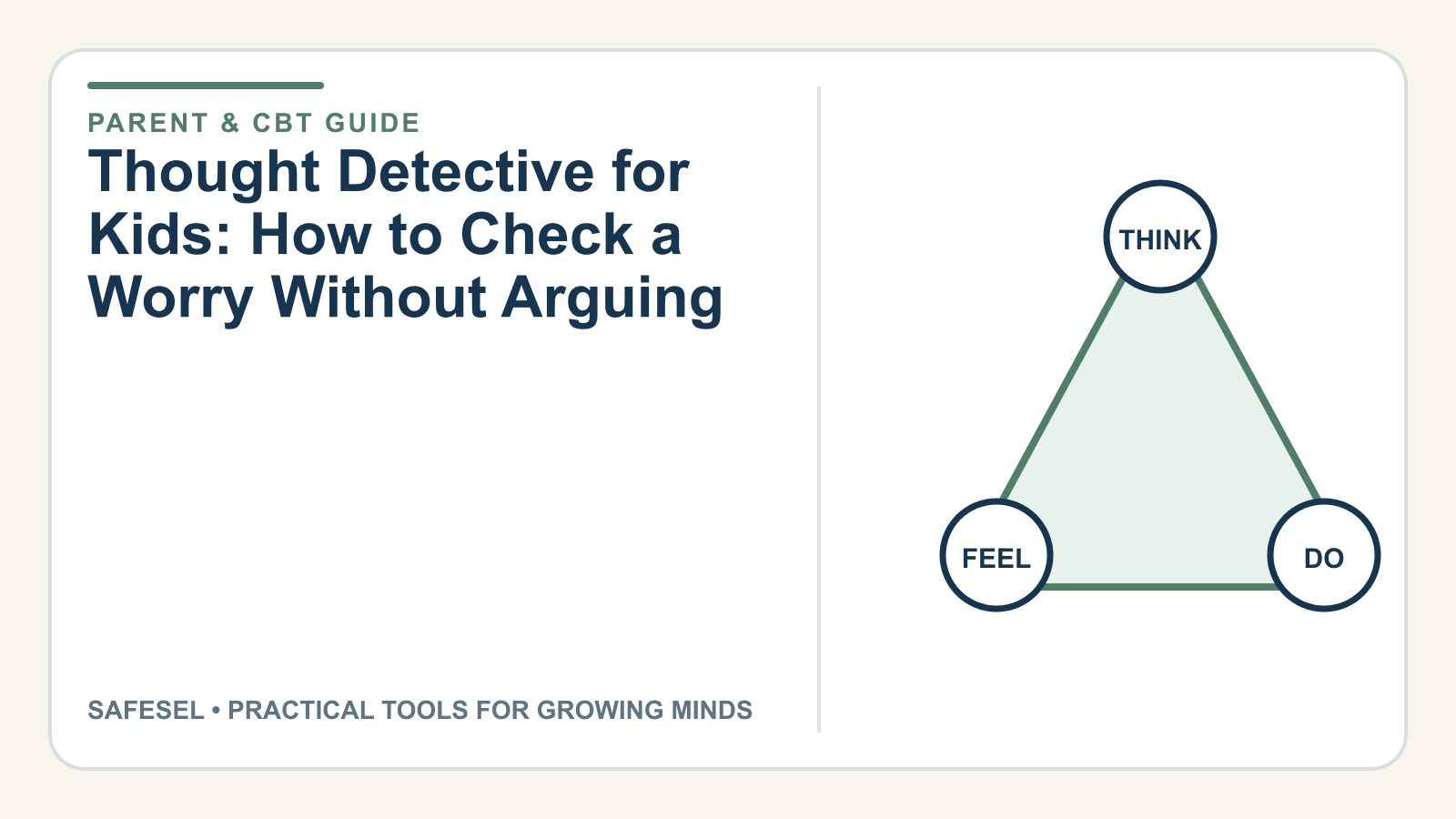
When a child treats an anxious thought as a fact, do not try to win an argument about whether the thought is true. Help the child notice the thought, name it as a mental event, check what is known and unknown, and choose a useful next action. The goal is flexible thinking—not replacing every uncomfortable thought with a positive one.
In brief: Use four steps: notice, name, check, choose. “I notice the thought ‘Everyone will laugh.’ A thought can feel convincing without being a complete fact. What evidence do we have, what is uncertain, and what can you do next?”
Why Thoughts Can Feel Certain
Thoughts arrive quickly and can trigger real body reactions. If a child imagines failing a test, their stomach may tighten and heart may race. Those sensations can then feel like additional proof: “I feel scared, so failure must be coming.”
Children are also still developing metacognition—the ability to think about thinking. Younger children may need concrete examples before they can separate a prediction, memory, rule, image, and fact.
For example, nine-year-old Ben thinks, “My friend did not answer, so she is angry with me.” The delayed reply is a fact. Anger is one interpretation. Other possibilities remain.
Twelve-year-old Sofia thinks, “If I make one mistake, the presentation will be a disaster.” The possibility of a mistake is real. The all-or-nothing conclusion is a prediction, not a completed event.
This does not mean adults should dismiss intuition or real risk. A child’s concern may contain important information about bullying, unsafe behavior, discrimination, illness, or another problem. Thought checking includes investigating evidence, not automatically deciding anxiety is wrong.
Step 1: Notice the Thought
Begin with observation rather than correction. Say, “What sentence is your mind giving you?” or “If the worry had a caption, what would it say?”
Some children notice an image instead of words. They may picture getting lost, being laughed at, or a caregiver being hurt. They can draw the image or describe the scene without being asked to relive it in detail.
Avoid “That is ridiculous” or “Stop thinking negatively.” These responses can make the child defend the thought or hide it.
Step 2: Name the Type of Mental Event
Add a small phrase:
- “I am having the thought that…”
- “My mind is predicting…”
- “I am remembering…”
- “I am noticing a worry image…”
- “My brain is using an all-or-nothing rule…”
The phrase does not prove the thought false. It creates distance between the child and the thought.
Use a concrete demonstration for younger children. Write “It will rain at recess” on a card. Ask whether writing it changes the weather. The card contains a prediction; evidence such as the forecast and sky helps evaluate it.
Step 3: Check What Is Known
Use a short set of questions. Too many questions can feel like cross-examination.
- What facts support this thought?
- What facts do not fit it?
- What part is unknown?
- Is there another possible explanation?
- If the difficult outcome happened, what support or response would be available?
For Ben, the check might be: his friend has not replied; she has sometimes replied late before; there was no argument; he does not know what she is doing. A balanced statement is not “She definitely loves me.” It is: “I do not know why she has not replied. There are several possibilities, and I can wait until tomorrow before checking once.”
For Sofia: she has made mistakes in presentations; most classmates did not react strongly; she knows the first two lines; the teacher allows note cards. A balanced thought could be: “I may make a mistake and still finish the presentation.”
Step 4: Choose an Action
Thinking work should lead to behavior. Ask, “What action fits the evidence and your values?”
Actions may include beginning the first homework item, sending one respectful message, asking a teacher a specific question, using a coping card, entering the activity for five minutes, or postponing further checking until a planned time.
Do not make certainty the requirement. A child can choose a useful action while still rating the thought as partly believable.
Use a Thought–Fact–Unknown Table
Create three columns:
“No one will sit with me.”
Facts available: Two friends are absent; one peer sat with me yesterday. Still unknown: Who will be at lunch and where they will sit.
“I will fail.”
Facts available: The test is tomorrow; two topics are difficult. Still unknown: The questions, score, and how much review will help.
“Mom is late because something happened.”
Facts available: Pickup is five minutes late; traffic is heavy. Still unknown: Exact arrival time and cause of delay.
Keep the exercise brief. If the child repeatedly completes the table to feel perfectly certain, it may become another reassurance ritual. Use it as skill practice, not compulsory proof.
Avoid Forced Positive Thinking
“Everything will be fine” may feel false because no one can guarantee it. A believable balanced thought includes uncertainty and coping:
- “I might feel awkward, and I can ask one question.”
- “The grade matters to me, but one grade does not decide everything.”
- “I do not know why they laughed. I can check the context before deciding it was about me.”
- “Something could go differently than planned, and adults have a backup plan.”
Validation and thought checking can coexist: “It makes sense that this prediction feels scary. We can respect the feeling and still examine the conclusion.”
When Not to Use Thought Checking
Pause the exercise when the child is highly dysregulated, exhausted, or asking about an immediate safety concern. Address safety first. Do not use cognitive reframing to minimize bullying, abuse, racism, discrimination, pain, or a realistic environmental threat.
Some children need a clinician-guided approach, especially when thoughts are intrusive, obsessive, trauma-related, psychotic-like, linked to self-harm, or accompanied by compulsive checking. Parents should not attempt to debate or manage these concerns through worksheets alone.
When to Seek Additional Support
Consult a pediatrician or qualified mental health professional when distressing thoughts are persistent, time-consuming, highly impairing, or interfere with school, sleep, eating, relationships, or everyday activities. Seek urgent help for thoughts about suicide, self-harm, harming others, or inability to remain safe.
CDC describes CBT as an evidence-based approach that can help children become aware of thoughts and feelings and develop more effective ways of thinking and coping. Formal CBT is treatment delivered within an appropriate plan; a parent using thought language at home is not a substitute for assessment or therapy.
Sources and further reading
- Treating Children's Mental Health with Therapy — Centers for Disease Control and Prevention
- Help Your Child Manage Anxiety: Tips for Home & School — American Academy of Pediatrics — HealthyChildren.org
- Enhancing and Practicing Executive Function Skills with Children from Infancy to Adolescence — Center on the Developing Child at Harvard University