← All guides
Anxiety

CBT Tools for Childhood Anxiety: A Practical Guide for Adults

Practical, developmentally respectful guidance on cbt tools for childhood anxiety: a practical guide for adults, with examples, decision steps, adult

Written bySafeSEL Editorial TeamEducational content team

CBT tools for childhood anxiety are most useful when they clarify predictions, reduce maintaining cycles, support gradual approach, and connect thinking work to behavior rather than becoming reassurance or positive-thinking exercises.

This guide is designed for educational and planning purposes. It does not provide a diagnosis or a universal protocol. Use the child’s development, communication, health, disability access needs, family context, culture, school environment, relationships, and safety conditions to adapt every recommendation.

In brief

A strong approach defines the target precisely, protects safety and dignity, reduces barriers unrelated to the target, teaches an observable skill or process, creates real-world practice, and reviews meaningful outcomes. The goal is not worksheet completion or emotional conformity.

Core framework

Area — What to examine — Practical implication

--- — --- — ---

Assessment — Identify feared situations, predictions, avoidance, checking, reassurance, physical symptoms, and functional impact.

Cognitive work — Separate events, interpretations, possibility, probability, coping, and uncertainty.

Behavioral learning — Use collaborative, graded practice and behavioral experiments.

Adult response — Validate distress without repeatedly providing impossible certainty.

Access — Adapt reading, writing, communication, sensory, and developmental demands.

The framework is a working hypothesis. New information may show that the original explanation was incomplete. Adults should be willing to revise the plan instead of defending a preferred technique.

Assessment before action

Start with a decision question. What does the team need to know or change? Describe the context, task, people, first observable cue, adult response, immediate outcome, delayed outcome, and the child’s perspective. Screen medical, developmental, sensory, communication, bullying, safeguarding, and urgent safety concerns where relevant.

Distinguish the primary goal from secondary hopes. The primary goal might be attendance, communication, task initiation, boundary use, safe recovery, repair, or transfer of an SEL skill. “Feel better” and “behave appropriately” are too broad for a useful plan.

Collect only the information needed for a decision. Continuous monitoring can change family or classroom interactions and create a large record without improving support.

Step-by-step implementation

1. Define one anxiety-maintaining pattern

Preserve the core goal while removing demands that are unrelated to that goal. Coordinate the core plan across adults while allowing authentic language and context-specific detail. The child should not have to learn a different rule in every room.

2. Choose the smallest tool that answers the clinical or educational question

Plan the first imperfect attempt instead of waiting for ideal motivation or calm. Write the step in plain language. When two adults would interpret it differently, add the missing cue, timing, or return condition. Specificity makes support more consistent and easier to evaluate.

3. Teach the tool with a neutral example

Keep adult language brief during stress and save fuller reasoning for later. Check whether the response increases safety, participation, communication, recovery, or independence. A strategy can be useful even when the child still feels uncomfortable.

4. Connect it to a real action

Make the step observable and small enough to use during an ordinary day. Coordinate the core plan across adults while allowing authentic language and context-specific detail. The child should not have to learn a different rule in every room.

5. Review predictions and outcomes

Define what the adult will do, what the child can do, and what will be reviewed. Write the step in plain language. When two adults would interpret it differently, add the missing cue, timing, or return condition. Specificity makes support more consistent and easier to evaluate.

6. Reduce reassurance and avoidance gradually

Use the child’s real setting rather than teaching the idea only in the abstract. Check whether the response increases safety, participation, communication, recovery, or independence. A strategy can be useful even when the child still feels uncomfortable.

7. Coordinate home, school, and therapy

Preserve the core goal while removing demands that are unrelated to that goal. Coordinate the core plan across adults while allowing authentic language and context-specific detail. The child should not have to learn a different rule in every room.

Worked examples

Example 1

A child uses a thought check before asking one classroom question.

In review, adults separate the immediate outcome from the longer-term learning and decide which part of the environment, instruction, communication, or support should change.

Example 2

A family uses a reassurance plan and brave-step ladder around bedtime.

In review, adults separate the immediate outcome from the longer-term learning and decide which part of the environment, instruction, communication, or support should change.

Example 3

A therapist adapts an exposure review to include sensory and communication barriers.

In review, adults separate the immediate outcome from the longer-term learning and decide which part of the environment, instruction, communication, or support should change.

Roles across home, school, and professional support

At home

Caregivers can connect practice to ordinary routines, provide emotional availability, hold clear limits, and observe patterns without turning family life into therapy. The task should be small enough to use and should not make the child responsible for adult disagreement.

At school

Teachers and counselors can protect access, privacy, and learning goals; use discreet cues; provide varied response modes; create return or transfer plans; and collect brief outcome data. School intervention must remain within professional scope and local policy.

In therapy or individualized support

Professionals can refine formulation, assess severity and differential possibilities, design developmentally appropriate experiments or rehearsal, support caregiver coordination, and identify when a generic resource is insufficient.

Equity, dignity, and unintended effects

Ask who can use the plan easily and who is penalized by its design. Public charts, heavy writing, rapid speech, eye-contact requirements, and adult-defined “appropriate calm” can create unequal access.

Monitor unintended effects. A support may improve one setting and interfere in another. Tracking may increase family stress. A small group may stigmatize participants. A friendship intervention may pressure the targeted child. Ethical review is part of effectiveness, not a separate concern.

Matching the CBT tool to the anxiety-maintaining process

Different tools answer different questions. A thought record is useful when a prediction or interpretation needs clarification. A worry tracker is useful when adults need to understand triggers, checking, reassurance, or timing. A behavioral experiment is useful when the child can test a prediction safely. A gradual-practice ladder is useful when avoidance has narrowed participation. A coping statement is useful when the child needs a believable bridge to action.

Do not begin with the product format. Begin with the maintaining process:

  • Repeated reassurance: use a shared response plan, uncertainty language, and a next action.
  • Avoidance: use a graded, collaborative approach with clear support and review.
  • Catastrophic prediction: separate possibility, probability, coping, and outcome.
  • Perfectionistic rules: test a small break in the rule and observe what happens.
  • Physical-symptom monitoring: reduce repeated checking while taking medical concerns seriously.
  • Social interpretation: separate observation from mind reading and gather information respectfully.

One child may need more than one tool, but not all at once. Too many worksheets can become another form of control or reassurance. Choose the smallest tool that leads to useful learning.

Planning a graded approach without coercion

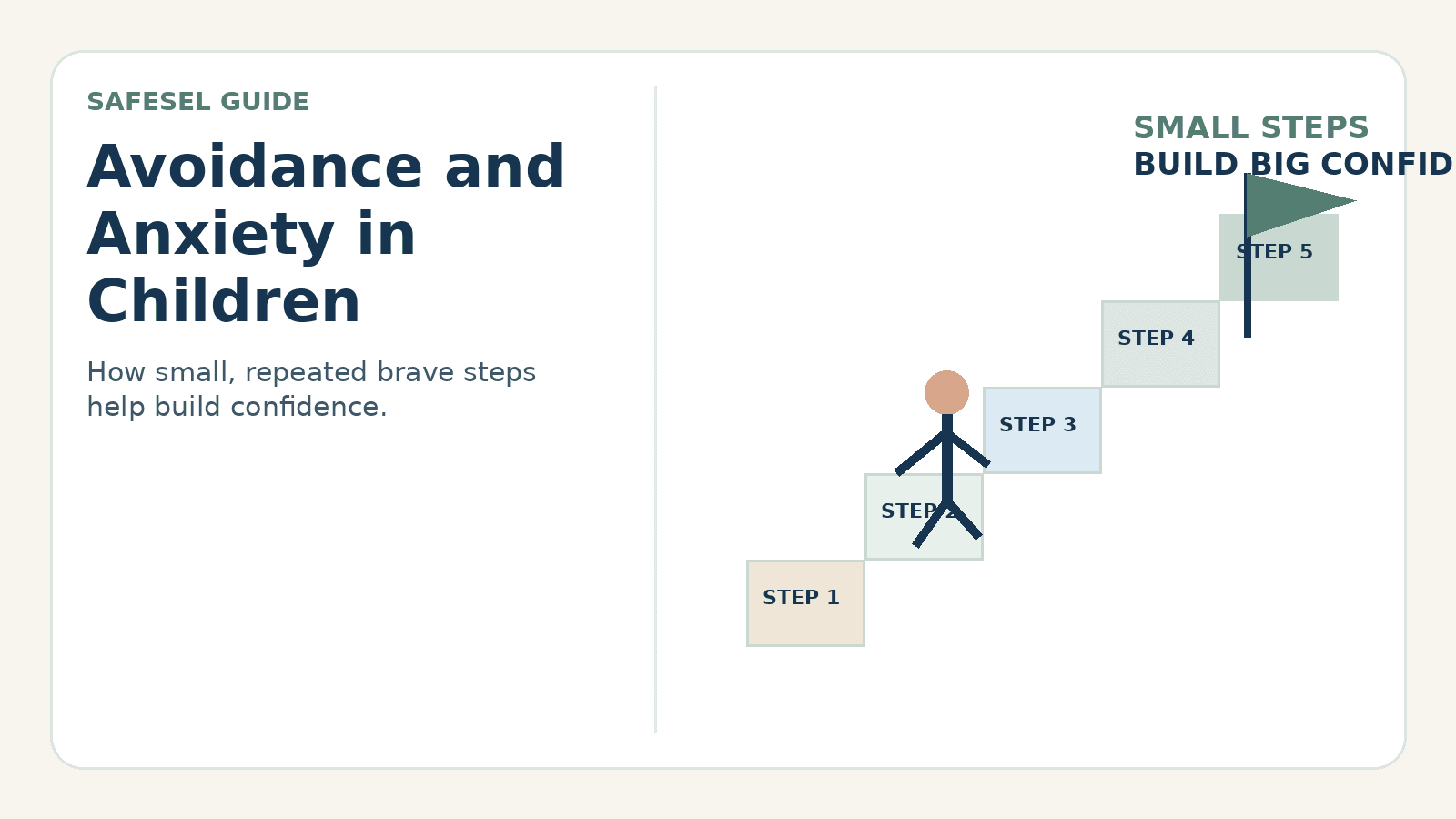
A graded approach should have a meaningful goal, transparent steps, acceptable risk, and child involvement. The child does not need complete control over attendance, health, or reasonable developmental expectations, but should understand the purpose and have genuine input into step size, communication, and support.

A practical ladder includes:

  1. the feared or avoided situation;
  2. the child’s prediction;
  3. the exact action being practised;
  4. available support;
  5. what counts as staying or returning;
  6. the observation recorded afterward.

Steps should vary by context, not only duration. For presentation anxiety, useful steps might include recording one sentence, speaking to a trusted adult, presenting to two peers, answering one planned question, and giving a shortened class presentation. Repeating the same artificial task for longer periods may not create transfer.

Review distress alongside functioning. High anxiety does not automatically mean the step was harmful, and completion does not automatically mean the design was good. Ask whether the child understood the plan, remained reasonably safe, had adequate access, and learned something relevant.

Avoiding common reassurance traps

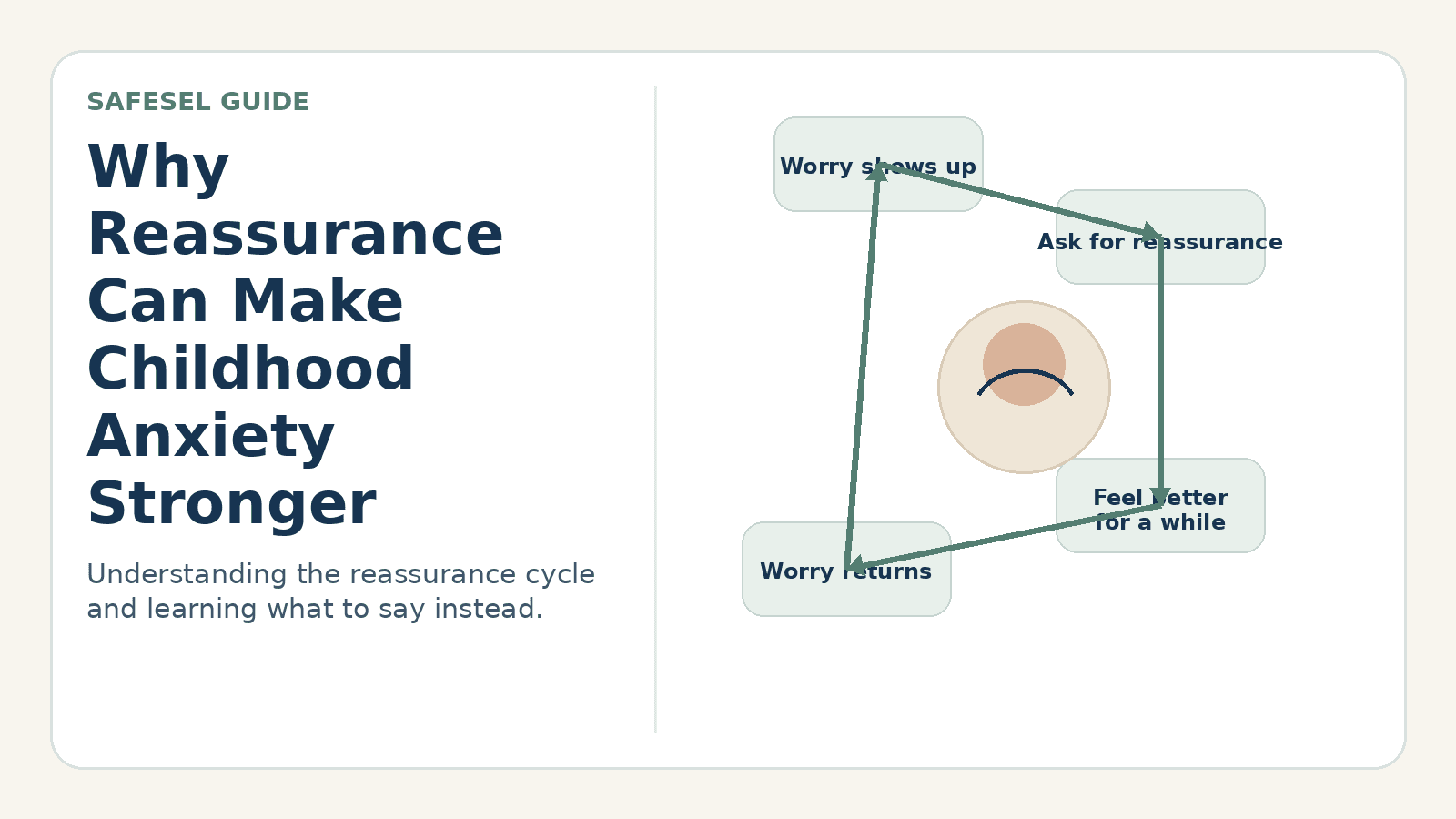
Adults often answer because the child appears distressed and the question sounds new. Yet anxiety can change wording while asking for the same guarantee. Agree in advance on what factual information will be provided, which questions can be checked once, and what phrase redirects to coping.

A useful response has three parts:

  • acknowledge the worry;
  • state what is known and unknown;
  • cue the next action.

For example: “You are worried the schedule might change. The plan currently says art after lunch. I cannot guarantee there will be no change, and you can check the visual board and use your change card if needed.”

This is not emotional withdrawal. The adult remains available while declining to build impossible certainty.

Reviewing whether CBT is helping

Look beyond completed pages. Useful change may include:

  • approaching a previously avoided situation;
  • asking fewer repeated certainty questions;
  • recovering after an unexpected outcome;
  • using more precise language for a prediction;
  • choosing a coping or communication step;
  • accepting a believable rather than perfect thought;
  • returning after a break;
  • needing less adult debate.

When the child understands the concepts but cannot use them, move practice closer to the real setting and reduce unnecessary task demands. When the child refuses the tool, investigate timing, relationship, shame, writing load, and whether adults have used CBT language to dismiss legitimate concerns.

Helpful adult and professional language

  • “We are testing a prediction, not testing your courage.”
  • “A balanced thought can include uncertainty.”
  • “What will this worksheet help you do next?”
  • “Support should make approach possible, not require perfect calm.”

Good language names the situation, preserves dignity, clarifies responsibility, and points to a usable next action. During high arousal, reduce words. During review, distinguish observation from interpretation.

Implementation checklist for anxiety-focused CBT

Before using the guide, confirm that:

  • the feared or avoided situation is specific;
  • medical, safeguarding, bullying, and access concerns have been considered;
  • the child understands the purpose of the tool;
  • the worksheet does not add unnecessary literacy or motor demands;
  • adults have agreed how reassurance questions will be answered;
  • the first behavioral step is defined;
  • there is a plan for reviewing predictions and outcomes;
  • progress includes participation and recovery, not only reduced anxiety;
  • the child has a route to communicate when the step is too large or unsafe;
  • the plan has a review date.

A useful session or parent meeting should end with one clear decision. Examples include: continue the same step, reduce one reassurance response, redesign the task, add an access support, obtain further assessment, or move practice into a more natural setting.

When several adults are involved, share only the information needed for the plan. The child should not need to repeat private fears to every teacher or caregiver. Use one core cue and one core response while allowing context-specific details.

Document what the child predicted, what happened, what support was used, and what changed next. Avoid progress notes that describe the child as brave, avoidant, resistant, or manipulative without observable detail.

Common implementation mistakes

  • Using CBT as forced positivity. This can reduce trust, hide access needs, or produce data that does not answer the actual question.
  • Completing worksheets without behavioral practice. This can reduce trust, hide access needs, or produce data that does not answer the actual question.
  • Ignoring genuine safety or access problems. This can reduce trust, hide access needs, or produce data that does not answer the actual question.
  • Starting with an overwhelming exposure. This can reduce trust, hide access needs, or produce data that does not answer the actual question.

A further mistake is evaluating only whether the child complied or appeared calm. A child may participate meaningfully while anxious, disappointed, angry, quiet, or using an alternative communication mode.

Measuring meaningful outcomes

  • Avoided situations become more accessible
  • Checking and reassurance become less repetitive
  • The child can recover and continue after uncertainty

Also measure adult consistency, amount of prompting, time to begin or return, access to help, and whether the child’s daily world is expanding or narrowing. Use several opportunities and a defined review date.

Practical questions

When is a worksheet useful?

When it answers a specific question and changes action.

Should anxiety disappear first?

No; progress can occur with anxiety present.

What if the child refuses?

Review timing, access, collaboration, and step size.

When additional or urgent support is needed

Seek individualized assessment when concerns are persistent, severe, worsening, appear across settings, or substantially interfere with education, health, sleep, eating, communication, development, relationships, or family life. Involve medical, developmental, disability, mental-health, and school professionals as indicated.

Use urgent local procedures for credible threats, serious aggression, suicidal statements, suspected abuse, severe bullying, unsafe sexual content, or acute medical symptoms. Educational materials, small groups, home plans, and worksheets do not replace crisis assessment or safeguarding action.

Related SafeSEL resources

  • Parent pillar: CBT Skills for Kids: Thoughts, Actions, and Flexible Learning
  • Suggested product line: CBT worksheets / Thought Detective / Circle of Control
  • Suggested free resource: CBT Starter Pack

Before publication, replace planning labels with exact URLs and connect the guide to narrower articles that answer clearly different search questions.

Sources and further reading

  1. Children and Mental Health: Is This Just a Stage? — NIMH
  2. When to Seek Help for Your Child — AACAP
  3. A Guide to Executive Function — Harvard Center on the Developing Child
  4. UDL Guidelines 3.0 — CAST
  5. What Is the CASEL Framework? — CASEL
SafeSEL printables

Related resources

View all Anxiety products →
Continue reading

Related articles

Childhood Anxiety Around Uncertainty: A Practical Guide for Adults

Practical, developmentally respectful guidance on childhood anxiety around uncertainty: a practical guide for adults, with examples, decision points, adult

Read guide →

A Necessary Break vs. Anxiety Avoidance: A Practical Decision Guide

Practical, developmentally respectful guidance on a necessary break vs. anxiety avoidance: a practical decision guide, with examples, decision points, adult

Read guide →

Brave Steps for Ages 10–12: Supporting Autonomy Without Handing Anxiety Control

Practical, developmentally respectful guidance on brave steps for ages 10–12: supporting autonomy without handing anxiety control, with examples, decision

Read guide →