← All guides
SEL

Emotion Cards vs. Feelings Worksheets: Which Tool Fits the Goal?

Compare emotion cards and feelings worksheets by skill goal, age, communication needs, and setting to choose the most useful

Written bySafeSEL Editorial TeamEducational content team

Emotion cards and feelings worksheets can both support emotional learning, but they do different jobs. Cards are quick, flexible, and easy to use without much writing. Worksheets create more space for reflection, sequencing, and an individualized plan.

The best choice depends on the skill goal—not on which product contains more items.

In brief

Choose emotion cards for recognition, sorting, conversation, role-play, rapid check-ins, and non-writing participation. Choose feelings worksheets for looking back at a specific situation, connecting feelings with thoughts and actions, identifying patterns, and creating a coping or communication plan. Combine them when the child benefits from a visual starting point before deeper reflection.

What emotion cards are best for

Emotion cards usually show a word, face, body cue, illustration, or short description. They are especially useful when the task needs to be:

  • brief;
  • visual;
  • interactive;
  • easy to repeat;
  • usable in a group;
  • accessible without long written answers.

Goal 1: recognising and naming emotions

A child can choose one or more cards that fit a situation. This is more flexible than asking, “How do you feel?” without support.

Adults can say:

“Choose any cards that are close. You do not have to find one perfect word.”

This matters because experiences are often mixed. A child may feel angry, embarrassed, and worried at the same time.

Goal 2: sorting intensity or similarity

Cards can be arranged from lower to higher intensity or grouped into families.

For example:

  • annoyed → frustrated → furious;
  • uncertain → worried → panicked;
  • disappointed → sad → devastated.

The goal is not to teach one universal hierarchy. Invite the child to explain how the words feel different to them.

Goal 3: perspective-taking

Present one situation and ask what different people might feel.

Scenario:

“Two children planned to sit together, but the teacher changed the seating plan.”

One child may feel disappointed, another relieved, and the teacher focused or stressed. This supports social awareness without requiring the child to disclose a personal event.

Goal 4: communication support

Cards can help a child point to an emotion when speaking is difficult. They can also pair the feeling with a need or next step:

  • overwhelmed → fewer words;
  • embarrassed → private conversation;
  • angry → space and a clear limit;
  • confused → explanation or visual example.

Goal 5: rapid check-ins

A child can select a card at the start or end of a session. Keep the process optional and private enough to avoid public emotional performance.

A check-in should not require the child to explain more than they want to share.

What feelings worksheets are best for

Worksheets are more useful when the task requires structure over time.

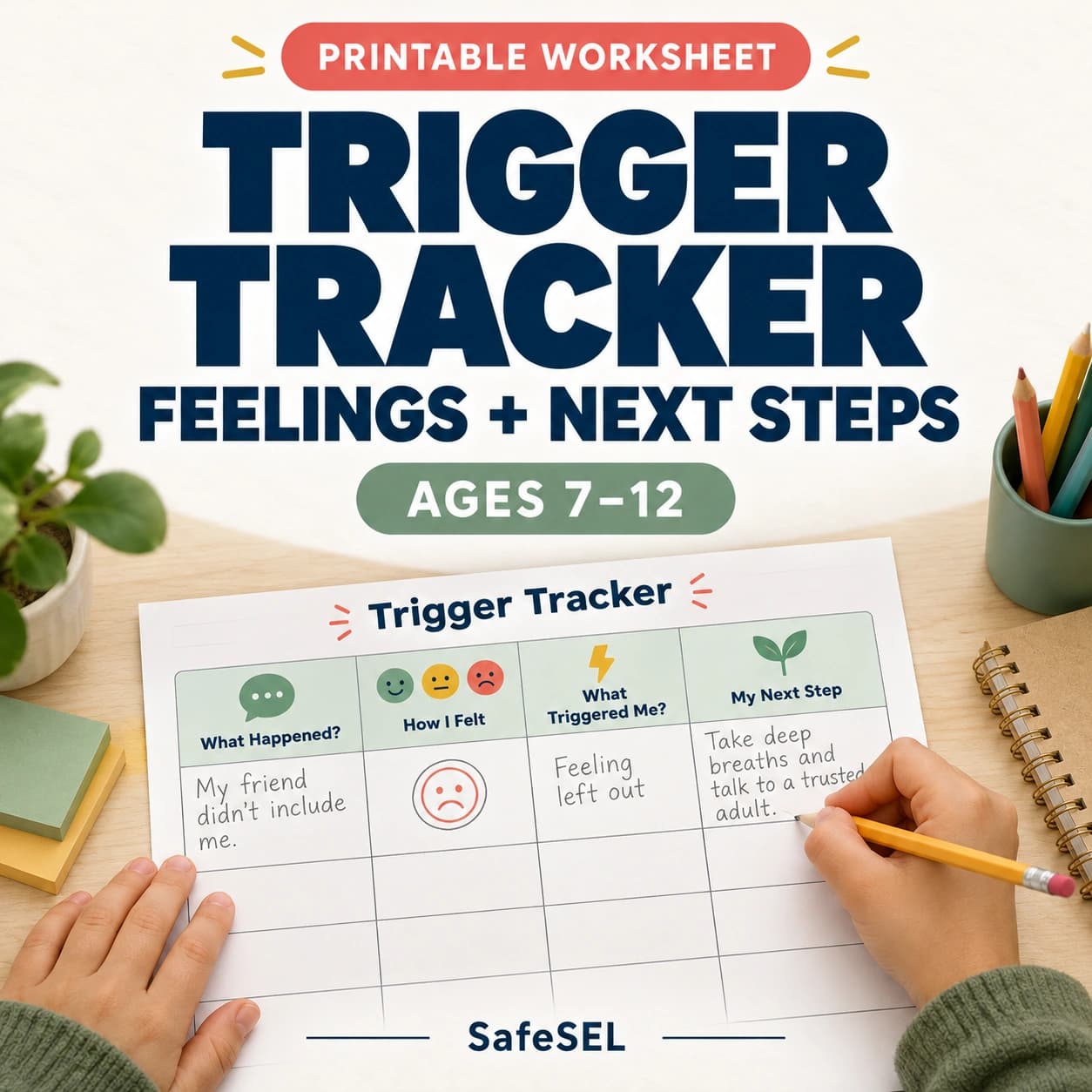
Goal 1: connecting situation, feeling, and action

A worksheet can help the child review:

  • what happened;
  • what they noticed in the body;
  • what they thought;
  • what they did;
  • what happened next.

This creates a more complete pattern than selecting one feeling word.

Goal 2: identifying triggers and repeated patterns

A child or adult can compare several situations and notice that distress increases during transitions, correction, unstructured time, or uncertainty.

Goal 3: creating a coping plan

A worksheet can connect a feeling or level of activation to:

  • one coping action;
  • an adult response;
  • a communication sentence;
  • a return plan;
  • a repair step.

Goal 4: reflection after a manageable event

When the child is calm enough, a worksheet can help organize a complex situation. It should not be used as forced reflection during peak distress.

Decision matrix

Skill goal — Emotion cards — Feelings worksheet — Combine both

--- — --- — --- — ---

Find a word or visual quickly — Best fit — May be too demanding — Cards first, brief note second

Explore mixed emotions — Very useful — Useful with enough space — Strong combination

Review one recent event — Limited detail — Best fit — Select cards, then complete only relevant sections

Support a child who does not write easily — Strong fit — Needs adaptation — Adult scribes after card selection

Create a coping plan — Useful as visual choices — Best fit for sequencing — Cards become the final choice menu

Run a classroom discussion — Strong fit — Better for private follow-up — Cards in group, worksheet individually

Track a pattern over days — Not designed for this — Strong fit — Cards can provide consistent labels

How to combine the tools in one short activity

A ten-minute sequence might look like this:

  1. Present six relevant emotion cards.
  2. Ask the child to choose one or two that fit the situation.
  3. Ask, “What did your body or mind do that matches this card?”
  4. Complete only three worksheet prompts:
  • what happened;
  • what I needed;
  • what I can try next.
  1. Choose one card to use as a reminder during the next similar situation.

The worksheet does not need to be completed in full.

When cards are a better choice

Choose cards when:

  • the child is young;
  • the child is tired or has limited attention;
  • writing is a barrier;
  • the group needs a shared visual language;
  • the goal is sorting, discussion, or role-play;
  • the child communicates by pointing, selecting, or using augmentative communication;
  • adults want a brief, low-pressure check-in.

When worksheets are a better choice

Choose worksheets when:

  • the child needs to sequence an event;
  • a repeated pattern is being reviewed;
  • the goal is a written home or school plan;
  • the child wants private reflection;
  • several pieces of information must be connected;
  • adults need a structured way to review progress;
  • the child benefits from seeing the completed plan later.

Accessibility matters more than format labels

A card is not automatically accessible because it contains a picture. A worksheet is not automatically inaccessible because it contains text.

Check whether the resource:

  • uses clear, age-respectful visuals;
  • avoids crowded pages;
  • allows pointing, drawing, speaking, typing, or adult scribing;
  • includes culturally and physically varied representations;
  • does not require interpretation of facial expressions as the only clue;
  • explains vocabulary;
  • offers enough choices without overwhelming the child.

CAST’s Universal Design for Learning guidance emphasizes multiple ways to perceive information and multiple ways to act and express understanding. The learning goal should remain the same even when the response method changes.

Common mistakes

Mistake 1: treating emotion naming as the whole skill

Knowing the word “frustrated” does not automatically help the child manage frustration, communicate a need, or solve the problem.

Mistake 2: requiring one correct card

Children may experience mixed emotions or interpret an illustration differently.

Mistake 3: using worksheets as consequences

A reflection page completed under pressure may become associated with shame rather than learning.

Mistake 4: selecting a huge set

Too many cards can make choice harder. Use a smaller group matched to the current activity.

Mistake 5: pushing disclosure

A child can participate in emotion learning through fictional scenarios without discussing a private experience.

A buyer’s checklist

For emotion cards, look for:

  • clear words and visuals;
  • intensity and nuance;
  • mixed-emotion possibilities;
  • age-respectful design;
  • more than one activity format;
  • accessible response options.

For worksheets, look for:

  • one clear goal per page;
  • realistic examples;
  • limited writing load;
  • room for uncertainty;
  • links to coping, communication, or action;
  • adult guidance;
  • no forced confession or moralizing language.

When to seek additional support

Difficulty identifying or expressing emotions can occur for many reasons and is not, by itself, a diagnosis. Seek individualized support when emotional distress, shutdown, aggression, anxiety, or participation difficulties are persistent, severe, or causing significant impairment across settings.

Educational tools can support communication and skill practice, but they cannot determine the cause of a child’s difficulties.

Related SafeSEL resources

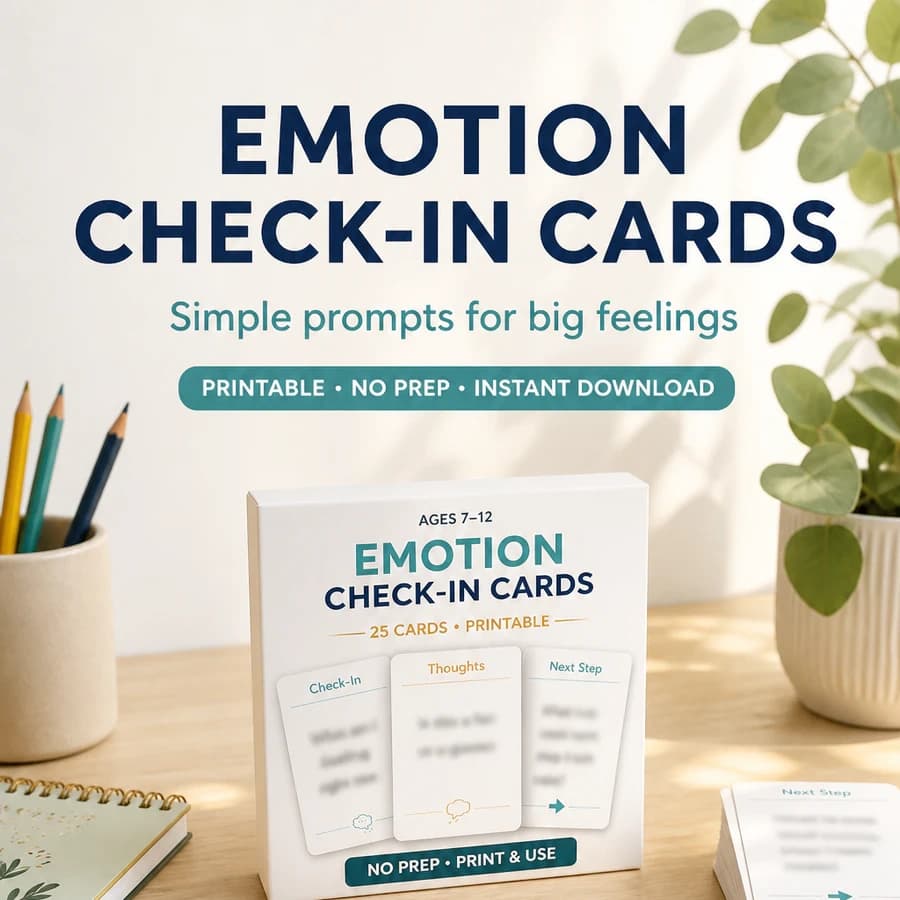
SafeSEL emotion cards can support quick selection, sorting, discussion, perspective-taking, and communication. Feelings and regulation worksheets can then help children connect emotions to body signs, thoughts, actions, coping choices, and repair.

The strongest combination is often: visual access first, structured reflection second, real-life practice next.

Sources and further reading

  1. What Is SEL? — Collaborative for Academic, Social, and Emotional Learning
  2. Explicit SEL Instruction — Collaborative for Academic, Social, and Emotional Learning
  3. The UDL Guidelines — CAST
  4. Expression and Communication — CAST
  5. Emotion Dysregulation Resource Center — American Academy of Child and Adolescent Psychiatry
  6. Child Development — Centers for Disease Control and Prevention
SafeSEL printables

Related resources

View all SEL products →
Continue reading

Related articles

Calm-Down Cards for Sensory and Communication Needs: What to Look For

Choose calm-down cards with sensory, movement, communication, and space options that can be individualized and used without relying on spoken

Read guide →

Emotion Cards in the Classroom: Five Uses Beyond Naming Feelings

Use emotion cards for intensity, perspective-taking, communication, scenario work, and private reflection—not only naming

Read guide →

How to Teach a Feelings Scale Without Turning It Into Compliance

A feelings scale is useful when it helps a student communicate intensity, notice change, and choose support. It becomes a compliance tool when adults require a “green” answer, dispute the student’s rating, or withhold access until the…

Read guide →