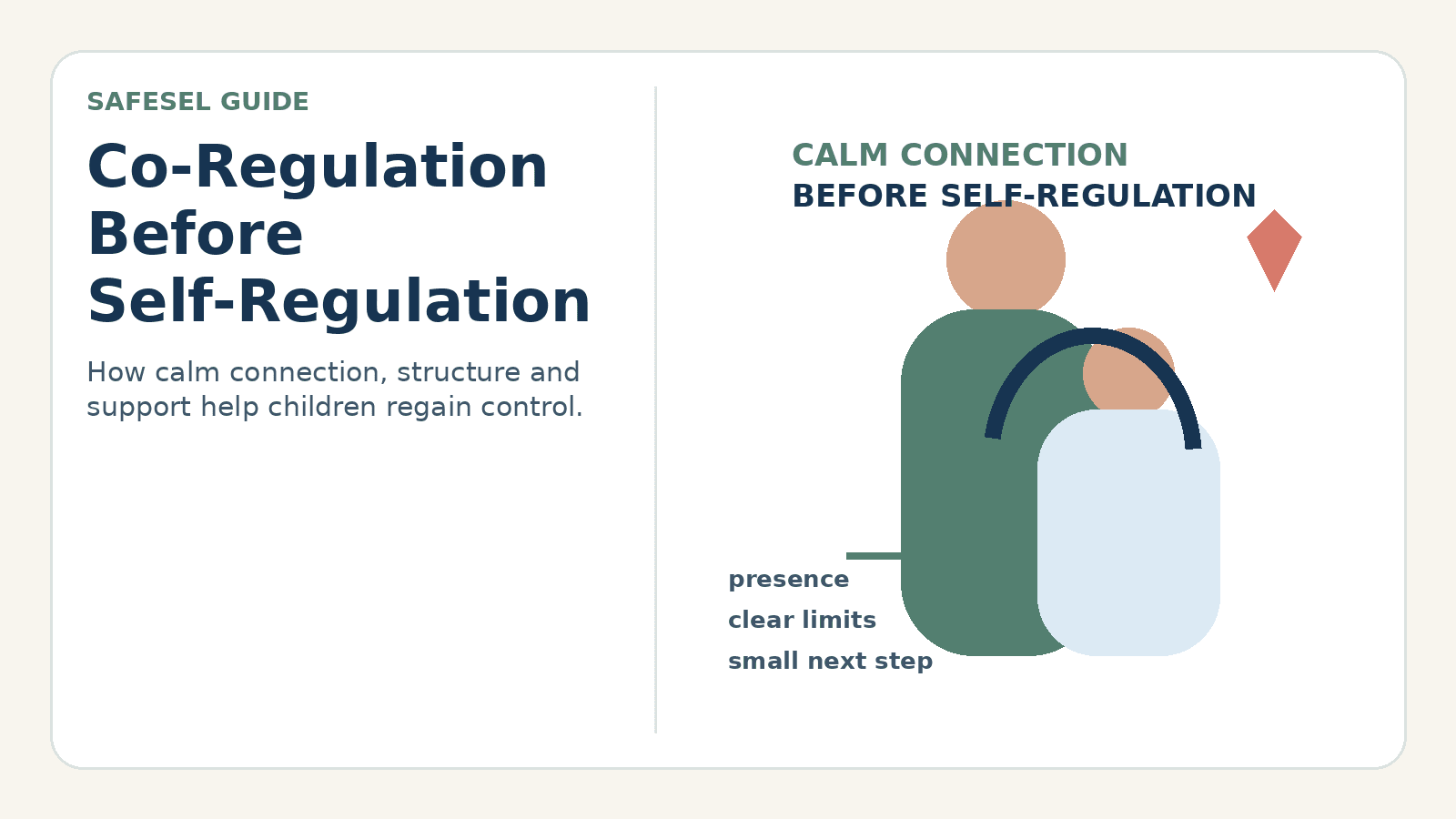
A family emotional-regulation plan creates shared language, predictable safety limits, individualised regulation options, and repair routines without requiring every family member to calm in the same way.
This guide is designed for educational and planning purposes. It does not provide a diagnosis or a universal protocol. Use the child’s development, communication, health, disability access needs, family context, culture, school environment, relationships, and safety conditions to adapt every recommendation.
In brief
A strong approach defines the target precisely, protects safety and dignity, reduces barriers unrelated to the target, teaches an observable skill or process, creates real-world practice, and reviews meaningful outcomes. The goal is not worksheet completion or emotional conformity.
Core framework
Area — What to examine — Practical implication
--- — --- — ---
Shared core — Family members know the safety rules and how to request space or help.
Individual differences — One person may need quiet, another movement, and another brief connection.
Adult responsibility — Caregivers hold boundaries and model repair without demanding equal performance from children.
Routines — Plans should fit meals, mornings, screens, homework, sibling conflict, and bedtime.
Repair — Family members return after conflict and address impact.
The framework is a working hypothesis. New information may show that the original explanation was incomplete. Adults should be willing to revise the plan instead of defending a preferred technique.
Assessment before action
Start with a decision question. What does the team need to know or change? Describe the context, task, people, first observable cue, adult response, immediate outcome, delayed outcome, and the child’s perspective. Screen medical, developmental, sensory, communication, bullying, safeguarding, and urgent safety concerns where relevant.
Distinguish the primary goal from secondary hopes. The primary goal might be attendance, communication, task initiation, boundary use, safe recovery, repair, or transfer of an SEL skill. “Feel better” and “behave appropriately” are too broad for a useful plan.
Collect only the information needed for a decision. Continuous monitoring can change family or classroom interactions and create a large record without improving support.
Step-by-step implementation
1. Identify recurring family pressure points
Use the child’s real setting rather than teaching the idea only in the abstract. Notice whether the step accidentally removes every opportunity to practise the target skill or, at the other extreme, demands performance in an unsafe or inaccessible setting.
2. Agree on two or three shared safety rules
Preserve the core goal while removing demands that are unrelated to that goal. Review several opportunities rather than one success or failure. Change one variable at a time so the team can learn what actually helped.
3. Create individual regulation options
Plan the first imperfect attempt instead of waiting for ideal motivation or calm. Rehearse the step before the high-pressure moment. The child can use speech, pointing, writing, drawing, role-play, or AAC when those modes fit the learning goal and access needs.
4. Define how space is requested and ended
Keep adult language brief during stress and save fuller reasoning for later. Notice whether the step accidentally removes every opportunity to practise the target skill or, at the other extreme, demands performance in an unsafe or inaccessible setting.
5. Plan adult coordination
Make the step observable and small enough to use during an ordinary day. Review several opportunities rather than one success or failure. Change one variable at a time so the team can learn what actually helped.
6. Teach return and repair
Define what the adult will do, what the child can do, and what will be reviewed. Rehearse the step before the high-pressure moment. The child can use speech, pointing, writing, drawing, role-play, or AAC when those modes fit the learning goal and access needs.
7. Review what works without comparing family members
Use the child’s real setting rather than teaching the idea only in the abstract. Notice whether the step accidentally removes every opportunity to practise the target skill or, at the other extreme, demands performance in an unsafe or inaccessible setting.
Worked examples
Example 1
One child uses movement, another chooses quiet, and a parent needs a brief pause before discussion.
In review, adults separate the immediate outcome from the longer-term learning and decide which part of the environment, instruction, communication, or support should change.
Example 2
Separated caregivers share the same reassurance phrase but keep different bedtime routines.
In review, adults separate the immediate outcome from the longer-term learning and decide which part of the environment, instruction, communication, or support should change.
Example 3
Sibling conflict includes a plan for protecting belongings and reconnecting later.
In review, adults separate the immediate outcome from the longer-term learning and decide which part of the environment, instruction, communication, or support should change.
Roles across home, school, and professional support
At home
Caregivers can connect practice to ordinary routines, provide emotional availability, hold clear limits, and observe patterns without turning family life into therapy. The task should be small enough to use and should not make the child responsible for adult disagreement.
At school
Teachers and counselors can protect access, privacy, and learning goals; use discreet cues; provide varied response modes; create return or transfer plans; and collect brief outcome data. School intervention must remain within professional scope and local policy.
In therapy or individualized support
Professionals can refine formulation, assess severity and differential possibilities, design developmentally appropriate experiments or rehearsal, support caregiver coordination, and identify when a generic resource is insufficient.
A two-week review cycle
During the first week, change only one or two variables and collect small samples from meaningful opportunities. Include ordinary successful moments, not only crises. At the end of the week, identify what made access easier or harder.
During the second week, adjust one variable: cue timing, task size, response mode, privacy, sensory input, adult language, or return structure. At review, continue, fade, redesign, or seek additional assessment. The plan should become clearer, not collect rules indefinitely.
Creating the shared family core
A family plan needs only a few shared elements.
Shared safety rules
Examples:
- no hitting, threatening, or damaging belongings;
- adults intervene when someone cannot stay safe;
- people may request space;
- space is not used to intimidate or abandon;
- repair happens after sufficient regulation.
Shared communication
Choose short phrases that all adults understand, such as:
- “I need space and I will check back in ten minutes.”
- “I can listen now, help solve, or give quiet.”
- “The limit is the same; the support can change.”
- “We will discuss impact after everyone is safe.”
Family members do not have to use identical words, but the meaning should remain predictable.
Individual regulation options
One person may need quiet, another movement, another a drink and brief connection. Children should not be forced to use the adult’s preferred method. At the same time, strategies must respect other people’s safety and space.
Planning for common family pressure points
Mornings
Reduce decisions, prepare materials, use a visible sequence, and identify the adult’s first response to delay or refusal.
After school
Some children need food, movement, quiet, or low-demand connection before questions and homework. This does not eliminate later responsibilities.
Homework
Clarify the first task, help route, break rules, and stopping point. Avoid turning every error into an emotional lesson.
Screens
Use visible endings, save points where possible, transition warnings, and a plan for safe response when the activity stops.
Sibling conflict
Protect belongings and physical space, teach boundary phrases, define adult intervention, and separate immediate safety from later repair.
Bedtime
Limit repeated reassurance, make the routine visible, and identify what happens when worries return after the agreed discussion.
Adults as part of the regulation system
Adults are not expected to remain perfectly calm. They are responsible for recognising when their own activation is affecting safety and communication.
An adult plan may include:
- pausing before responding;
- handing over to another caregiver;
- using a short boundary instead of a lecture;
- naming the need for a temporary pause;
- returning at the promised time;
- apologising and repairing after yelling or harshness.
Children learn from adult repair, not from adult perfection.
Different caregivers and households
Consistency means a small shared core, not identical homes. Caregivers can use different routines while agreeing on safety, reassurance responses, repair, and communication.
Do not ask the child to carry messages or enforce the plan between adults. Use a neutral communication channel and share only information needed for support.
Reviewing the family plan
Review whether:
- conflict becomes safer;
- requests for space occur earlier;
- adults follow through on return;
- family members use more precise communication;
- repair happens reliably;
- the plan reduces rather than increases monitoring;
- children retain developmentally appropriate autonomy.
Change one element at a time. A family plan should make daily life more workable, not turn the home into a treatment programme.
Helpful adult and professional language
- “We do not all have to calm in the same way.”
- “The safety rule is shared even when the strategy is different.”
- “Space needs a return or check-in plan.”
- “Adults repair too.”
Good language names the situation, preserves dignity, clarifies responsibility, and points to a usable next action. During high arousal, reduce words. During review, distinguish observation from interpretation.
Writing the family plan
Keep the written plan to one or two pages. Include:
- shared safety boundaries;
- individual early signs;
- preferred support options;
- how family members request space;
- who supervises younger children;
- how adults coordinate;
- when ordinary responsibilities resume;
- how repair occurs;
- what triggers urgent help;
- when the plan will be reviewed.
Use language the family will actually say. A perfect clinical script that nobody uses is less valuable than a respectful, concise phrase that feels authentic.
Place the plan where adults can access it without publicly displaying private information. Children may have a simplified visual or card, while adults keep the fuller safety and coordination details.
Review the plan after calm periods as well as conflicts. Ask what helped daily life go smoothly. Building from successful routines is often more effective than designing only around crises.
Common implementation mistakes
- Making one calm-down method mandatory. This can reduce trust, hide access needs, or produce data that does not answer the actual question.
- Using the family plan to monitor every mood. This can reduce trust, hide access needs, or produce data that does not answer the actual question.
- Expecting children to regulate adult conflict. This can reduce trust, hide access needs, or produce data that does not answer the actual question.
- Confusing consistency with identical households. This can reduce trust, hide access needs, or produce data that does not answer the actual question.
A further mistake is evaluating only whether the child complied or appeared calm. A child may participate meaningfully while anxious, disappointed, angry, quiet, or using an alternative communication mode.
Measuring meaningful outcomes
- Conflicts become safer
- Requests for help or space occur earlier
- Repair and reconnection become more predictable
Also measure adult consistency, amount of prompting, time to begin or return, access to help, and whether the child’s daily world is expanding or narrowing. Use several opportunities and a defined review date.
Practical questions
Should every family member use the same words?
A small shared core helps, but authentic language is better than rigid scripts.
Can a parent take space?
Yes, with safety, timing, and return clarified.
What if caregivers disagree?
Focus on the smallest child-centred shared principles.
When additional or urgent support is needed
Seek individualized assessment when concerns are persistent, severe, worsening, appear across settings, or substantially interfere with education, health, sleep, eating, communication, development, relationships, or family life. Involve medical, developmental, disability, mental-health, and school professionals as indicated.
Use urgent local procedures for credible threats, serious aggression, suicidal statements, suspected abuse, severe bullying, unsafe sexual content, or acute medical symptoms. Educational materials, small groups, home plans, and worksheets do not replace crisis assessment or safeguarding action.
Related SafeSEL resources
- Parent pillar: Parent Support: Connection, Limits, Routines, and Practice
- Suggested product line: Parent handouts / Home plans / Therapy support bundle
- Suggested free resource: Family Regulation Starter Pack
Before publication, replace planning labels with exact URLs and connect the guide to narrower articles that answer clearly different search questions.
Sources and further reading
- Family Intervention in Child and Adolescent Treatment — AACAP
- Stressful Experiences: How to Help Your Child Heal — HealthyChildren.org
- What’s the Best Way to Discipline My Child? — HealthyChildren.org
- Three Principles to Improve Outcomes for Children and Families — Harvard Center on the Developing Child
- Children and Mental Health: Is This Just a Stage? — NIMH