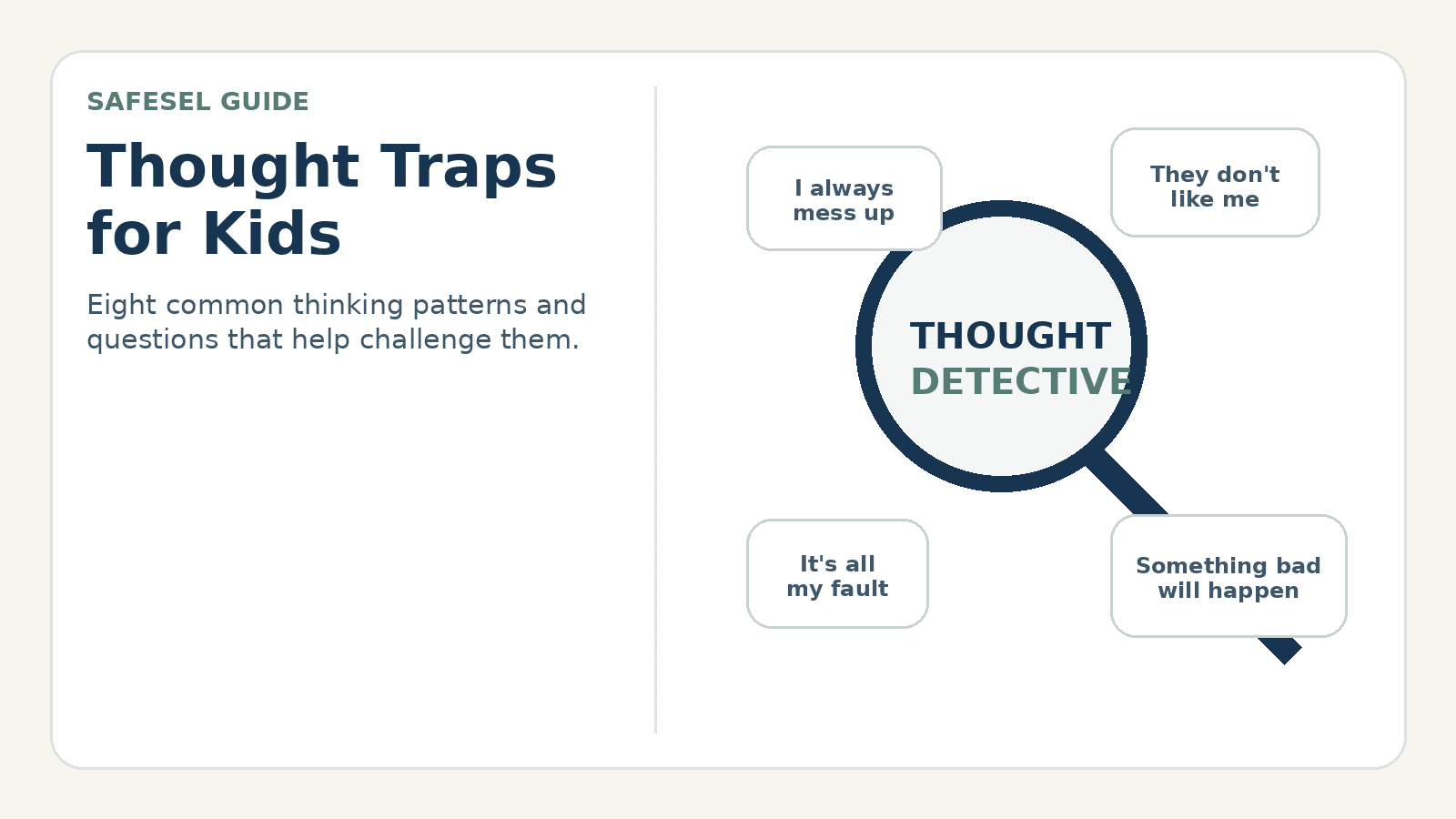
All-or-nothing thinking turns a mixed result into an absolute conclusion: “I missed one answer, so I’m terrible at math,” or “We argued, so she is not my friend.” Do not counter with an equally absolute positive claim. Help the child find the information between zero and one hundred percent.
In brief: Notice the absolute word, place the situation on a continuum, identify exceptions, and choose one action that fits the more precise picture.
Listen for Extreme Categories
Words such as always, never, everyone, nobody, perfect, ruined, best, and worst can signal a thought worth checking. They are not automatically distorted; “nobody is in the empty room” may be factual. Ask what the word means in this situation.
Try: “When you say the project is ruined, which part cannot be used and which part still works?” This invites detail without telling the child their feeling is wrong.
Use a Continuum
Draw a line from “not at all” to “completely.” Place the event using evidence. A test with eight correct answers out of ten does not belong at “complete failure,” even if the child feels deeply disappointed.
Then add two anchors: what would a slightly better result look like, and what would a genuinely worse result look like? This creates gradations that emotion may temporarily hide.
Find One Exception
Ask for a time the absolute statement was not fully true. If the child says, “I never finish anything,” recall one completed task without turning it into a lecture. The aim is not to defeat the child in debate but to widen the available data.
Pair the Thought With Action
A more balanced statement might be: “This part went badly, and I can ask how to revise it.” Then complete one step. Thought checking is most useful when it supports behavior, not when a child must produce an approved sentence.
What Commonly Backfires
- saying “That’s ridiculous” or “You’re being dramatic”;
- replacing “I failed” with “You are amazing”;
- demanding a positive thought during peak distress;
- using the worksheet to prove the adult is right;
- ignoring a real pattern of exclusion, difficulty, or unfairness.
When to Seek Support
Seek qualified help when rigid negative conclusions are persistent, cause significant anxiety or hopelessness, or interfere with school, sleep, relationships, or daily activities. Take self-harm or suicide statements seriously and use urgent local support.
Use the guidance in a real situation
When helping a child notice all-or-nothing thinking, choose one recent, specific example that fits the pattern; write down the event, the first observable sign of difficulty, the adult response, and what happened next so that a broad label does not replace the details needed for a useful decision.
Use “Listen for Extreme Categories” as the first action from the guide and define who will try it, where it will happen, and how long the first attempt will last; keep other parts of the routine stable so the result is interpretable.
Language and access
- In a conversation about helping a child notice all-or-nothing thinking, an adult might say “I am here. We can make the next step smaller.”
- In a conversation about helping a child notice all-or-nothing thinking, an adult might say “Show me whether you need less talking, more space, or help starting.”
When applying “Listen for Extreme Categories,” accept an accessible response format unless the format itself is the skill being taught; reduce unnecessary writing, public disclosure, sensory load, and rapid verbal demands.
Review what changed
To review helping a child notice all-or-nothing thinking, track earlier recognition of body cues, safer communication, use of one practiced support, shorter recovery, and return with less adult direction; compare several similar opportunities before concluding that the plan worked or failed, and alter only one major variable at a time.
In this guide to helping a child notice all-or-nothing thinking, do not interpret shutdown, tears, movement, or refusal from appearance alone; language processing, fatigue, pain, sensory load, fear, and task difficulty can produce similar outward behavior.
When to seek additional help
Seek individualized assessment when difficulty remains persistent, worsening, unsafe, or substantially affects learning, sleep, health, relationships, or daily life despite trying “Listen for Extreme Categories”; educational guidance cannot determine a diagnosis or replace appropriate professional care.
Use this guide as a starting point for helping a child notice all-or-nothing thinking, not as a fixed script; a useful plan remains specific enough to repeat, flexible enough to preserve access, and clear about which signs require a different level of support.
Before increasing difficulty in work on helping a child notice all-or-nothing thinking, compare the current attempt with the original example and ask whether “Listen for Extreme Categories” became easier, needed less prompting, or worked in one additional setting; record the support that was present, because a better result with support is useful evidence and does not need to be dismissed as dependence, and note what the child could do before and after that support was added.
Sources and further reading
- Treating Children's Mental Health with Therapy — Centers for Disease Control and Prevention
- Help Your Child Manage Anxiety: Tips for Home & School — American Academy of Pediatrics — HealthyChildren.org
- Enhancing and Practicing Executive Function Skills with Children from Infancy to Adolescence — Center on the Developing Child at Harvard University