← All guides
Anxiety

How to Help a Child Who Is Afraid to Use the School Bathroom

Practical steps for how to help a child who is afraid to use the school bathroom: what to notice, what to say, and how to build a safer, more usable

Written bySafeSEL Editorial TeamEducational content team

Fear of the school bathroom may involve noise, privacy, cleanliness, bullying, getting locked in, bodily embarrassment, or worry about missing class. Adults can respond more effectively when they separate the immediate task—safety, transition, communication, or support—from the later task of teaching. The aim is not to remove every difficult feeling. It is to make the next safe and learnable step clearer.

The direct answer

First, ask concrete questions rather than assuming the child is simply avoiding school. Next, create a graded plan such as entering with an adult, using a quiet time, then gradually increasing independence. The central goal is to identify the specific barrier, protect medical and toileting needs, and build a discreet approach plan with school staff. Children should not be shamed, denied reasonable bathroom access, or forced to hold urine or stool as a behavior strategy.

The first ten minutes matter

During a difficult moment, adults often move too quickly into explanation, correction, or questions. For this pattern, the first task is simpler: ask concrete questions rather than assuming the child is simply avoiding school. The second task is to protect the boundary: children should not be shamed, denied reasonable bathroom access, or forced to hold urine or stool as a behavior strategy. Teaching comes later.

A short sequence

  1. Notice the first cue.
  2. Reduce language and competing demands.
  3. State the safe option.
  4. Wait before repeating.
  5. Return to the issue only when participation is possible.

Why the situation is difficult

Uncertainty and prediction

Anxiety tries to obtain certainty about what will happen and whether the child will cope. Fear of the school bathroom may involve noise, privacy, cleanliness, bullying, getting locked in, bodily embarrassment, or worry about missing class.

Short-term relief

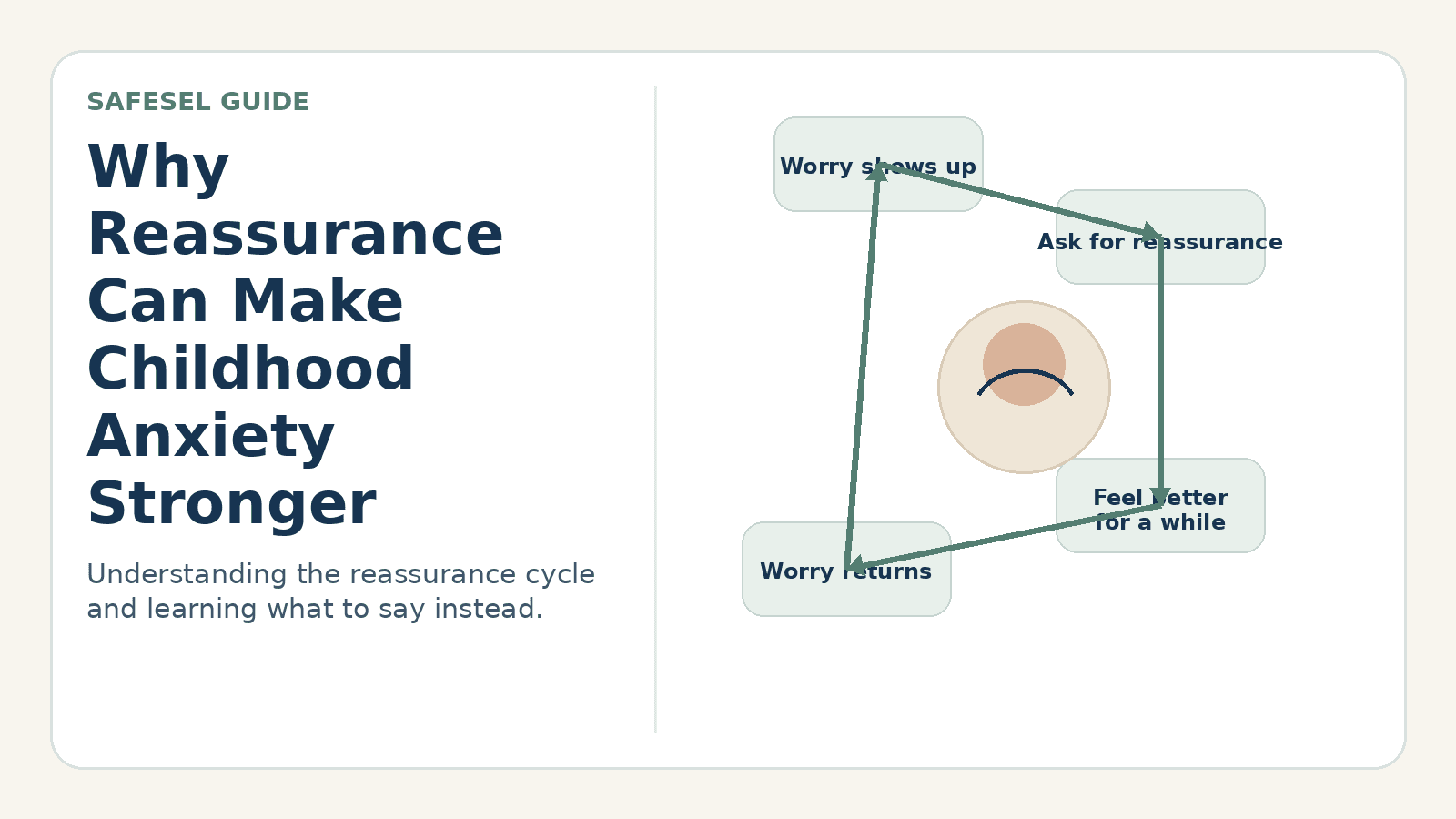
Avoidance, repeated reassurance, checking, or adult rescue can reduce distress immediately. That relief is powerful, but it can also prevent the child from learning that discomfort can rise and fall without the feared outcome occurring.

The size of the step

A step can be developmentally reasonable and still be too large for this child today. Good support does not remove every challenge; it adjusts the approach so that practice remains possible. create a graded plan such as entering with an adult, using a quiet time, then gradually increasing independence.

Real-world conditions

Anxiety should not be used to explain away actual problems such as bullying, pain, unsafe facilities, or unclear adult procedures. Before building a practice plan, adults should check the context: check the bathroom itself, access rules, hand dryers, locks, supervision, and whether an alternative restroom is available.

Prevention checklist

  • [ ] The adult has identified the exact trigger or demand
  • [ ] The first response uses one or two sentences
  • [ ] The child has an available alternative action
  • [ ] The limit can actually be enforced calmly
  • [ ] There is a return or repair step
  • [ ] The plan accounts for body state and environment

A checklist is not meant to make family life clinical. It prevents adults from relying on memory in the same high-stress moments when children are also struggling.

What the replacement skill should look like

Create a graded plan such as entering with an adult, using a quiet time, then gradually increasing independence. The skill should be brief enough to use in the real context and should include what happens next. “Take a break” is incomplete if the child does not know where to go, how to communicate, or how to return.

Relevant examples include: fear of loud hand dryers; worry that peers will hear or tease; or avoidance after a lock malfunction. Practice with the least intense version first.

A case example

Consider Nina. In one recent situation, fear of loud hand dryers. The adult’s first impulse is to explain why the reaction is unnecessary. Instead, the adult uses the agreed first move: ask concrete questions rather than assuming the child is simply avoiding school. This does not solve the whole problem, but it lowers the number of demands in the moment.

Later, when Nina is more available, they review another example: worry that peers will hear or tease. The adult does not ask for a perfect account. They identify one cue, practice one replacement response, and restate the boundary: children should not be shamed, denied reasonable bathroom access, or forced to hold urine or stool as a behavior strategy. The next attempt is measured by whether the plan was used earlier or more safely—not by whether the child felt no distress.

Language that supports without rescuing

  • “Which part feels unsafe: the room, the sounds, privacy, or being away from class?”
  • “We will make a private plan with the school.”
  • “You do not have to solve every step today.”
  • “Your body’s needs are not misbehavior.”

Four responses to avoid

  • Avoid public charts about bathroom use. This can increase shame, confusion, dependence on adult rescue, or escalation without teaching a usable alternative.
  • Avoid restricting fluids without medical advice. This can increase shame, confusion, dependence on adult rescue, or escalation without teaching a usable alternative.
  • Avoid forcing exposure without understanding the fear. This can increase shame, confusion, dependence on adult rescue, or escalation without teaching a usable alternative.
  • Avoid assuming the child is manipulating. This can increase shame, confusion, dependence on adult rescue, or escalation without teaching a usable alternative.

Questions adults frequently ask

Should I reassure the child?

Support and accurate information are helpful. Repeating certainty that no one can guarantee may strengthen the reassurance loop.

Should I make the child face the fear?

Do not force or surprise. Use gradual, collaborative steps after checking that the situation is genuinely safe.

What counts as progress?

Approaching sooner, staying slightly longer, using less reassurance, or recovering after discomfort can all represent progress.

When the plan needs changing

What adults observe — A possible interpretation — A useful next response

--- — --- — ---

Fear is mainly sensory — Environmental modification may help — Use quieter facilities or headphones where appropriate

Fear is social or privacy-based — Adult protection and discrete access are needed — Coordinate with school staff

There are physical symptoms — Medical assessment may be needed — Consult a pediatric professional

Use a brief review after two or three attempts:

  • Earlier cue: Did the child or adult notice the pattern sooner?
  • Safer action: Was there less harm, less intensity, or a more appropriate exit?
  • Participation: Could the child stay involved or return more effectively?
  • Support level: Did the child need the same amount of adult help?
  • Repair: Was impact addressed without prolonged shame?

The aim is not a perfectly calm performance. The aim is a more workable sequence. If there is no improvement, change one variable—timing, task size, cue, environment, or adult wording—rather than adding more consequences.

When to seek additional support

Additional support may be helpful when the pattern is frequent, worsening, or substantially interferes with school, sleep, health, friendships, or family functioning. Seek prompt professional advice when there is persistent aggression, property destruction, severe avoidance, repeated panic, significant toileting or medical symptoms, or a marked change from the child’s usual functioning. Do not assume that avoidance is anxiety when the child may be reporting pain, bullying, unsafe conditions, or another real problem.

Related SafeSEL resources

  • Parent guide: Childhood Anxiety: Practical Support Without Reinforcing Avoidance
  • Suggested product line: Anxiety worksheets / Parent anxiety handouts / Brave Steps resources
  • Free practice resource: Worry Pattern Tracker

Sources and further reading

  1. Emotional Issues and Bathroom Problems — American Academy of Pediatrics
  2. Help Your Child Manage Anxiety — American Academy of Pediatrics
  3. What to Do (and Not Do) When Children Are Anxious — Child Mind Institute
  4. 10 Tips for Parenting Anxious Kids — Child Mind Institute
  5. Fears & Phobias in Children — American Academy of Pediatrics
  6. School Avoidance — American Academy of Pediatrics
SafeSEL printables

Related resources

View all Anxiety products →
Continue reading

Related articles

Anticipatory Anxiety Before Medical or Dental Appointments

Practical steps for anticipatory anxiety before medical or dental appointments: what to notice, what to say, and how to build a safer, more usable

Read guide →

What to Do When a Child Is Anxious Before Birthday Parties

Practical steps for what to do when a child is anxious before birthday parties: what to notice, what to say, and how to build a safer, more usable

Read guide →

What to Do When a Child Uses a Calm Corner to Avoid Returning

Practical steps for what to do when a child uses a calm corner to avoid returning: what to notice, what to say, and how to build a safer, more usable

Read guide →