Parents often leave a child therapy session with good intentions and too much information. A useful handout does not try to summarize an entire treatment model. It helps the family remember one idea and use one small action in daily life.
In brief
Choose parent handouts that are focused, practical, respectful, and connected to an individualized goal. A strong handout explains why a response may help, shows what it looks like, acknowledges limits, and gives the parent a realistic way to review what happened.
What parents need after a session
A parent may need to remember:
- the purpose of a strategy;
- when to use it;
- what to say;
- what not to expect immediately;
- how to adapt it;
- what information to bring back to therapy.
A handout should reduce cognitive load, not create a new homework burden.
Quality feature 1: one clear purpose
A handout titled “Supporting Big Feelings” is too broad unless it narrows the task. Better topics include:
- what to say during reassurance seeking;
- how to respond during the peak of a meltdown;
- how to support one brave step;
- how to review a conflict after everyone is calm;
- how to notice an avoidance pattern.
The reader should be able to state the purpose in one sentence.
Quality feature 2: non-blaming language
Parents are less likely to use a resource that implies they caused the problem or have been responding incorrectly because they do not care.
Use language such as:
“Repeated reassurance often develops because both the child and adult are trying to reduce distress quickly.”
Avoid:
“Parents reinforce anxiety by giving in.”
The first describes a pattern and opens space for change.
Quality feature 3: observable actions
“Provide co-regulation” is not enough.
A usable handout might say:
“Use one short validating sentence, lower the amount of language, and offer one next step.”
Or:
“Before answering the same worry again, ask the child what they already know and which coping statement they want to use.”
Quality feature 4: realistic expectations
The handout should explain that a helpful response may not make the child calm immediately. The aim may be:
- maintaining safety;
- reducing escalation;
- helping the child remain in the situation;
- increasing recovery;
- practising one step;
- collecting useful information.
This protects parents from judging a strategy only by whether distress disappeared.
Quality feature 5: adaptation
Families differ in routines, culture, time, language, sensory needs, and available support.
A handout should offer choices:
- spoken or visual prompts;
- shorter and longer versions;
- options for different ages;
- alternatives when writing is difficult;
- guidance for separated caregivers or school-home coordination.
Quality feature 6: boundaries and safety
A responsible handout states when the strategy is not enough. It should not present a printable as treatment for severe anxiety, aggression, trauma, or safety risk.
It should also protect privacy. Tracking should focus on situations and responses, not create detailed surveillance of every emotion.
Quality feature 7: a review question
End with one or two questions:
- “What was the difficult moment?”
- “What did the adult try?”
- “What changed, even slightly?”
- “What support was missing?”
The purpose is collaborative learning, not grading the parent.
Information handouts vs practice handouts
Information handouts
These explain a concept, such as the avoidance cycle, co-regulation, or why repeated reassurance can maintain worry.
Practice handouts
These guide a small action, such as a brave-step plan, repair conversation, or one-week support plan.
A bundle should include both. Information without action is hard to apply. Practice without explanation can feel arbitrary.
How therapists can introduce a handout
Do not hand over a stack at the end of a session.
A short introduction is more effective:
- link the handout to the family’s stated goal;
- circle the one section that matters this week;
- adapt the language together;
- decide when the action will be tried;
- agree that partial use is still useful information.
Example:
“You described the hardest moment as the repeated questions before bed. Let’s use only this one-page reassurance plan and review what happened next week.”
How parents can use handouts without over-monitoring
A worksheet does not need to be completed after every event. Choose one or two representative situations.
Track:
- context;
- the child’s likely goal or difficulty;
- the adult response;
- what happened next;
- one adjustment.
Avoid rating the child as good, cooperative, dramatic, or manipulative.
One-page quality rubric
A strong handout answers yes to most questions:
- Is the topic narrow and clear?
- Does it explain why the strategy may help?
- Are the actions observable?
- Is the tone non-blaming?
- Are expectations realistic?
- Are adaptations offered?
- Are safety limits stated?
- Is there one review question?
- Can it be read quickly?
- Does it fit the therapy goal?
Buyer checklist
When choosing a parent bundle, look for:
- practical topics rather than broad psychoeducation only;
- parent scripts that sound natural;
- separate plans for anxiety, anger, meltdowns, and repair;
- space for individualized notes;
- clear age guidance;
- professional design without dense text;
- educational disclaimers;
- no diagnostic claims;
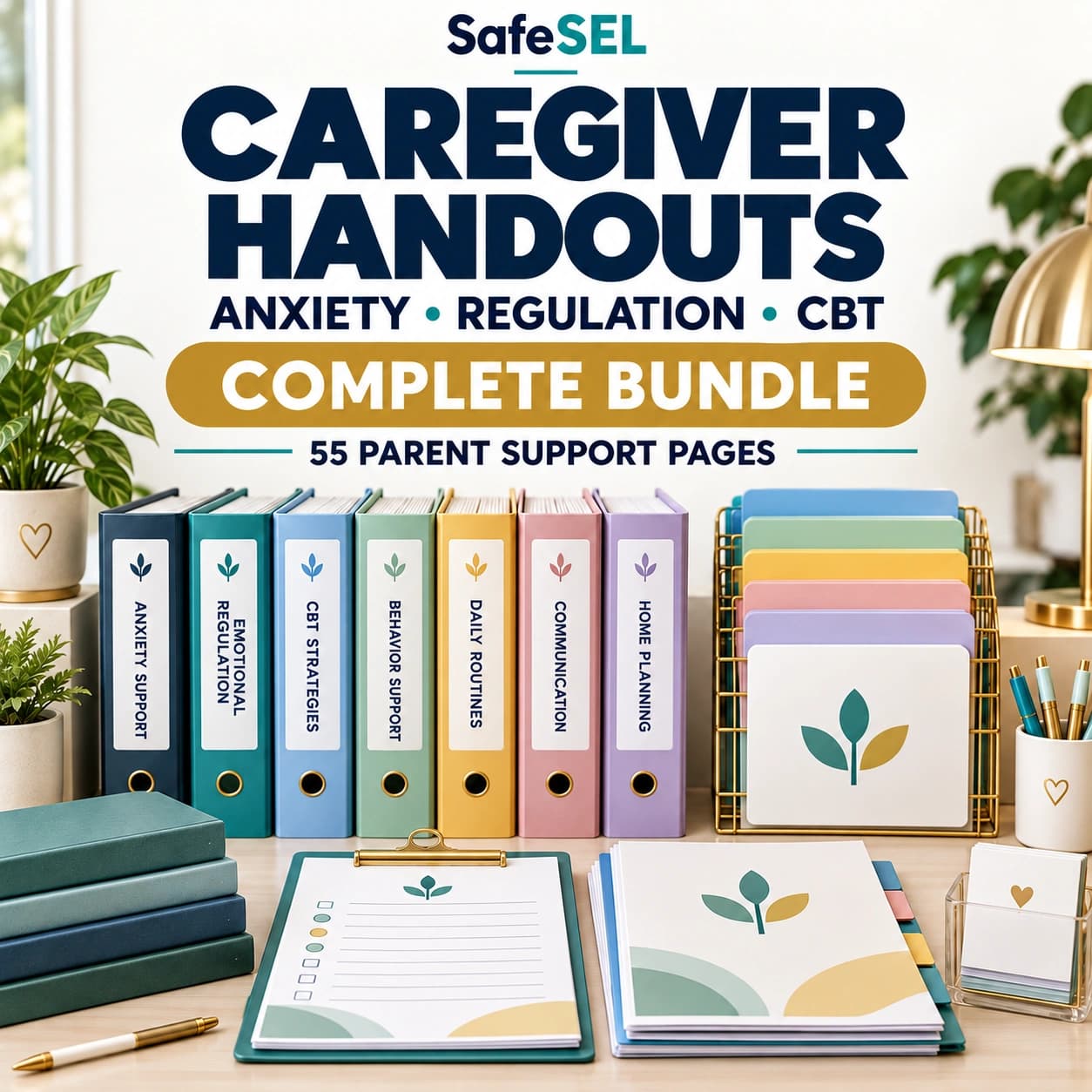
- resources that a therapist can select individually rather than give all at once.
When to seek additional support
Contact the treating clinician or another qualified professional when symptoms intensify, functioning worsens, safety is a concern, or the family cannot implement a plan without significant conflict. Handouts should support care, not replace it.
Related SafeSEL resources
A useful parent library may include anxiety pattern trackers, anger trackers, meltdown response plans, reassurance guides, brave-step plans, and repair conversation sheets.
What a handout should not promise
Be cautious with resources that promise to stop meltdowns, eliminate anxiety, fix defiance, or produce rapid emotional control. A handout cannot determine why a behavior occurs or replace an individualized formulation. Responsible materials describe likely mechanisms, practical options, and limits.
The same caution applies to neuroscience language. Statements about a child’s “thinking brain going offline” may be useful metaphors, but they should not be presented as precise explanations of every event.
Organizing a handout library
Therapists and practices can organize handouts by clinical task rather than by diagnosis alone: understanding a pattern, responding during distress, practising a skill, tracking one situation, and reviewing repair. This makes it easier to choose one relevant page. Parents should not receive an entire bundle unless there is a clear reason and guidance about where to begin.
Sources and further reading
- Psychotherapy for Children and Adolescents: Different Types — American Academy of Child and Adolescent Psychiatry
- Social Anxiety Disorder: Recognition, Assessment and Treatment — National Institute for Health and Care Excellence
- Children and Mental Health — National Institute of Mental Health
- Children’s Mental Health — Centers for Disease Control and Prevention
- UDL Guidelines — CAST
- CASEL Framework — Collaborative for Academic, Social, and Emotional Learning