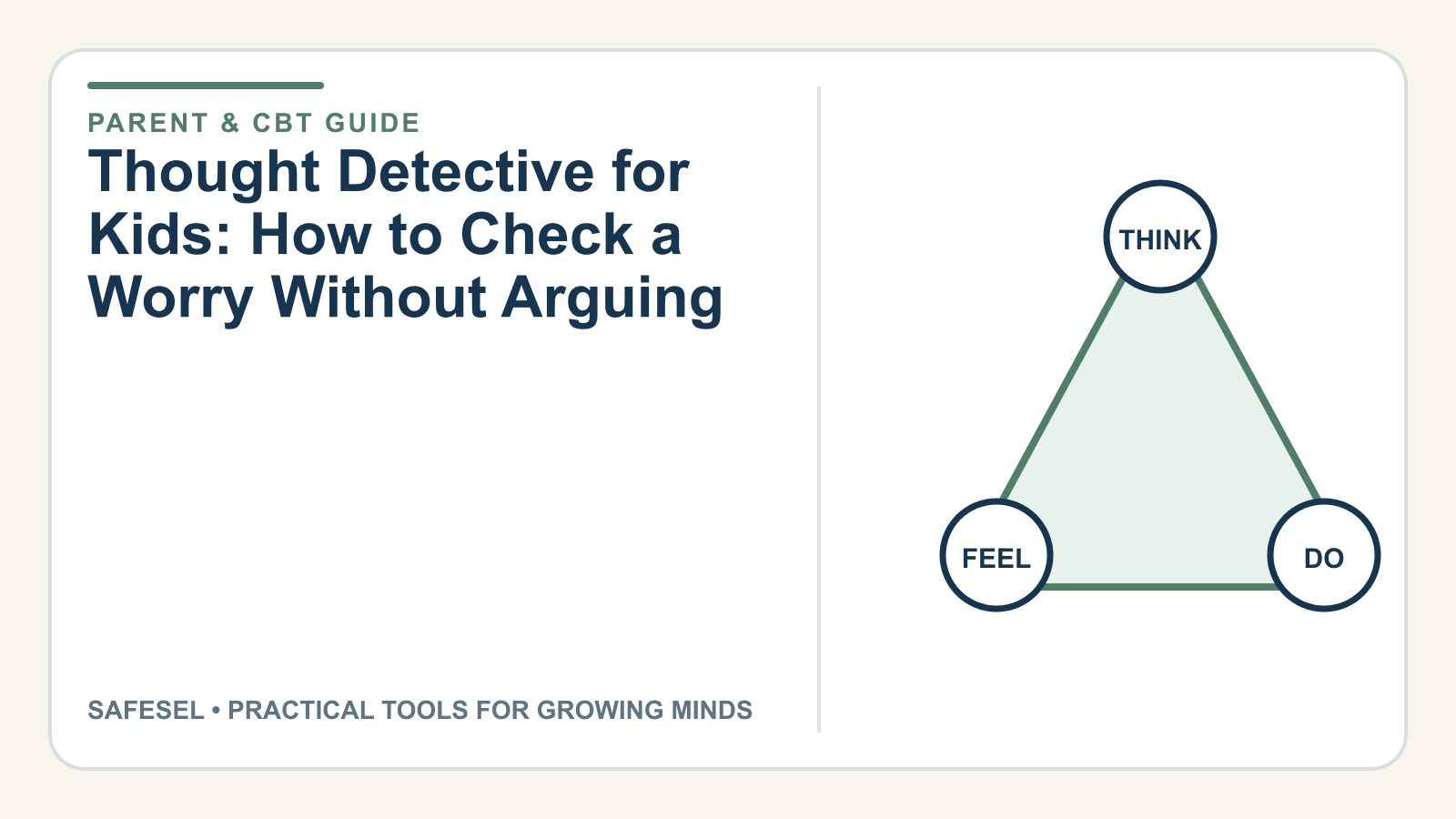
A thought record helps a child slow down one moment and examine a prediction. It is not a form for correcting “negative thinking,” and it should not be completed while the child is highly activated.
In brief: Use one recent, specific situation. Write the child’s own words, distinguish thoughts from feelings, look at evidence on both sides, and create a believable—not artificially positive—alternative.
Keep the Structure Short
Use five boxes:
- What happened? “The teacher returned my math page.”
- What did your mind say? “I got everything wrong.”
- What feeling and body signal showed up? Embarrassed; hot face.
- What supports or does not fully support the thought? Two corrections; eight answers correct.
- What is a fairer thought and next action? “I made two mistakes and can ask about the first one.”
If writing is a barrier, the adult can scribe, use drawings, or offer choices. Preserve the child’s meaning rather than translating it into clinical language.
Avoid the Positivity Trap
“Everything will be fine” may feel unbelievable. A balanced thought makes room for uncertainty: “I might make a mistake, and I can correct one step.” Do not use the record to debate realistic concerns such as bullying or unsafe conditions; those require adult action.
End With Behavior
A thought record should lead to a small experiment, coping choice, request for help, or plan. Otherwise it can become rumination on paper. Review later whether the alternative thought helped the child act—not whether they endorsed the adult’s answer.
Use the guidance in a real situation
When using a thought record with an elementary-age child, choose one recent, specific example that fits the pattern; write down the event, the first observable sign of difficulty, the adult response, and what happened next so that a broad label does not replace the details needed for a useful decision.
Use “Keep the Structure Short” as the first action from the guide and define who will try it, where it will happen, and how long the first attempt will last; keep other parts of the routine stable so the result is interpretable.
Language and access
- In a conversation about using a thought record with an elementary-age child, an adult might say “What happened, and what did your mind predict?”
- In a conversation about using a thought record with an elementary-age child, an adult might say “What do we know, what are we guessing, and what could we check?”
When applying “Keep the Structure Short,” accept an accessible response format unless the format itself is the skill being taught; reduce unnecessary writing, public disclosure, sensory load, and rapid verbal demands.
Review what changed
To review using a thought record with an elementary-age child, track more precise descriptions of thoughts, generation of a second plausible explanation, willingness to test a prediction, and choices guided by evidence rather than certainty; compare several similar opportunities before concluding that the plan worked or failed, and alter only one major variable at a time.
In this guide to using a thought record with an elementary-age child, do not argue a child out of a fear, require a positive statement they do not believe, or use a worksheet while arousal blocks reflection; check facts, uncertainty, safety, communication, and access before challenging an interpretation.
When to seek additional help
Seek individualized assessment when difficulty remains persistent, worsening, unsafe, or substantially affects learning, sleep, health, relationships, or daily life despite trying “Keep the Structure Short”; educational guidance cannot determine a diagnosis or replace appropriate professional care.
Use this guide as a starting point for using a thought record with an elementary-age child, not as a fixed script; a useful plan remains specific enough to repeat, flexible enough to preserve access, and clear about which signs require a different level of support.
Before increasing difficulty in work on using a thought record with an elementary-age child, compare the current attempt with the original example and ask whether “Keep the Structure Short” became easier, needed less prompting, or worked in one additional setting; record the support that was present, because a better result with support is useful evidence and does not need to be dismissed as dependence, and note what the child could do before and after that support was added.
Sources and further reading
- What Is the CASEL Framework? — CASEL
- Enhancing and Practicing Executive Function Skills with Children from Infancy to Adolescence — Center on the Developing Child at Harvard University
- Communication Skills Start at Home — American Academy of Pediatrics — HealthyChildren.org