← All guides
SEL

What to Look for in a Calm-Down Corner Kit for Children

Choose a calm-down corner kit with clear entry, limited tools, visual choices, adult guidance, accessibility, and a return-to-activity

Written bySafeSEL Editorial TeamEducational content team

A calm-down corner should be a taught support for regulation and return—not a decorated place where children are sent away when adults are frustrated. The quality of a kit depends less on the number of posters and more on whether it helps children understand how to enter, what to do, how adults respond, and how participation resumes.

In brief

A useful calm-down corner kit includes a clear purpose, an entry signal, a small menu of regulation options, simple visual guidance, adult response instructions, and a return path. It should be accessible, age-respectful, and separate from punishment. Avoid kits that rely on crowded posters, forced reflection, timers used as threats, or a universal list of coping skills.

The purpose of the space

A calm-down corner may help a child:

  • reduce stimulation;
  • pause before behavior becomes unsafe;
  • communicate a need for space;
  • use a familiar regulation strategy;
  • recover after a strong emotional moment;
  • prepare to return to learning, play, or conversation.

It should not be used to:

  • remove a child because adults do not want to deal with emotion;
  • isolate a child indefinitely;
  • require calmness before basic support is offered;
  • replace investigation of bullying or other safety concerns;
  • avoid teaching or adapting a difficult task;
  • force the child to complete reflection work during peak distress.

Essential component 1: a clear entry system

Children need to know how the space is used.

Possible entry routes include:

  • the child uses a break card;
  • the child points to a visual;
  • the adult offers a private prompt;
  • the child moves there according to a pre-agreed plan;
  • the adult directs the child there only when safety requires it.

The system should clarify whether the child needs permission, how to communicate when speech is difficult, and what happens when the space is already occupied.

Useful language:

“You can use the break card and move to the calm space. I will check in after the timer, and we will decide the next step.”

Essential component 2: a limited tool menu

A corner does not need twenty sensory items and fifteen coping posters. Too much choice can increase overload.

A small menu might include:

  • one visual breathing option;
  • one movement or pressure option;
  • one communication card;
  • headphones or another sensory support when appropriate;
  • paper for drawing or writing;
  • a simple emotion or body scale;
  • water access if feasible;
  • a visual “return” sequence.

Select tools based on actual use. Remove items that become distracting, unsafe, stigmatizing, or ineffective.

Essential component 3: visual guidance that can be used under stress

When a child is highly activated, long explanations are difficult to process.

Visuals should be:

  • concise;
  • uncluttered;
  • readable at the child’s developmental level;
  • respectful for older children;
  • available in more than one communication mode when needed.

A simple sequence may be:

  1. Signal or move to the space.
  2. Choose one support.
  3. Adult checks in.
  4. Choose: return, request help, or use the agreed next step.

Avoid posters filled with inspirational language that does not tell the child what to do.

Essential component 4: an adult-response guide

A calm corner cannot work consistently if each adult responds differently.

The kit should clarify:

  • how adults prompt the space privately;
  • how much language to use;
  • whether adults stay nearby;
  • how safety limits are maintained;
  • how to respond if the child refuses the space;
  • how to avoid arguing during escalation;
  • when a separate safety plan is required;
  • how the child returns.

A brief adult script can help:

“I can see this is getting hard. You can use the calm space or sit beside me with the break card. I will not let anyone be hurt. We will solve the problem after your body has more room to think.”

Essential component 5: a return path

A break without a return plan can unintentionally become a way to escape every difficult demand.

The return path should answer:

  • How will the child know the break is ending?
  • Who checks in?
  • Does the child return to the same task, a reduced first step, or another agreed activity?
  • What support is available during return?
  • When is the original task postponed for a legitimate reason?
  • What happens if the child is still not ready or safe?

A visual return sequence may be:

  1. Check body level.
  2. Choose one support for returning.
  3. Complete the first small step.
  4. Review later.

Calm corner vs. punishment space

Calm-down support — Punishment space

--- — ---

Taught before distress — Introduced during conflict

Can be requested by the child — Used mainly as adult removal

Offers a small set of supports — Offers isolation or inactivity

Includes a return plan — Ends when the adult decides the child is compliant

Does not require public disclosure — May involve public correction or shame

Part of a broader regulation plan — Replaces teaching and problem-solving

The physical location may look similar, but the function is different.

How to introduce the corner

Teach it during a calm period.

  1. Explain the purpose in one or two sentences.
  2. Show how to request the space.
  3. Demonstrate each tool.
  4. Practise choosing one tool.
  5. Practise returning to a simple activity.
  6. Ask the child what would make the space more or less helpful.
  7. Review after real use.

Do not wait for a major outburst before the child sees the materials.

Accessibility and sensory cautions

A kit should support different ways of responding. CAST’s UDL guidance emphasizes multiple means of perception, action, and expression.

Consider:

  • picture, symbol, text, or object cues;
  • pointing, speech, gesture, or augmentative communication;
  • reduced visual clutter;
  • lighting and noise;
  • safe seating and movement;
  • motor access;
  • age-respectful design;
  • whether sensory tools are actually preferred by the child.

A sensory item is not automatically calming. Some textures, movements, sounds, or breathing tasks may increase discomfort. Test tools collaboratively.

What should not be included

Avoid or reconsider:

  • mandatory apology forms;
  • long behavior reflections;
  • public behavior charts;
  • timers used as threats;
  • slogans suggesting the child chooses all emotions;
  • universal instructions to make eye contact or sit still;
  • unsafe sensory equipment without supervision;
  • a large box of distracting toys;
  • materials that infantilize older children;
  • promises that the corner will stop meltdowns.

A quality checklist

Essential

  • clear purpose;
  • entry/request visual;
  • limited coping menu;
  • adult guide;
  • return sequence;
  • accessibility options;
  • safety boundaries.

Helpful but optional

  • emotion scale;
  • body-sign visual;
  • privacy screen that remains safely observable;
  • drawing or writing tools;
  • brief timer or check-in cue;
  • home-school shared language.

Avoid

  • forced completion tasks;
  • indefinite isolation;
  • reward or punishment language as the main mechanism;
  • too many choices;
  • no return plan;
  • use as a substitute for individualized support.

When a calm corner is not enough

A child may need an individualized safety, behavioral, sensory, medical, or mental-health plan when distress is frequent, severe, prolonged, or involves significant aggression, self-harm, elopement, trauma concerns, or major disruption across settings.

A calm corner is one environmental support. It cannot determine why a child is struggling or replace professional assessment.

Related SafeSEL resources

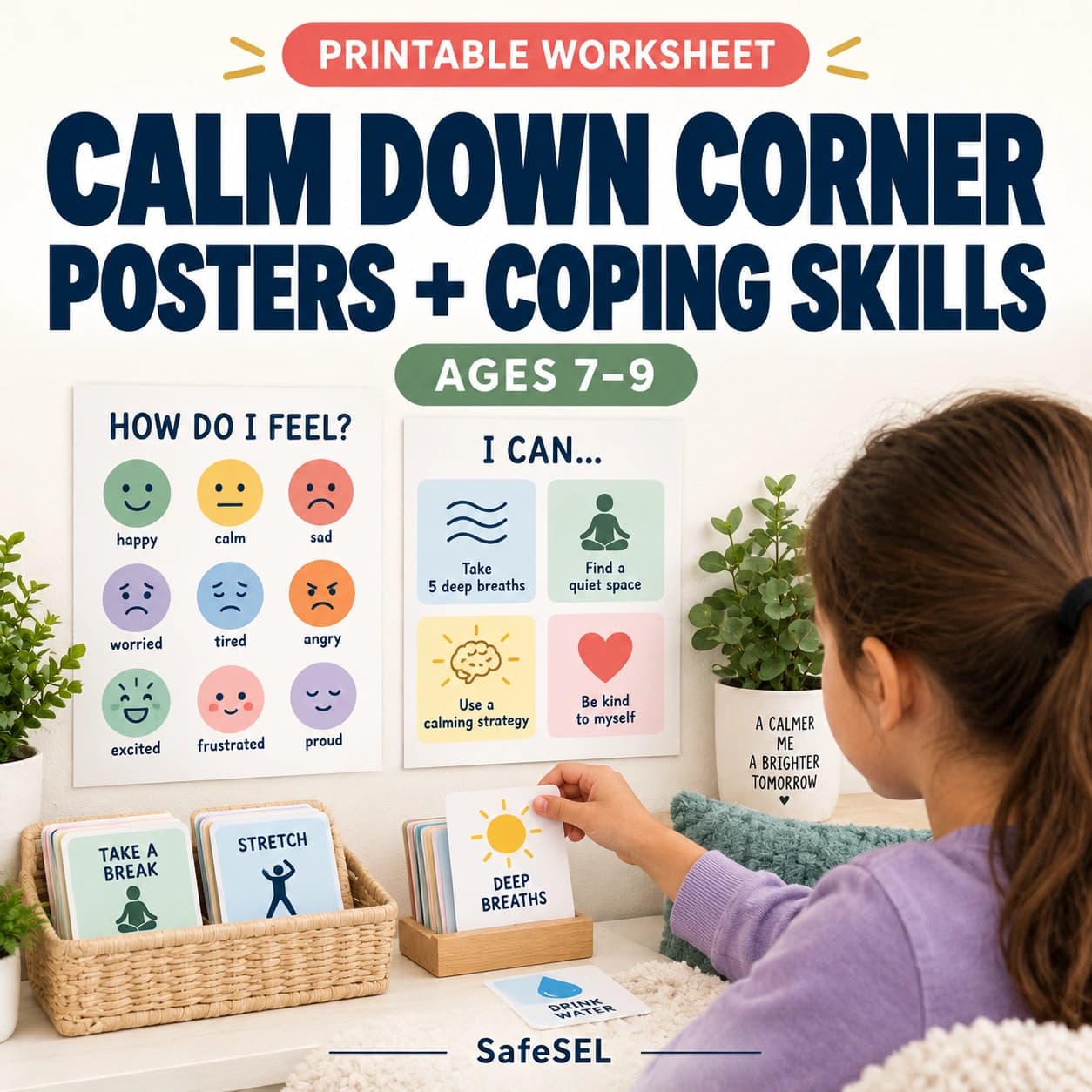
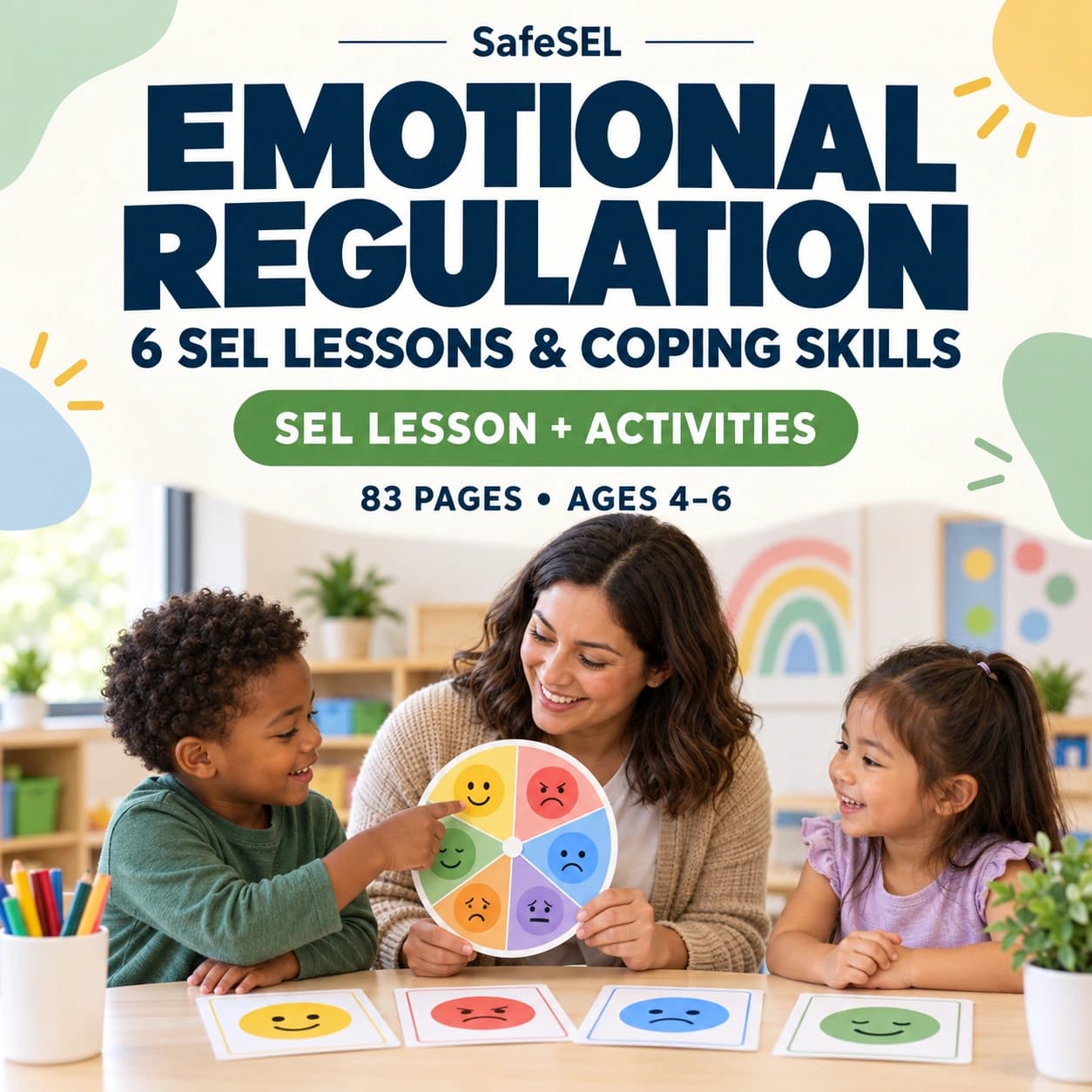
SafeSEL calm-down materials can include:

  • break/request cards;
  • emotion and body-level visuals;
  • a small coping menu;
  • return-to-activity steps;
  • parent or teacher response guides;
  • reflection and repair tools used later, when appropriate.

Choose a kit that helps the child rejoin life—not disappear from it.

Sources and further reading

  1. What Is the CASEL Framework? — Collaborative for Academic, Social, and Emotional Learning
  2. Explicit SEL Instruction — Collaborative for Academic, Social, and Emotional Learning
  3. The UDL Guidelines — CAST
  4. Action and Expression — CAST
  5. Emotion Dysregulation Resource Center — American Academy of Child and Adolescent Psychiatry
  6. Child Development — Centers for Disease Control and Prevention
SafeSEL printables

Related resources

View all SEL products →
Continue reading

Related articles

Calm-Down Tools for Kids: How to Build a Useful Set

A large basket of sensory items can look impressive but become distracting or inaccessible. A useful set is small, taught, portable enough for its setting, and connected to a clear return plan.

Read guide →

How to Build a Return Plan From the Calm Corner to Learning

Practical, developmentally respectful guidance on how to build a return plan from the calm corner to learning. Use clear steps, supportive language, and

Read guide →

A Calm Corner vs. a Break Area vs. a Removal Space

Practical, developmentally respectful guidance on a calm corner vs. a break area vs. a removal space, with examples, decision steps, adult language,

Read guide →