← All guides
SEL

Why Deep Breathing Does Not Help Every Child Every Time

Practical guidance on why deep breathing does not help every child every time. Learn what to notice, what to say, and how to build a safer, more usable

Written bySafeSEL Editorial TeamEducational content team

Deep breathing can help some children at some times, but it may feel uncomfortable, increase attention to bodily sensations, require too much control, or simply not match the child’s need. Adults can respond more effectively when they separate the immediate task—safety, transition, communication, or support—from the later task of teaching. The aim is not to remove every difficult feeling. It is to make the next safe and learnable step clearer.

A quick answer for the difficult moment

First, if breathing increases distress, stop and choose a lower-demand alternative. Next, experiment with gentle exhale-focused breathing during calm periods and compare it with other tools. The central goal is to treat breathing as one option, not the universal test of regulation. A child should not be punished for refusing or “doing breathing wrong.”

Do not begin by asking “Why?”

During stress, “why” questions can require memory, self-observation, language, and a willingness to accept the adult’s framing. Begin with what can be observed. The key contextual factors for this topic are asthma or medical concerns, panic sensitivity, hyperventilation, breathing used to silence legitimate protest.

Five decision points

Is anyone unsafe?

If yes, move people, secure objects, or obtain appropriate help. Keep language brief. Safety action is not the time for proving a point.

Is the situation accessible?

Offer multiple categories of support: movement, sensory input, connection, problem-solving, and paced exhalation. Check whether the child has the information, sensory access, time, and communication route needed to participate.

Is the adult asking for a choice the child can make?

If breathing increases distress, stop and choose a lower-demand alternative. If the child cannot process several options, narrow them.

Is the boundary specific?

A child should not be punished for refusing or “doing breathing wrong.” Boundaries work better when they describe action rather than character.

Is there a return?

Record what happened and refine the coping plan based on function, not popularity. Without a return step, breaks, exits, or consequences can leave the original skill untouched.

What may be happening

Arousal changes access to skills

Regulation is not simply knowing the name of a strategy. When arousal is high, working memory, language, flexible thinking, and impulse control may all be less available. Deep breathing can help some children at some times, but it may feel uncomfortable, increase attention to bodily sensations, require too much control, or simply not match the child’s need.

The function of the support

A tool is useful when it helps the child become safer, communicate a need, remain involved, or return to an activity. A child who looks still but is shut down, frightened, or unable to re-engage may not be meaningfully regulated.

Co-regulation and independence

Adult support is not the opposite of self-regulation. Children often learn by borrowing structure, language, and calm from a reliable adult, then taking over small parts of the plan as the sequence becomes familiar.

Context and body state

Sleep, food, sensory load, excitement, pain, and transition demands can change the child’s capacity. Prevention includes more than teaching: offer multiple categories of support: movement, sensory input, connection, problem-solving, and paced exhalation.

A small practice ladder

  1. Discuss one mild example.
  2. Identify the earliest cue.
  3. Adult models the replacement phrase.
  4. Child tries the first action with support.
  5. Repeat in a slightly more realistic context.
  6. Review what helped without grading the emotion.

The practice target is: experiment with gentle exhale-focused breathing during calm periods and compare it with other tools.

Example and adult response

Consider Eli. In one recent situation, dizziness during large breaths. The adult’s first impulse is to explain why the reaction is unnecessary. Instead, the adult uses the agreed first move: if breathing increases distress, stop and choose a lower-demand alternative. This does not solve the whole problem, but it lowers the number of demands in the moment.

Later, when Eli is more available, they review another example: panic when focusing on heartbeat. The adult does not ask for a perfect account. They identify one cue, practice one replacement response, and restate the boundary: a child should not be punished for refusing or “doing breathing wrong.” The next attempt is measured by whether the plan was used earlier or more safely—not by whether the child felt no distress.

Short language options

  • “Breathing is one tool, not the rule.”
  • “Would movement or pressure fit better?”
  • “Try a slow exhale only if it feels okay.”
  • “We are looking for what helps you do the next step.”

If the response keeps failing

  • Avoid commanding “take a deep breath” repeatedly. This can increase shame, confusion, dependence on adult rescue, or escalation without teaching a usable alternative.
  • Avoid very large forced inhalations. This can increase shame, confusion, dependence on adult rescue, or escalation without teaching a usable alternative.
  • Avoid assuming visible calm equals regulation. This can increase shame, confusion, dependence on adult rescue, or escalation without teaching a usable alternative.
  • Avoid using one technique for every state. This can increase shame, confusion, dependence on adult rescue, or escalation without teaching a usable alternative.

Failure may mean that the cue was too late, the demand too large, the support too verbal, or the real problem was not the one adults assumed. Change one part and test again.

A brief review form

After the next attempt, record only five items: the first cue, the adult’s opening sentence, the child’s available action, whether safety was maintained, and whether a return occurred. Keep the note factual. “Refused to cooperate” gives little planning information; “covered ears, moved behind the desk, and did not respond to three verbal choices” is more useful. The purpose of tracking is to improve support, not to create a permanent record of the child’s hardest moments.

Age and autonomy

Ages 4–6 usually need more adult-led structure, immediate visual cues, and physical demonstration. Ages 7–9 can use a short plan and compare options. Ages 10–12 should have more privacy and input, but adults still provide boundaries and safety.

Quick comparison

What adults observe — A possible interpretation — A useful next response

--- — --- — ---

Breathing feels neutral — It may be usable with practice — Keep it brief

Breathing increases dizziness or panic — Interoceptive focus may be unhelpful — Stop and ground externally

Child needs movement — Arousal may require active regulation — Use safe heavy work or walking

When to seek additional support

Additional support may be helpful when the pattern is frequent, worsening, or substantially interferes with school, sleep, health, friendships, or family functioning. Seek prompt professional advice when there is persistent aggression, property destruction, severe avoidance, repeated panic, significant toileting or medical symptoms, or a marked change from the child’s usual functioning.

Related SafeSEL resources

  • Parent guide: Emotional Regulation in Children: Skills, Support, and Recovery
  • Suggested product line: Emotion cards / Calm-down plans / Emotional regulation toolkit
  • Free practice resource: Coping Skill Match Sheet

Sources and further reading

  1. What Is the CASEL Framework? — CASEL
  2. How Can We Help Kids With Self-Regulation? — Child Mind Institute
  3. How to Help Children Calm Down — Child Mind Institute
  4. A Guide to Executive Function — Harvard Center on the Developing Child
  5. The Importance of Family Routines — American Academy of Pediatrics
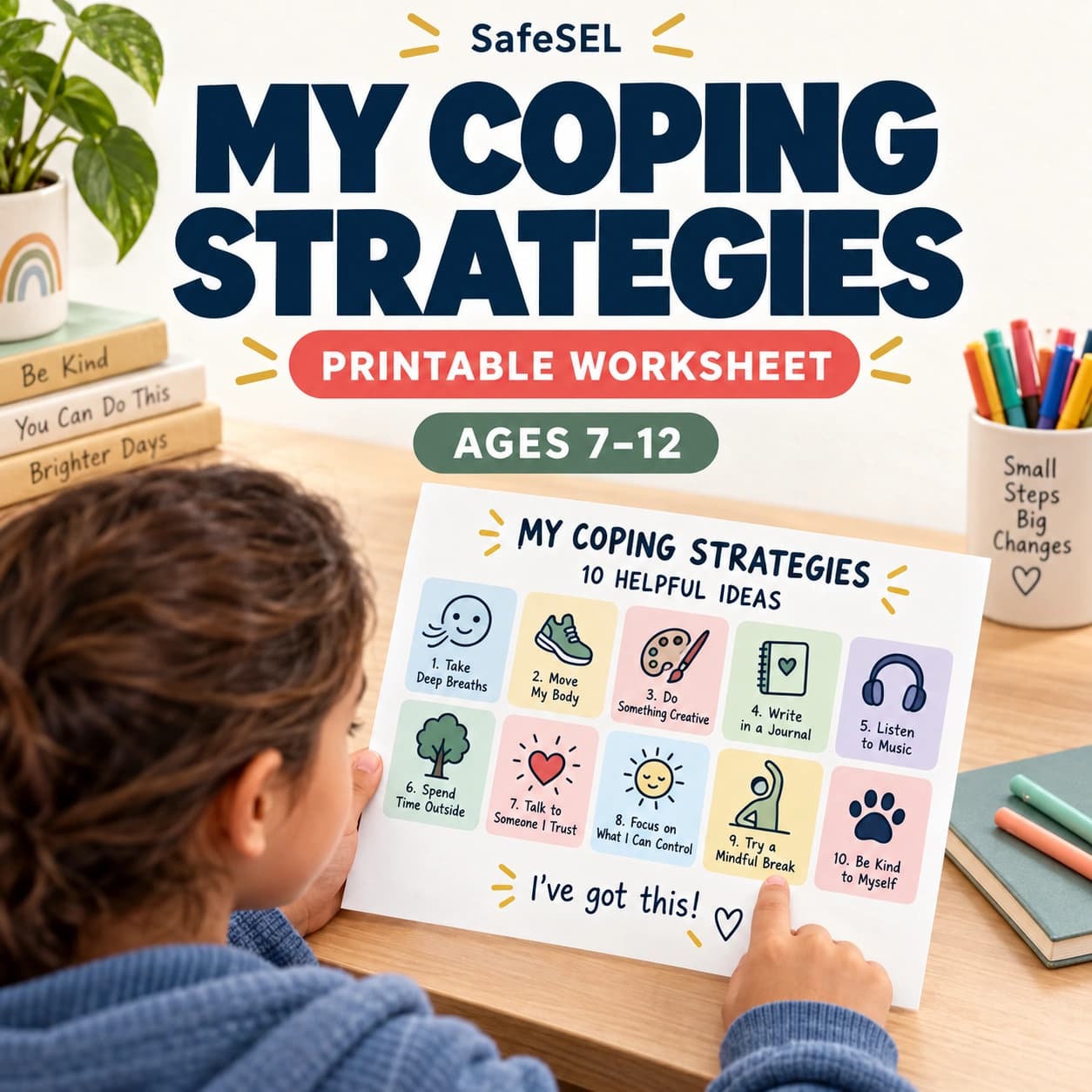
SafeSEL printables

Related resources

View all SEL products →
Continue reading

Related articles

When a Child Rejects Every Calm-Down Suggestion

Practical guidance on when a child rejects every calm-down suggestion. Learn what to notice, what to say, and how to build a safer, more usable

Read guide →

Why Unstructured Time Can Lead to Dysregulation

Practical guidance on why unstructured time can lead to dysregulation. Learn what to notice, what to say, and how to build a safer, more usable

Read guide →

How to Help a Child Recover After the Peak of a Meltdown

Practical guidance on how to help a child recover after the peak of a meltdown. Learn what to notice, what to say, and how to build a safer, more usable

Read guide →