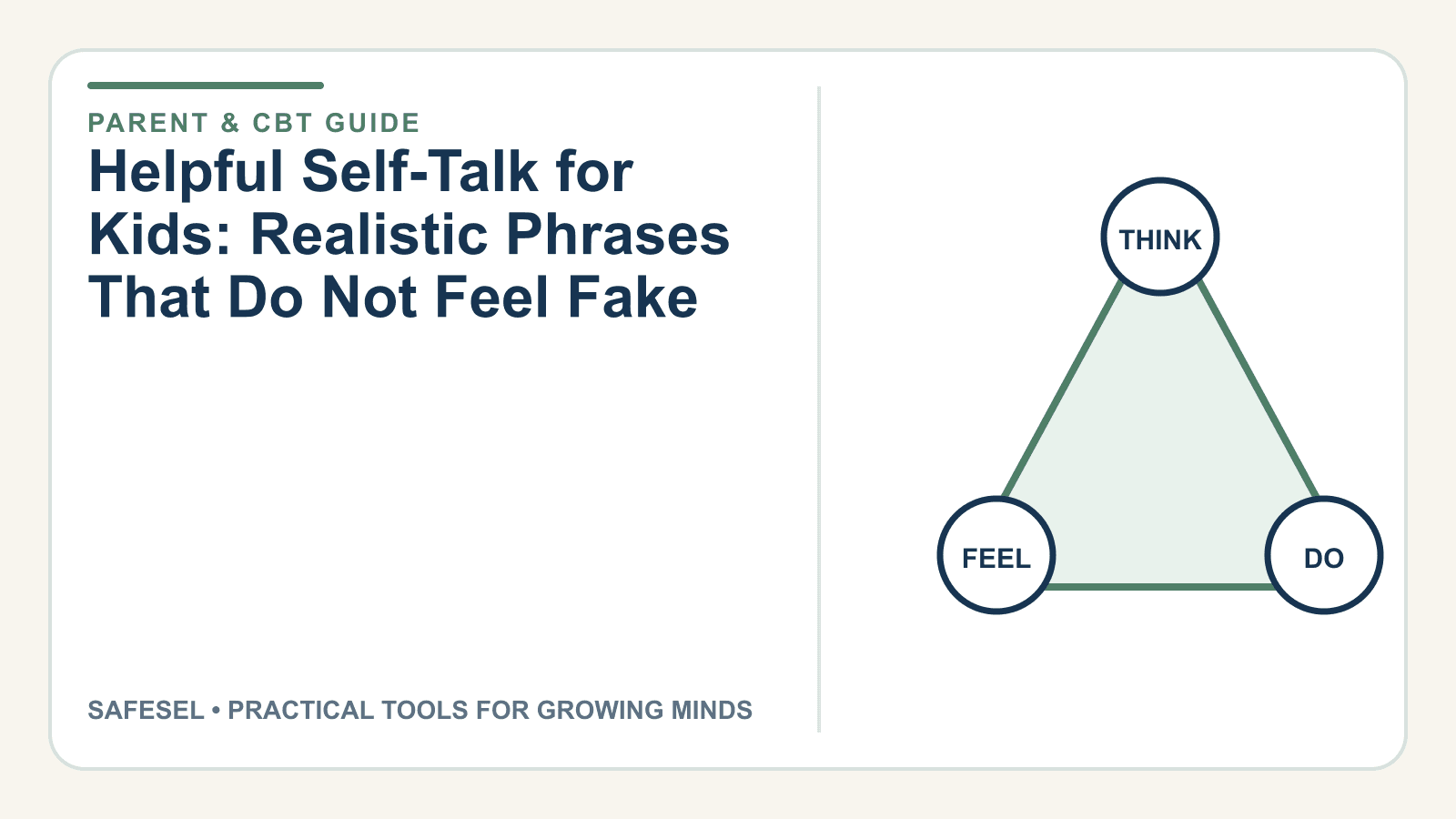
Cognitive behavioral therapy examines links among situations, interpretations, emotions, body responses, and actions. With children, effective work is developmentally adapted, practical, collaborative, and often includes caregivers.
Important: A worksheet using CBT vocabulary is not therapy. Qualified professionals assess the child, select methods, monitor response, and adapt for safety, development, disability, family context, and diagnosis where relevant.
Core Ideas in Everyday Language
- Minds make fast predictions that may be useful, incomplete, or exaggerated.
- Feelings and body responses provide information but do not prove every prediction.
- Avoidance can bring short relief while keeping fear untested.
- Small planned actions can gather new information.
- Balanced thinking is believable and evidence-aware, not forced positivity.
- Practice across contexts helps skills become available under stress.
Explore the SafeSEL CBT Library
- Start with the CBT triangle for children.
- Learn how to use a child-friendly thought record.
- Plan a small behavioral experiment.
- Distinguish coping strategies from safety behaviors.
- Support shutdown after mistakes.
- Understand why balanced thoughts may feel fake.
A Parent’s Role
Parents can model curiosity, reduce shame, support agreed practice, notice accommodation patterns, and share observations with the professional. Do not run high-distress exposure, challenge realistic danger, or abruptly remove necessary support without guidance.
- Choose CBT coping cards
- Select worry activities
- Reassurance versus confidence-building
- Browse CBT resources
Use the guidance in a real situation
When addressing CBT for children, choose one recent, specific example that fits the pattern; write down the event, the first observable sign of difficulty, the adult response, and what happened next so that a broad label does not replace the details needed for a useful decision.
Use “Core Ideas in Everyday Language” as the first action from the guide and define who will try it, where it will happen, and how long the first attempt will last; keep other parts of the routine stable so the result is interpretable.
Language and access
- In a conversation about CBT for children, an adult might say “First this small step, then the agreed next part.”
- In a conversation about CBT for children, an adult might say “Would you like a reminder, a model, or two minutes before you begin?”
When applying “Core Ideas in Everyday Language,” accept an accessible response format unless the format itself is the skill being taught; reduce unnecessary writing, public disclosure, sensory load, and rapid verbal demands.
Review what changed
To review CBT for children, track fewer repeated prompts, a smaller delay before starting, clearer requests for help, safer expression, and a more reliable return to the routine; compare several similar opportunities before concluding that the plan worked or failed, and alter only one major variable at a time.
In this guide to CBT for children, changing several rules after one difficult evening obscures the real barrier; consider fatigue, hunger, transitions, sibling dynamics, task size, and competing demands before adding consequences.
When to seek additional help
Seek individualized assessment when difficulty remains persistent, worsening, unsafe, or substantially affects learning, sleep, health, relationships, or daily life despite trying “Core Ideas in Everyday Language”; educational guidance cannot determine a diagnosis or replace appropriate professional care.
Use this guide as a starting point for CBT for children, not as a fixed script; a useful plan remains specific enough to repeat, flexible enough to preserve access, and clear about which signs require a different level of support.
Before increasing difficulty in work on CBT for children, compare the current attempt with the original example and ask whether “Core Ideas in Everyday Language” became easier, needed less prompting, or worked in one additional setting; record the support that was present, because a better result with support is useful evidence and does not need to be dismissed as dependence, and note what the child could do before and after that support was added.
Sources and further reading
- Treating Children's Mental Health with Therapy — Centers for Disease Control and Prevention
- Help Your Child Manage Anxiety: Tips for Home & School — American Academy of Pediatrics — HealthyChildren.org
- Enhancing and Practicing Executive Function Skills with Children from Infancy to Adolescence — Center on the Developing Child at Harvard University