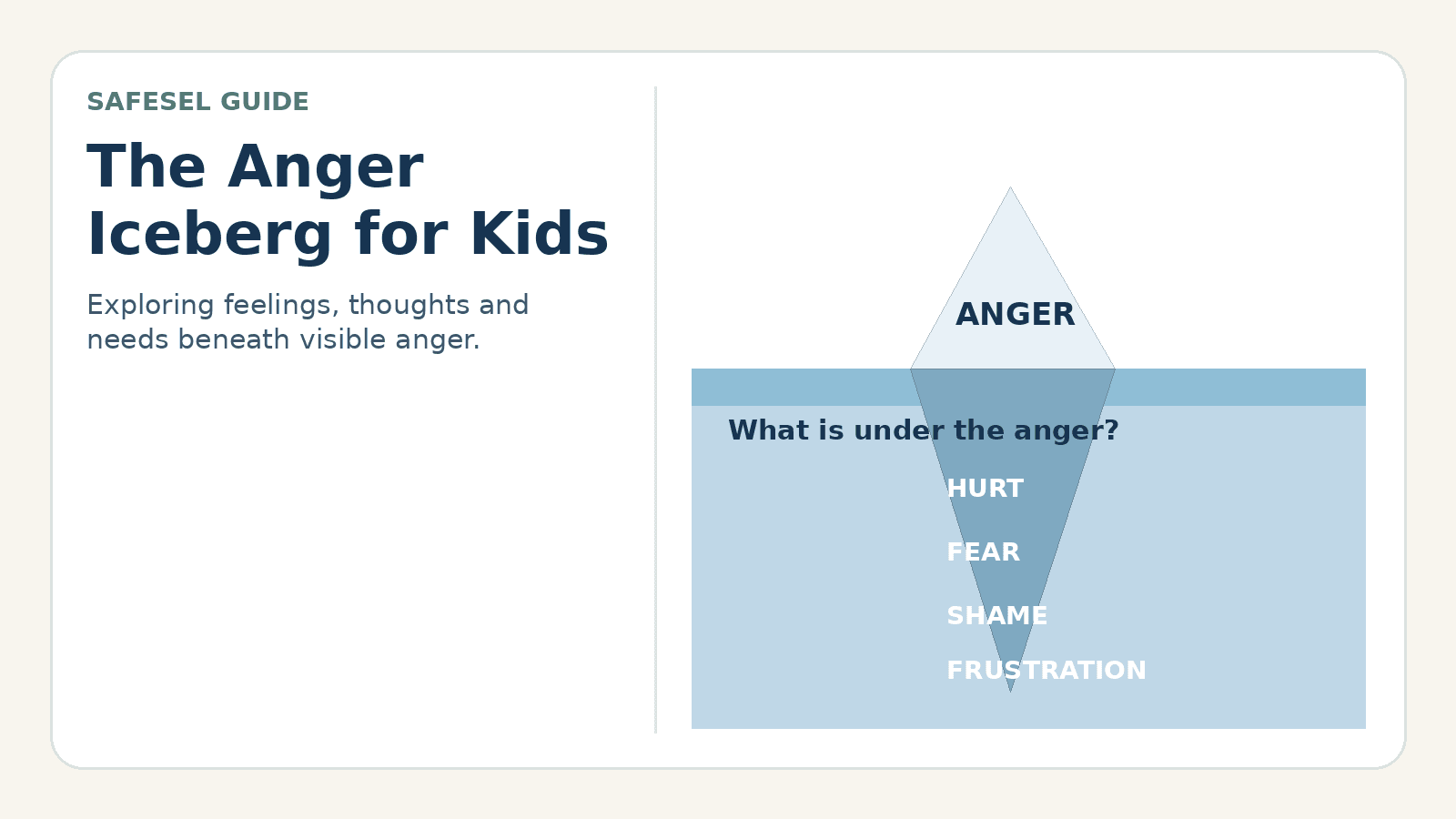
CBT-informed support for anger combines trigger and meaning analysis, body awareness, flexible thinking, behavior planning, consequences connected to impact, and repair.
This guide is designed for educational and planning purposes. It does not provide a diagnosis or a universal protocol. Use the child’s development, communication, health, disability access needs, family context, culture, school environment, relationships, and safety conditions to adapt every recommendation.
In brief
A strong approach defines the target precisely, protects safety and dignity, reduces barriers unrelated to the target, teaches an observable skill or process, creates real-world practice, and reviews meaningful outcomes. The goal is not worksheet completion or emotional conformity.
Core framework
Area — What to examine — Practical implication
--- — --- — ---
Trigger — What happened immediately before anger rose?
Appraisal — What did the child believe the event meant about fairness, threat, shame, control, or rejection?
Body and action — What signs appeared and what did the child do next?
Maintaining pattern — What adult, peer, escape, or consequence sequence followed?
Learning — Which thought, communication, coping, problem-solving, or repair skill is missing?
The framework is a working hypothesis. New information may show that the original explanation was incomplete. Adults should be willing to revise the plan instead of defending a preferred technique.
Assessment before action
Start with a decision question. What does the team need to know or change? Describe the context, task, people, first observable cue, adult response, immediate outcome, delayed outcome, and the child’s perspective. Screen medical, developmental, sensory, communication, bullying, safeguarding, and urgent safety concerns where relevant.
Distinguish the primary goal from secondary hopes. The primary goal might be attendance, communication, task initiation, boundary use, safe recovery, repair, or transfer of an SEL skill. “Feel better” and “behave appropriately” are too broad for a useful plan.
Collect only the information needed for a decision. Continuous monitoring can change family or classroom interactions and create a large record without improving support.
Step-by-step implementation
1. Map a specific anger sequence
Define what the adult will do, what the child can do, and what will be reviewed. Check whether the response increases safety, participation, communication, recovery, or independence. A strategy can be useful even when the child still feels uncomfortable.
2. Separate observation from interpretation
Use the child’s real setting rather than teaching the idea only in the abstract. Coordinate the core plan across adults while allowing authentic language and context-specific detail. The child should not have to learn a different rule in every room.
3. Identify rigid rules or catastrophic meanings
Preserve the core goal while removing demands that are unrelated to that goal. Write the step in plain language. When two adults would interpret it differently, add the missing cue, timing, or return condition. Specificity makes support more consistent and easier to evaluate.
4. Teach an early safe response
Plan the first imperfect attempt instead of waiting for ideal motivation or calm. Check whether the response increases safety, participation, communication, recovery, or independence. A strategy can be useful even when the child still feels uncomfortable.
5. Use experiments or rehearsal
Keep adult language brief during stress and save fuller reasoning for later. Coordinate the core plan across adults while allowing authentic language and context-specific detail. The child should not have to learn a different rule in every room.
6. Keep connected consequences
Make the step observable and small enough to use during an ordinary day. Write the step in plain language. When two adults would interpret it differently, add the missing cue, timing, or return condition. Specificity makes support more consistent and easier to evaluate.
7. Review impact and repair
Define what the adult will do, what the child can do, and what will be reviewed. Check whether the response increases safety, participation, communication, recovery, or independence. A strategy can be useful even when the child still feels uncomfortable.
Worked examples
Example 1
A child tests the rule “If I lose, everyone thinks I am weak” through a coached game.
In review, adults separate the immediate outcome from the longer-term learning and decide which part of the environment, instruction, communication, or support should change.
Example 2
A student practises interpreting correction as information rather than humiliation.
In review, adults separate the immediate outcome from the longer-term learning and decide which part of the environment, instruction, communication, or support should change.
Example 3
A family changes a debate-and-escape pattern after screen transitions.
In review, adults separate the immediate outcome from the longer-term learning and decide which part of the environment, instruction, communication, or support should change.
Roles across home, school, and professional support
At home
Caregivers can connect practice to ordinary routines, provide emotional availability, hold clear limits, and observe patterns without turning family life into therapy. The task should be small enough to use and should not make the child responsible for adult disagreement.
At school
Teachers and counselors can protect access, privacy, and learning goals; use discreet cues; provide varied response modes; create return or transfer plans; and collect brief outcome data. School intervention must remain within professional scope and local policy.
In therapy or individualized support
Professionals can refine formulation, assess severity and differential possibilities, design developmentally appropriate experiments or rehearsal, support caregiver coordination, and identify when a generic resource is insufficient.
A four-level implementation model
Use four levels: understand, teach, apply, and generalize. Understanding defines the pattern and target. Teaching makes the skill or support explicit. Applying brings it into a realistic situation with appropriate scaffolding. Generalizing tests whether the child can use or adapt it across settings and over time.
A plan can fail at any level. Repeating instruction will not solve an inaccessible environment. More data will not solve an undefined target. Removing adult support will not create generalization when the child has never practised the skill in context.
Building a CBT-informed formulation of anger
A useful anger formulation follows a sequence rather than treating anger as a fixed trait.
- Situation: What happened immediately before the anger rose?
- Meaning: What did the child believe the event meant?
- Body: What early physical or sensory signs appeared?
- Action urge: What did the child want to do?
- Behavior: What happened next?
- Response: How did adults and peers react?
- Immediate result: What stopped, changed, or was obtained?
- Long-term effect: What became more or less likely the next time?
The meaning may involve unfairness, humiliation, rejection, loss of control, danger, intrusion, or a rigid rule such as “If I am corrected, people think I am stupid.” The meaning can be inaccurate, partly accurate, or fully understandable while the behavior remains unsafe.
This map helps adults choose intervention. A child who interprets every correction as humiliation may need private feedback, cognitive flexibility, and a correction script. A child who becomes aggressive when a preferred activity ends may need visible transition cues, frustration practice, and a connected consequence. A child who is overloaded by noise needs environmental access as well as safety boundaries.
Thought work after regulation
Do not challenge interpretations during peak aggression. When the child is sufficiently regulated, use one concrete incident. Ask:
- What happened that a camera could record?
- What did your mind say it meant?
- How certain were you?
- What else might also be true?
- What action did that meaning push you toward?
- What response would protect both your goal and other people?
The aim is not to convince the child that nothing was unfair. A more balanced formulation might be: “The teacher corrected me in front of the group, and I felt embarrassed. That does not prove the teacher wanted to humiliate me. I can ask to discuss feedback privately and still complete the correction.”
Behavioral experiments for rigid anger rules
Some anger rules can be tested safely:
- “If I lose, everyone will disrespect me.”
- “If I do not argue, adults will think I agree.”
- “If I ask for space, nobody will listen.”
- “If I make a mistake, the activity is ruined.”
Choose a low-risk situation, define the prediction, practise the alternative response, and record what happened. An experiment is not an excuse to provoke the child or expose them publicly. It should be collaborative and proportionate.
For the rule “If I lose, I have to quit or people will laugh,” an experiment might involve one short game with a trusted adult, a rehearsed losing phrase, and a planned two-minute continuation after the result.
Consequences, repair, and learning
CBT-informed support does not remove consequences. Consequences should connect to safety, property, participation, or repair. If the child throws materials, the activity pauses and the child later contributes to cleanup or replacement. If peers were threatened, re-entry may require a safety plan and supervised contact.
Afterward, connect repair to the formulation: “When your mind said the correction meant everyone thought you were stupid, you threw the book. What earlier response could protect you and the room next time?”
Measure change in earlier communication, reduced severity, improved return, and completed repair—not only in whether the child can name a thought trap.
Helpful adult and professional language
- “The trigger matters, and what happens next can still change.”
- “What did your mind say this event meant?”
- “A more flexible thought does not excuse unsafe behavior.”
- “Repair is part of the new learning.”
Good language names the situation, preserves dignity, clarifies responsibility, and points to a usable next action. During high arousal, reduce words. During review, distinguish observation from interpretation.
Implementation checklist for CBT-informed anger support
Before using the plan, confirm that:
- immediate safety roles are clear;
- the target is a specific anger sequence;
- the child’s interpretation has been separated from observable events;
- sensory, communication, anxiety, learning, and relationship factors have been considered;
- adults know the early cue and short response;
- the alternative behavior has been rehearsed;
- consequences connect to impact;
- repair does not require forced forgiveness;
- the harmed person has independent support;
- urgent-risk procedures are separate from ordinary skill teaching.
Review one event without turning the meeting into a courtroom. Establish what each person observed, identify the child’s meaning, and decide what earlier action is teachable. Adults should also examine their own contribution, including public correction, repeated debate, inconsistent limits, or unclear transition demands.
A useful plan should reduce the need for crisis responses. If serious aggression continues despite a clear, consistently used plan, seek more individualized assessment rather than adding longer worksheets or harsher consequences.
Common implementation mistakes
- Cognitive debate during peak anger. This can reduce trust, hide access needs, or produce data that does not answer the actual question.
- Using anger thoughts to blame the child. This can reduce trust, hide access needs, or produce data that does not answer the actual question.
- Removing all triggers. This can reduce trust, hide access needs, or produce data that does not answer the actual question.
- Treating apology as the only repair. This can reduce trust, hide access needs, or produce data that does not answer the actual question.
A further mistake is evaluating only whether the child complied or appeared calm. A child may participate meaningfully while anxious, disappointed, angry, quiet, or using an alternative communication mode.
Measuring meaningful outcomes
- Earlier recognition and communication
- Reduced aggression or prolonged debate
- More flexible action and completed repair
Also measure adult consistency, amount of prompting, time to begin or return, access to help, and whether the child’s daily world is expanding or narrowing. Use several opportunities and a defined review date.
Practical questions
Can CBT help all anger?
It can help some thinking and behavior patterns, but safety, development, sensory needs, family context, and other assessment remain important.
Should adults challenge every thought?
No; some perceptions of unfairness or harm are accurate and require action.
When additional or urgent support is needed
Seek individualized assessment when concerns are persistent, severe, worsening, appear across settings, or substantially interfere with education, health, sleep, eating, communication, development, relationships, or family life. Involve medical, developmental, disability, mental-health, and school professionals as indicated.
Use urgent local procedures for credible threats, serious aggression, suicidal statements, suspected abuse, severe bullying, unsafe sexual content, or acute medical symptoms. Educational materials, small groups, home plans, and worksheets do not replace crisis assessment or safeguarding action.
Related SafeSEL resources
- Parent pillar: CBT Skills for Kids: Thoughts, Actions, and Flexible Learning
- Suggested product line: CBT worksheets / Thought Detective / Circle of Control
- Suggested free resource: CBT Starter Pack
Before publication, replace planning labels with exact URLs and connect the guide to narrower articles that answer clearly different search questions.
Sources and further reading
- Children and Mental Health: Is This Just a Stage? — NIMH
- When to Seek Help for Your Child — AACAP
- What’s the Best Way to Discipline My Child? — HealthyChildren.org
- A Guide to Executive Function — Harvard Center on the Developing Child
- What Is the CASEL Framework? — CASEL