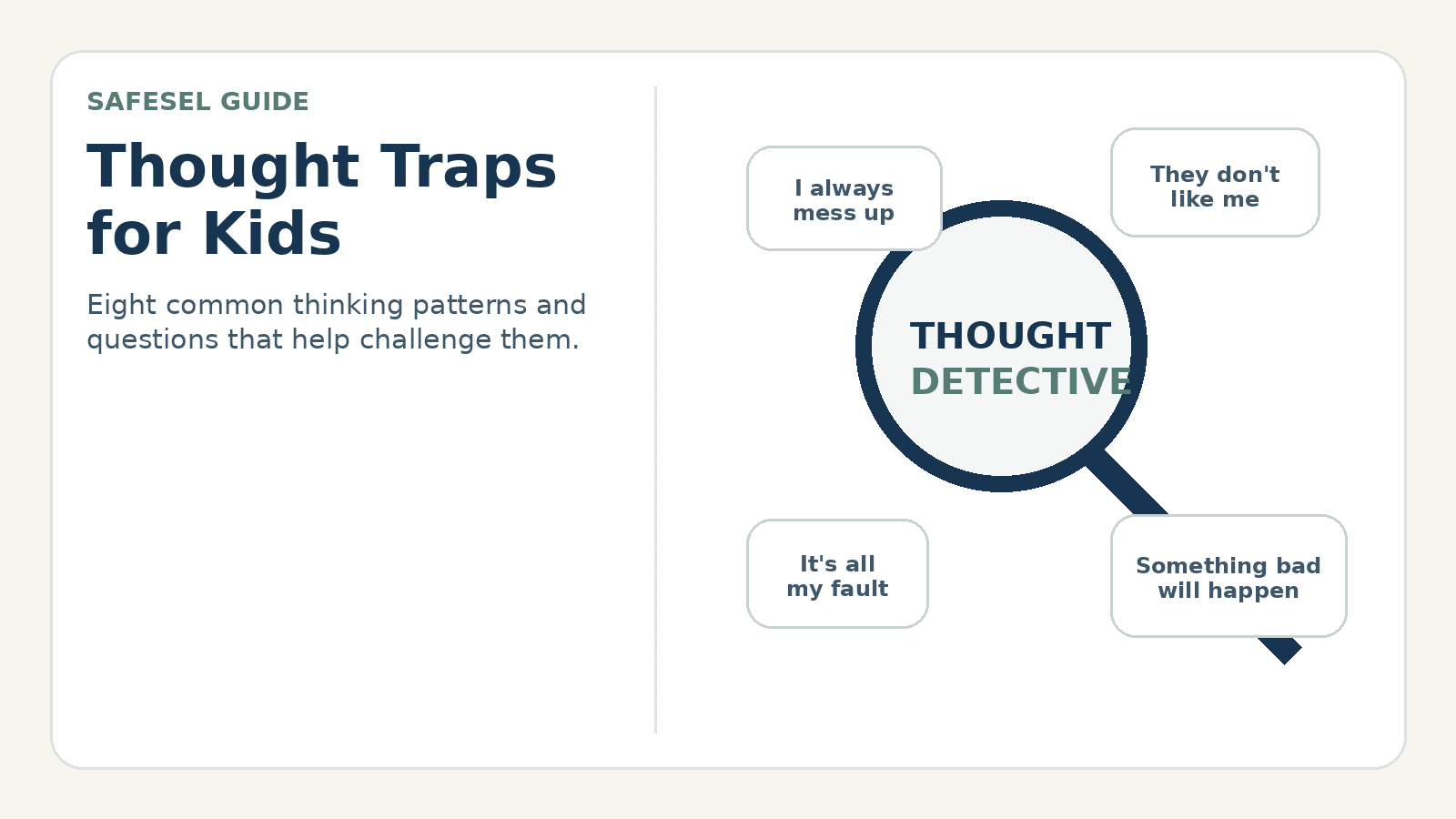
Try one prediction the child can investigate safely
For an illustrative example, a child predicts that asking the teacher to repeat an instruction will annoy them. Separate the prediction from the known facts, discuss a reasonable alternative and identify a safe opportunity to ask. Afterward, record what actually happened without requiring the outcome to prove that every future request will go well.
Keep the experiment small and suited to the child. Do not use real danger, bullying or an inaccessible demand as a learning test. A drawing or spoken response can replace an evidence column when writing distracts from the skill. Individual therapeutic experiments belong within a qualified clinician's plan. If you discuss thinking errors, describe patterns that anyone can have rather than marking the child's thinking as bad.
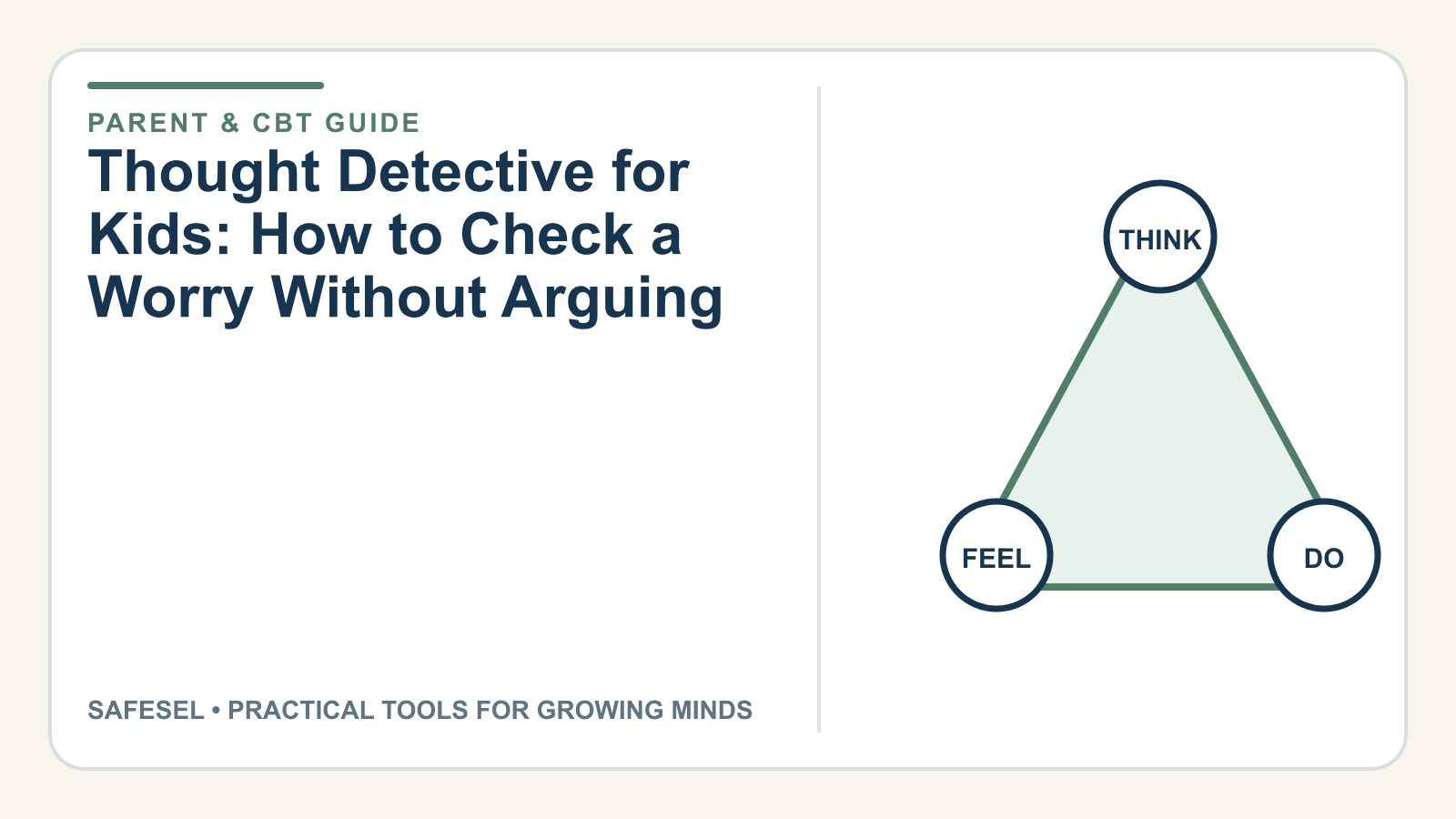
Use a thought detective worksheet to organize the steps
Start with what actually happens
Choose a manageable recent event the child remembers. At ages 7–9, concrete examples often make the difference between what happened and what was predicted easier to discuss than abstract labels.
Fit the plan to ages 7–9
For children ages 7–9 learning about CBT skills for ages 7–9, combine a concrete example with a visual scale, short rehearsal, or simple comparison; ask one question at a time and check understanding before adding abstract vocabulary.
Children in this age range can help review the plan for CBT skills for ages 7–9, but still benefit from visible choices and adult reminders in the real setting; fade prompts after the skill works reliably, not immediately after one successful practice.
A practical sequence
1. Start with a recent manageable situation
Pick a situation with enough detail to revisit, such as answering one question in class. Do not begin with the child's most frightening experience simply to make the lesson meaningful.
2. Separate what happened from what the mind predicted
Write or draw the observable event separately from the prediction. 'Two children laughed' does not by itself prove 'They will laugh at everything I say.'
3. Use two evidence columns or cards
Use a small number of clues for and against a prediction. This is a joint inquiry, not a courtroom exercise where the adult argues until the child agrees.
4. Develop one believable alternative
Develop an alternative that allows uncertainty: 'Some people might notice a mistake, and I can still finish.' Avoid replacing a worry with a guarantee of success.
5. Choose a small test or coping action
Agree on a safe, manageable action relevant to the idea. Do not test predictions by creating danger, humiliation or a situation involving bullying.
6. Review the outcome in the child’s words
Ask what the child noticed and whether it changed the next step. Record their wording, including an outcome that did not fit the adult's expectation.
What this can sound like
'What did you see or hear, and what did your mind guess from that?'
What can make the plan backfire
CBT skills should not teach a child to distrust an accurate report of harm. Check real-world safety and access before exploring another interpretation.
How to review progress
Look for the ability to notice a prediction, consider evidence and choose a practical action. A child does not need to produce a positive thought to show learning.
Developmental and accessibility adjustments
Use drawing, cards, dictation or brief spoken responses. Adapt complexity to the individual child's development rather than assuming all children of the same age need the same worksheet.
When additional support is appropriate
These are educational examples. A qualified practitioner should guide treatment for significant anxiety, trauma-related concerns or other persistent impairment.
Sources and further reading
- Enhancing and Practicing Executive Function Skills — Harvard Center on the Developing Child
- Action & Expression — CAST
- Children and Mental Health: Is This Just a Stage? — NIMH
- What Is the CASEL Framework? — CASEL
- Young Children: Milestones and Schedules — CDC