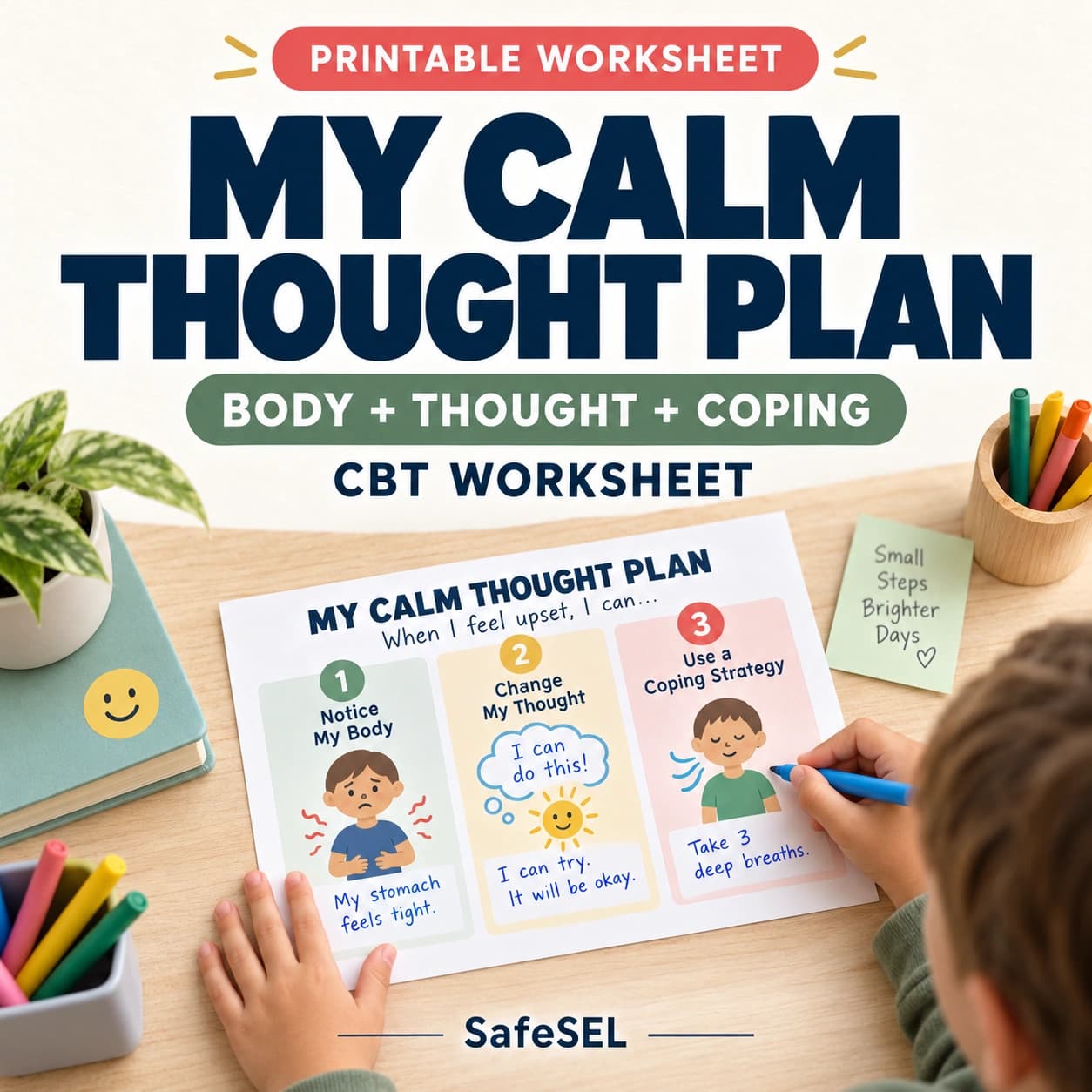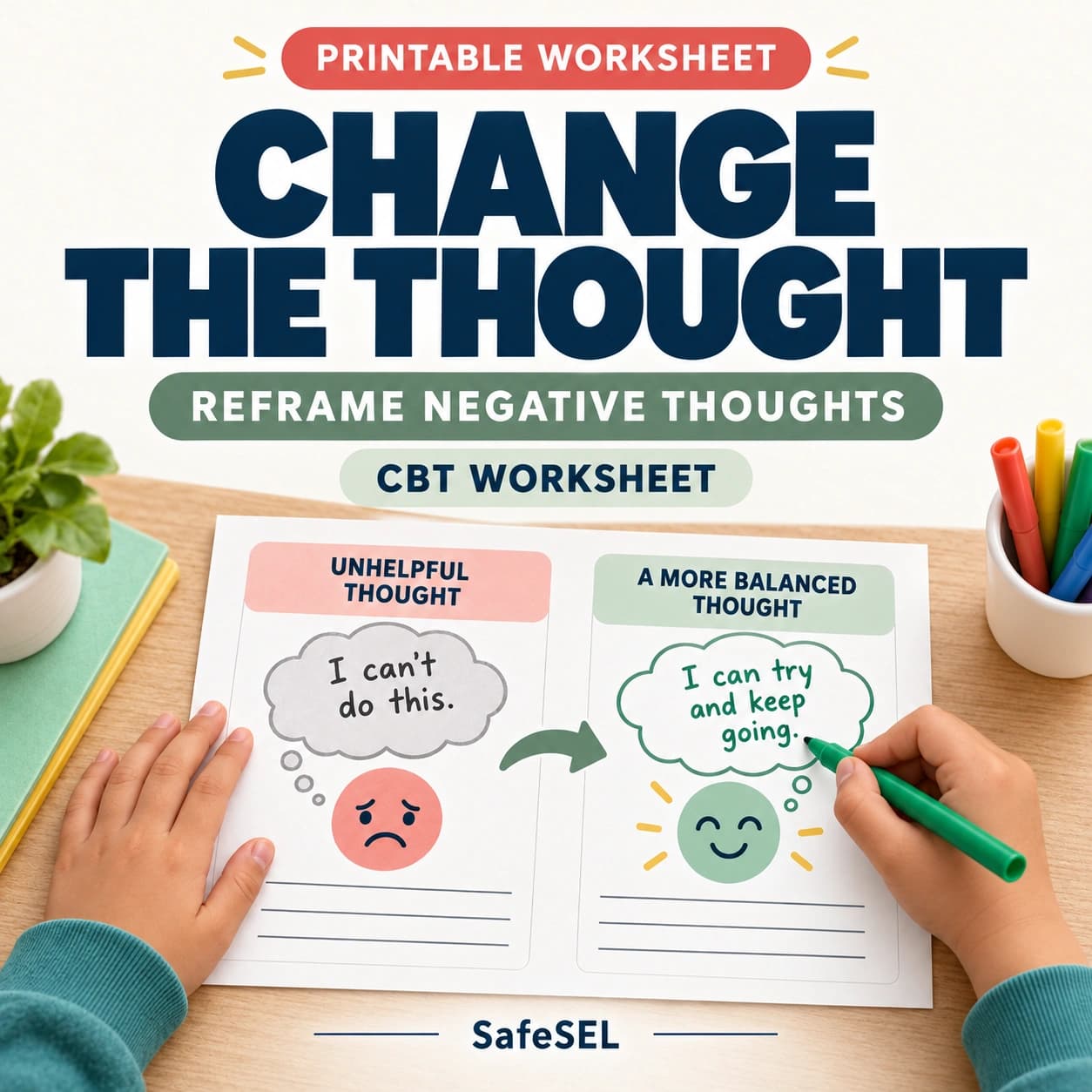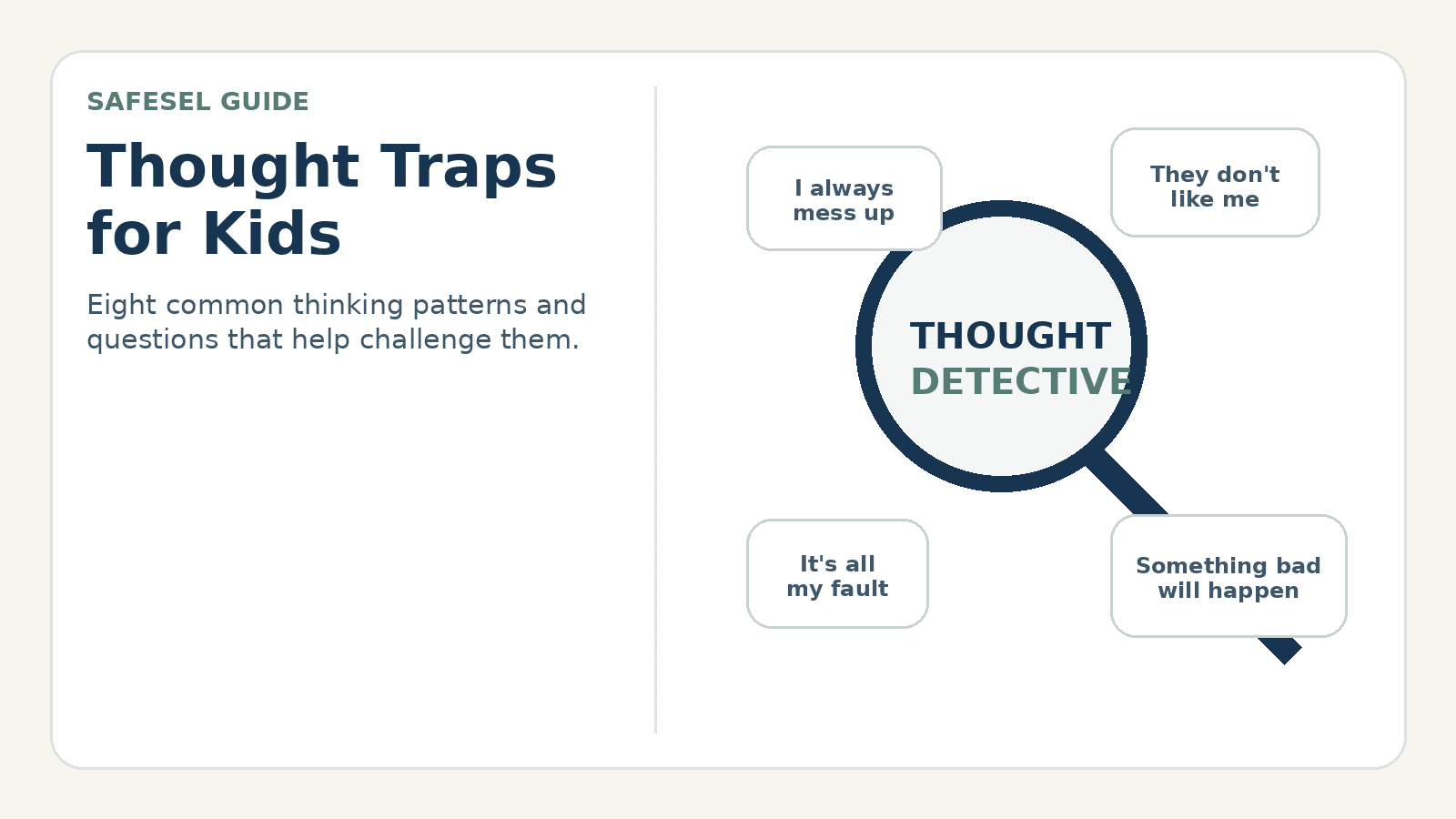
CBT printable worksheets can be adapted with a shared fictional example, fewer written questions, pictures or an adult recording the child’s words. For ages 6–12, use actual language and access needs rather than assume chronological age determines one correct format.
Adapt the response format of a CBT worksheet, not only the font
An older child may prefer privacy and space to question the example; a younger child may need concrete alternatives and more adult explanation. Either may use a different communication method. Keep the intended CBT skills clear and do not mistake a completed page, fluent reading or neat handwriting for understanding.
Start with what actually happens
When adapting one CBT worksheet across ages 6–12, choose two recent examples and one occasion when the difficulty was smaller. While considering “Define the worksheet’s true skill goal,” note what happened immediately beforehand, what the child did or communicated, how adults responded, and what allowed recovery or re-entry; the contrast can help distinguish a missing skill from overload, unclear expectations, avoidance, or an environmental barrier.
Begin with “Define the worksheet’s true skill goal.” Treat it as a low-risk first action, not proof that one explanation is correct. Decide in advance what would count as useful evidence for keeping, reducing, or changing this support for adapting one CBT worksheet across ages 6–12.
A practical sequence
1. Define the worksheet’s true skill goal
Specify what the child should understand or practise, independent of how many boxes the worksheet contains.
2. Remove reading or writing demands that are not the goal
Offer access arrangements for literacy and motor demands that are not part of the intended goal.
3. Prepare three levels of language and example complexity
Prepare simpler or more nuanced examples as needed, but do not use age bands as rigid tests of a child’s ability.
4. Offer multiple response modes
Allow an appropriate communication method and sufficient time without supplying the child’s answer.
5. Model one complete example
Demonstrate the full process with a fictional example, including uncertainty and how to ask for clarification.
6. Use the same success criterion across versions
Keep the learning aim consistent while evaluating it through an accessible response, not identical handwriting or output length.
What this can sound like
- “Would it be easier to talk, point, draw, or write one part?”
- “We only need the section that helps with today’s goal.”
- “Let’s decide what this tool should help us notice or practise.”
After introducing “Remove reading or writing demands that are not the goal” for adapting one CBT worksheet across ages 6–12, use the shortest sentence that directs attention to the next useful action; questions requiring a detailed explanation should wait until the child has enough regulation and language access to answer.
What can make the plan backfire
Before relying on “Define the worksheet’s true skill goal,” consider this caution: requiring every box to be completed can turn a support into a compliance test; select only the pages needed for the current goal and offer a spoken, visual, typed, or assisted response when appropriate.
When using “Define the worksheet’s true skill goal” to address adapting one CBT worksheet across ages 6–12, avoid turning the child’s response into a test of character, motivation, gratitude, or maturity; if the proposed route becomes the main conflict, change the format or reduce the step before abandoning the underlying safety or participation goal.
How to review progress
While reviewing adapting one CBT worksheet across ages 6–12, track whether the tool clarified communication, supported rehearsal, or changed one real-world action without becoming the main source of conflict. A brief record of “Define the worksheet’s true skill goal” can use three levels—independent, prompted, or not yet accessible—plus one sentence about the setting and the support available.
After practising “Use the same success criterion across versions,” review the pattern on an agreed date rather than redesigning the plan after each hard moment; keep what improved access, revise what did not, and increase difficulty only after the current step is reasonably reliable.
Developmental and accessibility adjustments
Adapt the route used for adapting one CBT worksheet across ages 6–12 to language, disability, sensory processing, attention, culture, privacy, and communication style. When practising “Remove reading or writing demands that are not the goal,” pictures, modeling, movement, assistive communication, a typed response, or extra processing time may remove a format barrier without lowering the core goal.
When adapting one CBT worksheet across ages 6–12, do not require eye contact, private disclosure, extensive writing, or a particular emotional display as proof of learning. Evaluate “Define the worksheet’s true skill goal” by whether it improves safety, participation, communication, or recovery in the setting where this difficulty occurs.
When additional support is appropriate
Seek qualified support when difficulty remains persistent, worsening, unsafe, or significantly interferes with school, sleep, health, relationships, or everyday functioning despite trying “Define the worksheet’s true skill goal” and “Remove reading or writing demands that are not the goal”; sudden or severe changes also warrant appropriate medical or mental-health assessment.
Related guide: How to Reduce Writing Demands in SEL Activities Without Reducing the Learning Goal
Related guide: CBT Skills for Ages 10–12: Autonomy, Nuance, and Realistic Thinking
Sources and further reading
- UDL Guidelines 3.0 — CAST
- Action & Expression — CAST
- Representation — CAST
- Enhancing and Practicing Executive Function Skills — Harvard Center on the Developing Child
- Young Children: Milestones and Schedules — CDC