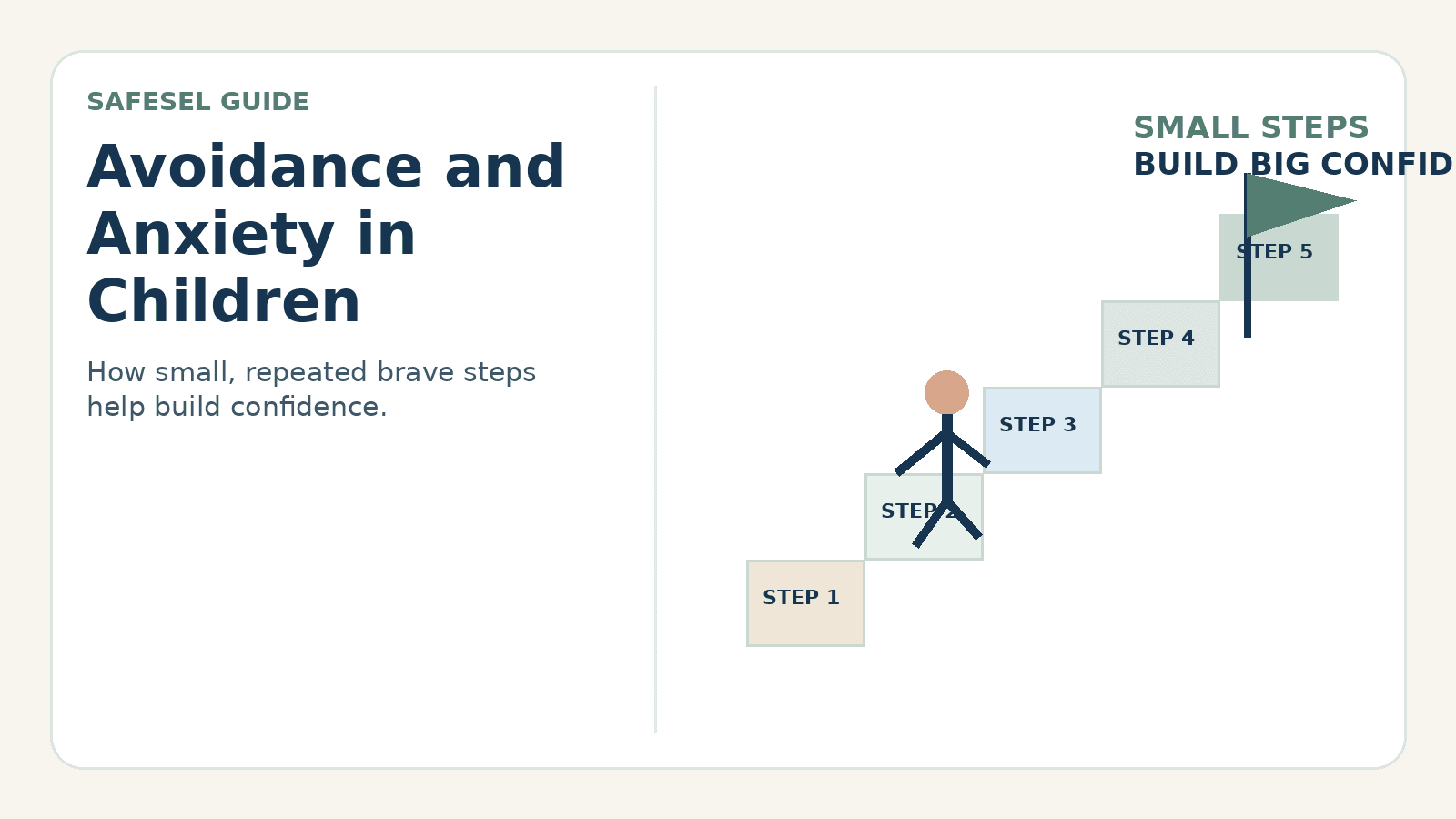
A gradual approach uses planned, collaborative contact with a feared or avoided situation so the child can learn from experience instead of waiting for complete confidence.
This article is educational rather than diagnostic. A single behavior rarely identifies one cause. The same outward response can reflect anxiety, anger, sensory strain, communication barriers, physical symptoms, peer conditions, developmental expectations, or several factors at once. Adults should use patterns, context, the child’s perspective, and appropriate professional assessment when needed.
In brief
A useful plan combines understanding with action. Define the pattern precisely, protect safety and access, teach a small set of relevant skills, create repeated real-world practice, and review whether functioning expands. The goal is not perfect emotional control or permanent comfort.
A framework for understanding the pattern
Question — Pattern A / first side — Pattern B / second side
--- — --- — ---
Target — The task is a specific situation or action, not “being brave” in general. — The child should understand what is being practiced.
Difficulty — The step is challenging enough to create learning and manageable enough to attempt. — Difficulty can be adjusted without turning the ladder into a pass/fail test.
Support — Adults provide structure, safety, and coping support without guaranteeing relief or completing the step for the child. — Support can become lighter as the child gains skill.
Learning — Review focuses on predictions, actual outcomes, recovery, and new information. — Visible anxiety can remain while meaningful progress occurs.
The framework should remain a working hypothesis. Adults should update it when new information appears rather than defend the first explanation. Consider the child’s age, health, communication, sensory profile, relationships, family circumstances, school demands, and recent changes.
Assessment before intervention
Begin with observable sequences: setting, demand, people, first cue, adult response, immediate outcome, delayed outcome, and the child’s later account. Screen for medical concerns, bullying, safeguarding, disability access, and acute safety needs where relevant. Identify whether the primary goal is safety, attendance, participation, communication, gradual approach, recovery, or repair.
Avoid collecting data without a decision question. A brief pattern tracker across several meaningful opportunities is usually more useful than continuous surveillance of mood and behavior.
Core implementation steps
1. Define the avoided situation and meaningful goal
Use the child’s real setting rather than teaching the skill only as an abstract idea. Review whether the step improved safety, access, communication, recovery, or participation. Visible distress can remain while the plan is still helping.
2. Build a range of possible steps
Explain the purpose briefly so support does not feel like a hidden test. Invite the child’s perspective in a developmentally appropriate way. The plan remains an adult responsibility, but it should not be built without information from the person using it.
3. Choose one collaborative starting step
Plan for an imperfect attempt and decide how the child can return. Review whether the step improved safety, access, communication, recovery, or participation. Visible distress can remain while the plan is still helping.
4. Plan coping, communication, and safety
Make this step concrete enough that two adults would implement it in a similar way. Coordinate the language used by the adults involved. Inconsistent reassurance, limits, or exit rules can become part of the maintaining pattern.
5. Repeat enough to gather information
Separate what the adult controls from what the child is being asked to practise. If the step consistently ends all contact with the task, add a realistic return path. If it overwhelms the child or ignores safety and access, reduce or redesign it.
6. Review what changed and what did not
Make this step concrete enough that two adults would implement it in a similar way. Write down what happens before the step, what the adult says or changes, and what the child can do next. This makes the plan teachable and prevents it from becoming a vague expectation such as “cope better.”
7. Revise the next step without shame
Plan for an imperfect attempt and decide how the child can return. Write down what happens before the step, what the adult says or changes, and what the child can do next. This makes the plan teachable and prevents it from becoming a vague expectation such as “cope better.”
Worked examples
Example 1
A child afraid of dogs begins by looking at a photo chosen by the child, then watching a calm dog from a distance, before approaching with a trained adult.
Example 2
A student afraid of reading aloud records one sentence privately, reads to the teacher, then reads a prepared line in a small group.
Home, school, and professional roles
At home, adults can keep routines predictable, reduce repetitive debate, practise one skill in ordinary situations, and preserve connection after difficult moments. At school, staff can adjust access, use discreet cues, preserve learning goals, create clear re-entry, and coordinate language. Professionals can help distinguish function, assess severity, design graded or skills-based practice, and review barriers that a generic worksheet cannot address.
The child should not be responsible for coordinating the adults. Plans should identify who does what, when information is shared, what remains private, and when the approach will be reviewed.
Helpful adult language
- “We are testing a prediction, not testing your courage.”
- “The step can be difficult and still be the right size.”
- “What support helps you stay rather than escape?”
- “What did the attempt teach us?”
Good language validates the child’s experience without confirming every feared interpretation, excusing unsafe behavior, or demanding emotional performance. During escalation, use fewer words. During review, use curiosity and concrete examples.
Common mistakes
- Starting with the hardest task. This can hide the function of the behavior, increase shame or pressure, or make the support harder to review.
- Using surprise or coercion. This can hide the function of the behavior, increase shame or pressure, or make the support harder to review.
- Repeating a poorly designed step without review. This can hide the function of the behavior, increase shame or pressure, or make the support harder to review.
- Treating distress as harm or, at the other extreme, ignoring genuine safety concerns. This can hide the function of the behavior, increase shame or pressure, or make the support harder to review.
Measuring meaningful progress
- The child attempts defined steps
- Recovery and return improve
- Avoided situations become more accessible over time
Also consider whether the child’s world is expanding or narrowing. Improvement may mean attending, remaining, communicating, recovering, returning, repairing, or accepting a manageable amount of uncertainty. It does not require the child to report no anxiety, anger, disappointment, or sensory discomfort.
When additional or urgent support is needed
Seek individualized assessment when symptoms or behaviors are persistent, severe, worsening, occur across settings, or interfere substantially with education, sleep, eating, health, family life, relationships, or development. Involve relevant medical, mental-health, developmental, disability, and school professionals as indicated.
Use urgent local procedures for credible threats, serious physical aggression, suicidal statements, inability to maintain safety, suspected abuse, severe bullying, or acute medical symptoms. Educational resources do not replace crisis assessment or a formal safety plan.
How the pattern can be maintained unintentionally
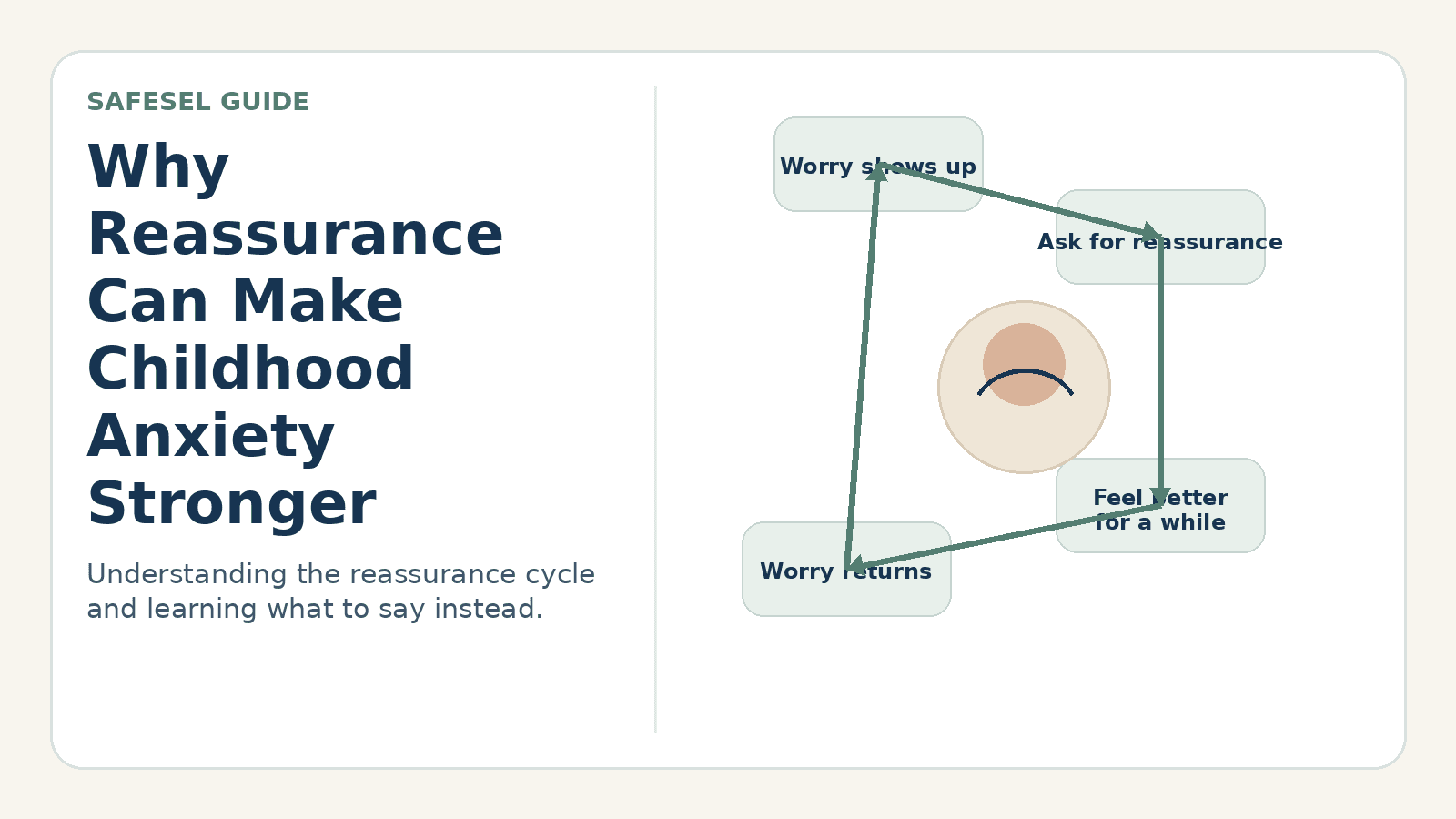
Anxiety is often maintained by a cycle in which a prediction produces distress, the child or adult changes the situation to obtain immediate relief, and the relief makes the same response more likely next time. This does not mean the child is choosing anxiety or that adults have caused the problem. It means that short-term relief and long-term learning can point in different directions.
Repeated reassurance, checking, speaking for the child, delaying, and removing every uncertain element can all become part of this cycle. The response should not be abrupt withdrawal. A better approach is to identify one form of support that preserves safety and access, then reduce only the part that repeatedly prevents the child from learning what happens when the feared situation is approached.
Adults should also look for barriers that are not anxiety-maintaining patterns: bullying, communication demands, disability access, physical illness, sensory overload, academic mismatch, unsafe relationships, and unrealistic expectations. A gradual approach is appropriate only when the task itself is reasonably safe and accessible.
Planning across home, school, and therapy
At home, choose ordinary situations that occur often enough for practice, such as bedtime questions, leaving for school, entering activities, ordering food, or tolerating a changed plan. Keep the response short and consistent. At school, define which adults respond, how the student communicates, what happens after a break, and how attendance or participation is protected. In therapy, use the child’s predictions, observations, and values to design practice rather than applying a standard ladder without context.
A shared plan might include:
- the specific situation being approached;
- the first signs that anxiety is taking control;
- the factual information adults will provide;
- the reassurance limit;
- the coping or communication option;
- the smallest meaningful action;
- the return or follow-up step;
- the date and criteria for review.
Questions for reviewing progress
Ask whether the child is doing more of ordinary life, communicating earlier, recovering more effectively, or needing less repetitive certainty. Do not use visible calm as the only outcome. A child may remain anxious while attending school, asking a question, entering a room, or completing a planned step.
Useful review questions include:
- What was the child’s prediction before the situation?
- What actually happened?
- Which support made action possible?
- Did any adult response unintentionally strengthen avoidance or checking?
- Was the task accessible and safe?
- What should remain the same for the next attempt?
- What should change by one small degree?
Practical questions adults often ask
Should adults wait until the child agrees to the plan?
Collaboration is important, but adults still hold responsibility for health, attendance, safety, and developmentally appropriate participation. The child should have meaningful choices about step size, communication, timing within reasonable limits, and preferred supports. The child does not need unlimited veto power over every contact with uncertainty. When the child refuses all planning, begin with understanding barriers and making the first action smaller rather than turning the interaction into a contest.
How much anxiety is acceptable during practice?
There is no universal number. Some discomfort is expected when approaching an avoided situation, but distress should be interpreted alongside safety, access, task design, and recovery. A practice step may be too large when the child cannot understand the plan, the environment is not reasonably safe, communication collapses, or repeated attempts produce no useful learning because the task is consistently overwhelming. Redesigning a step is not the same as abandoning the goal.
What if the child completes the step only with support?
Supported participation is still participation. Record what support was required and decide whether one component can later become lighter. A parent standing near the door, a teacher previewing the first question, or a counselor using a private signal may be appropriate stages. Independence should be built through deliberate fading, not through sudden removal intended to test the child.
How should adults respond when anxiety returns after progress?
Expect variation. Illness, transitions, peer events, sleep loss, new developmental demands, and long gaps in practice can temporarily increase support needs. Return to the most recent step that was both achievable and meaningful, review what changed, and rebuild. Avoid describing recurrence as losing all progress. The child still has prior learning that can be reactivated.
Publication checklist for this guide
Before publishing or applying the plan, confirm that the page clearly distinguishes education from diagnosis, identifies medical and safeguarding exceptions, does not promise symptom elimination, and links to a specific next-step resource. Examples should preserve the child’s dignity and avoid implying that every request for help is reassurance seeking or avoidance.
Related SafeSEL resources
- Parent pillar: Childhood Anxiety: Practical Support Without Reinforcing Avoidance
- Suggested product line: Anxiety worksheets / Parent anxiety handouts / Brave Steps resources
- Suggested free resource: Anxiety Starter Pack
Before publication, replace these planning labels with one exact product URL, one exact free resource, one parent or pillar article, and two or three related articles with clearly different search intentions.