← All guides
Anxiety

How to Choose an Anxiety Worksheet Based on the Skill a Child Needs

Choose anxiety worksheets by the skill a child needs: body awareness, thought checking, uncertainty, coping, or gradual brave

Written bySafeSEL Editorial TeamEducational content team

Anxiety worksheets are not interchangeable. A child who cannot identify what happens in the body needs a different tool from a child who understands the worry but avoids every uncertain situation. A thought-checking worksheet may help one child and create more debate for another.

Choose the worksheet by the skill gap, not by the broad label “anxiety.”

In brief

First identify what the child needs to learn next: notice anxiety, understand a pattern, relate differently to a worry thought, tolerate uncertainty, approach a feared situation gradually, or reduce reassurance and avoidance. Use one focused worksheet during a calm moment and connect it to a small real-life action. Worksheets should support evidence-based care, not replace individualized assessment or treatment.

The six most common worksheet goals

1. Body-awareness worksheets

These help children notice how anxiety may appear physically, such as:

  • stomach discomfort;
  • faster heartbeat;
  • tight chest;
  • shaky hands;
  • muscle tension;
  • feeling hot or cold;
  • dizziness;
  • needing the bathroom;
  • restlessness;
  • feeling frozen or unable to speak.

This type is useful when the child experiences anxiety mainly as a physical problem or says, “I don’t know—I just feel bad.”

A good page should avoid telling the child that every physical symptom is “just anxiety.” Physical complaints deserve appropriate medical attention, particularly when they are new, severe, persistent, or unexplained.

Useful prompts include:

  • “What did you notice first?”
  • “Where did you feel it?”
  • “How strong was it?”
  • “What was happening around you?”
  • “What helped you continue?”

2. Pattern-tracking worksheets

A pattern tracker explores the connection between:

  • situation;
  • worry or prediction;
  • feeling and body response;
  • avoidance or reassurance;
  • short-term relief;
  • what happened later.

This type is useful when anxiety seems unpredictable or when adults are unsure whether certain accommodations are helping.

The tracker should be brief. Recording every anxious thought and bodily sensation can increase attention to anxiety for some children. Choose a limited period or one target situation.

For example, track only:

“What happens on school mornings before the child asks to stay home?”

rather than documenting anxiety all day.

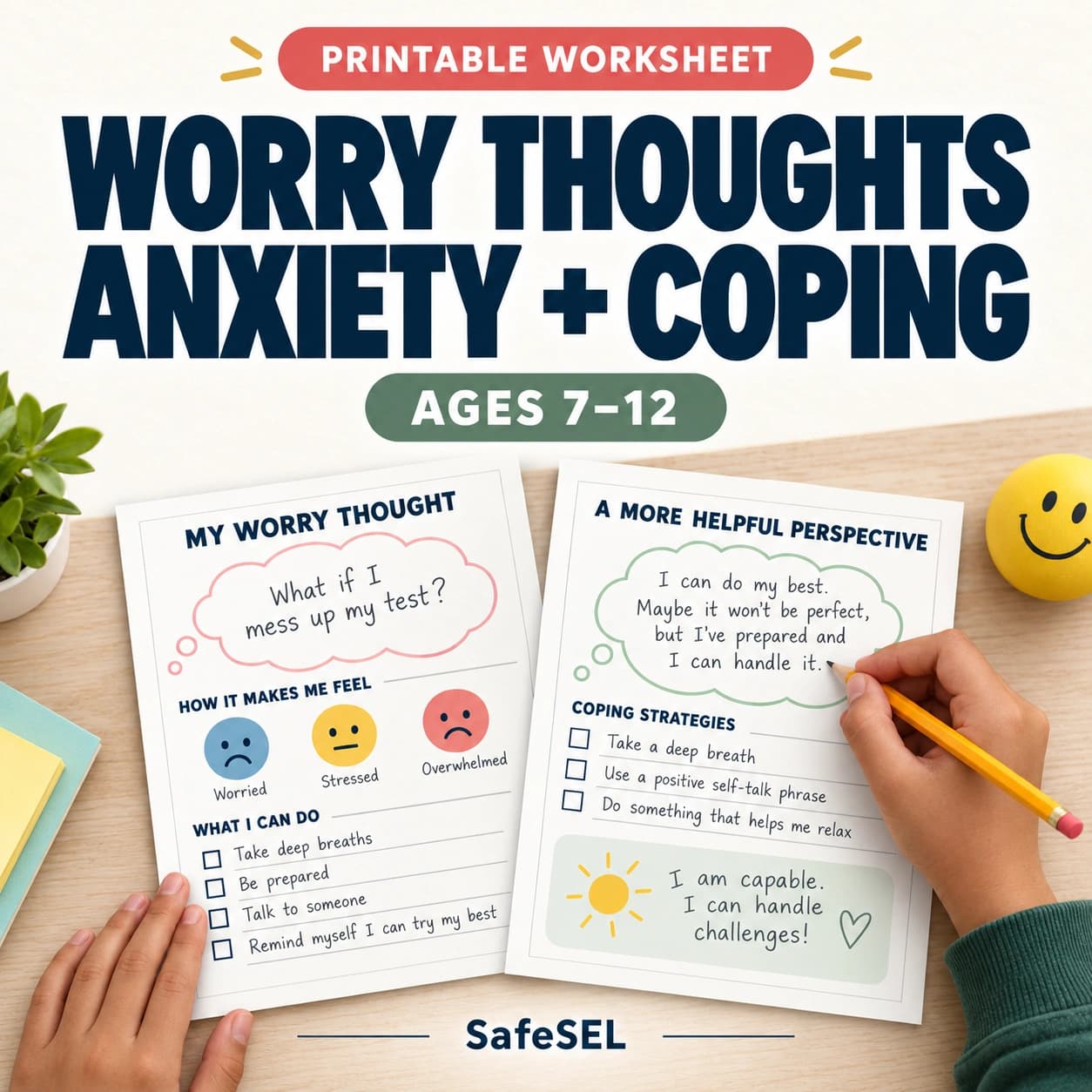
3. Thought-checking worksheets

These help children examine a prediction without demanding positive thinking.

A useful thought-checking page might ask:

  1. What is the worry predicting?
  2. What facts support that prediction?
  3. What facts suggest another outcome is possible?
  4. What is the most likely outcome—not only the worst or best?
  5. What could I do if the difficult outcome happened?
  6. What is a believable coping thought?

This type is most helpful when the child can pause and reflect. It is less useful during peak panic or when adults repeatedly use logic to reassure the child.

Avoid replacing an anxious thought with an unrealistic statement such as “Nothing bad will happen.” A more believable alternative may be:

“I cannot know exactly what will happen, but I can take one step and ask for help if I need it.”

4. Uncertainty-tolerance worksheets

Some worries continue because the child seeks complete certainty:

  • “Are you definitely coming back?”
  • “Are you sure I will not be sick?”
  • “Will everyone like my presentation?”
  • “Can you promise the fire alarm will not go off?”

A worksheet focused on uncertainty helps the child distinguish:

  • what can be planned;
  • what cannot be guaranteed;
  • what coping resources are available;
  • what small uncertain action can be practised.

The goal is not to tell the child to stop asking questions. It is to reduce the cycle in which repeated reassurance briefly lowers anxiety but leaves the child needing another guarantee.

Useful prompts:

  • “What do I want to know for certain?”
  • “Can anyone know that completely?”
  • “What can I prepare?”
  • “What can I handle even without certainty?”
  • “What is one small uncertainty I can practise?”

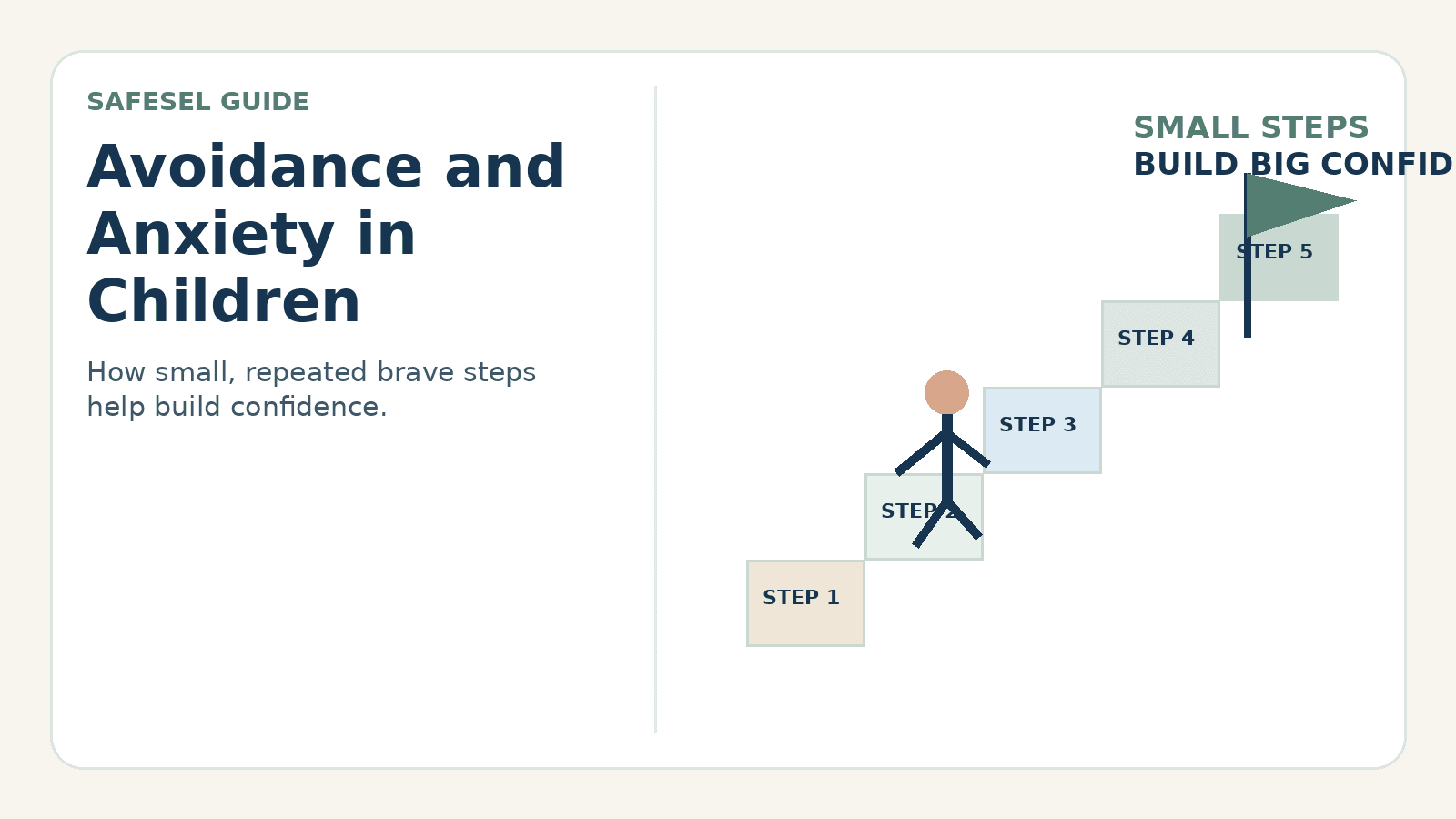
5. Brave-step or approach worksheets

These help children gradually approach situations that anxiety has made difficult. Cognitive behavioral approaches for childhood anxiety commonly include graduated exposure or approach practice, delivered in a collaborative, developmentally appropriate way.

A brave-step worksheet should include:

  • a clearly defined goal;
  • a sequence from easier to harder tasks;
  • child involvement in selecting the steps;
  • repetition rather than one dramatic challenge;
  • a way to review learning;
  • support that does not force or deceive the child.

Example goal: entering a birthday party.

Possible steps:

  1. look at photos of the location;
  2. drive past the location;
  3. visit briefly when it is quiet;
  4. arrive with a trusted adult and stay for five minutes;
  5. join one planned activity;
  6. stay for a longer period.

The aim is not to wait until anxiety disappears. It is to help the child learn that anxiety can rise and change while they take meaningful action.

6. Coping-plan worksheets

A coping plan identifies what the child and adults will do before, during, and after a difficult situation.

A strong plan includes:

  • the target situation;
  • early signs;
  • one or two coping actions;
  • an adult response;
  • a return or continuation plan;
  • how progress will be reviewed.

It should not become an escape plan that automatically ends every feared activity. For example, a break may help the child regulate, but the plan should clarify whether and how the child returns.

A decision table

What is happening? — Best worksheet starting point — Avoid starting with

--- — --- — ---

The child experiences unexplained physical fear — Body signs and context — Long thought records

Anxiety seems random to the family — Pattern tracker — Tracking every symptom all day

The child treats a prediction as a fact — Thought checking — Reassuring that the fear is impossible

The child needs repeated guarantees — Uncertainty tolerance — Answering the same question indefinitely

The child avoids a specific situation — Brave-step plan — A large forced exposure

The child knows the skill but cannot use it in context — Coping and transfer plan — More psychoeducation only

Match the worksheet to developmental level

Ages 7–9

Choose tools with:

  • short prompts;
  • concrete examples;
  • drawing, circling, sorting, or rating;
  • adult collaboration;
  • one main skill per page;
  • visual sequences.

A seven-year-old may not benefit from a detailed evidence-for-and-against table. The same principle can be taught through a “worry prediction” and “what actually happened” comparison.

Ages 10–12

Children may benefit from:

  • more nuanced probability questions;
  • private written reflection;
  • autonomy in selecting brave steps;
  • discussion of social and digital worries;
  • planning for setbacks;
  • separating what matters from what anxiety demands.

Do not assume older children want childish graphics or public discussion of personal fears.

The worksheet should lead to action

A completed page is not the endpoint. Ask:

“What will we do differently because of what we noticed?”

Possible next actions:

  • practise one brave step;
  • reduce one repeated reassurance response;
  • use a coping card during a school transition;
  • ask a teacher for a specific support;
  • test one prediction;
  • schedule a limited worry-review time;
  • return to an activity after a brief regulated break.

Without a real-life action, the worksheet can remain an intellectual exercise.

Do not use worksheets to argue with anxiety

Adults sometimes use a thought record as evidence that the child should stop worrying:

“See? You wrote that it is unlikely, so there is nothing to be anxious about.”

This can invalidate the child and create pressure to produce the “right” answer.

A more useful response is:

“Your body may still feel anxious even when part of you knows the feared outcome is unlikely. What small action can you take while that feeling is present?”

Signs of a well-designed anxiety worksheet

Look for resources that:

  • state a clear skill goal;
  • use developmentally appropriate language;
  • allow uncertainty and mixed feelings;
  • include realistic worked examples;
  • avoid guaranteed reassurance;
  • connect thinking with behavior;
  • support gradual approach rather than avoidance;
  • offer non-writing options;
  • include adult guidance;
  • explain when professional support is appropriate.

Be cautious with worksheets that promise to eliminate anxiety, insist on positive thoughts, or ask a child to repeatedly rate every bodily sensation without a clear purpose.

When a worksheet is not enough

Seek individualized support when anxiety is persistent, intense, or significantly interferes with school attendance, sleep, eating, friendships, family life, medical care, or ordinary activities. Support is also important when the child experiences panic-like symptoms, severe distress, self-harm thoughts, trauma concerns, or a major change in functioning.

Anxiety can coexist with medical, developmental, learning, sensory, mood, or family factors. A worksheet cannot determine the cause.

Related SafeSEL resources

A structured anxiety library may include:

  • body-sign maps;
  • anxiety-cycle worksheets;
  • avoidance and reassurance trackers;
  • thought-checking pages;
  • circle-of-control tools;
  • uncertainty practice;
  • brave-step ladders;
  • home and school coping plans;
  • parent handouts.

Select the smallest tool that fits the child’s current learning goal, then review whether it changes participation in real life.

Sources and further reading

  1. Anxiety and Depression in Children — Centers for Disease Control and Prevention
  2. Social Anxiety Disorder: Recognition, Assessment and Treatment—Recommendations — National Institute for Health and Care Excellence
  3. D., & Ollendick, T. H. Cognitive Behavioral Therapy for Anxiety Disorders in Youth — Seligman, L
  4. T., et al. Cognitive Behavioral Therapy for Children and Adolescents With Anxiety Disorders — Stiede, J
  5. C., et al. Implementing Cognitive-Behavioral Therapy in Children and Adolescents With Anxiety Disorders — Patriarca, G
  6. Cognitive Behavioral Therapy Alters Brain Activity in Children With Anxiety — National Institute of Mental Health
SafeSEL printables

Related resources

View all Anxiety products →
Continue reading

Related articles

Anxiety Worksheets for Kids: What to Choose and How to Use Them

An anxiety worksheet is useful when it helps a child do one specific piece of thinking: notice a body signal, name a worry, separate a prediction from a fact, plan a small coping action or reflect on what happened afterward. It is less…

Read guide →

Choosing Anger Worksheets for Body Signs, Triggers, Coping, or Repair

Choose anger worksheets by the skill a child needs: noticing body signs, understanding triggers, practising coping, or repairing

Read guide →

Coping Strategy vs. Safety Behavior in Childhood Anxiety

Deep breathing, sitting near an adult, carrying a card, or checking a plan can be helpful coping. The same action can also become a safety behavior—a ritual the child believes must happen to prevent catastrophe. The action alone does…

Read guide →