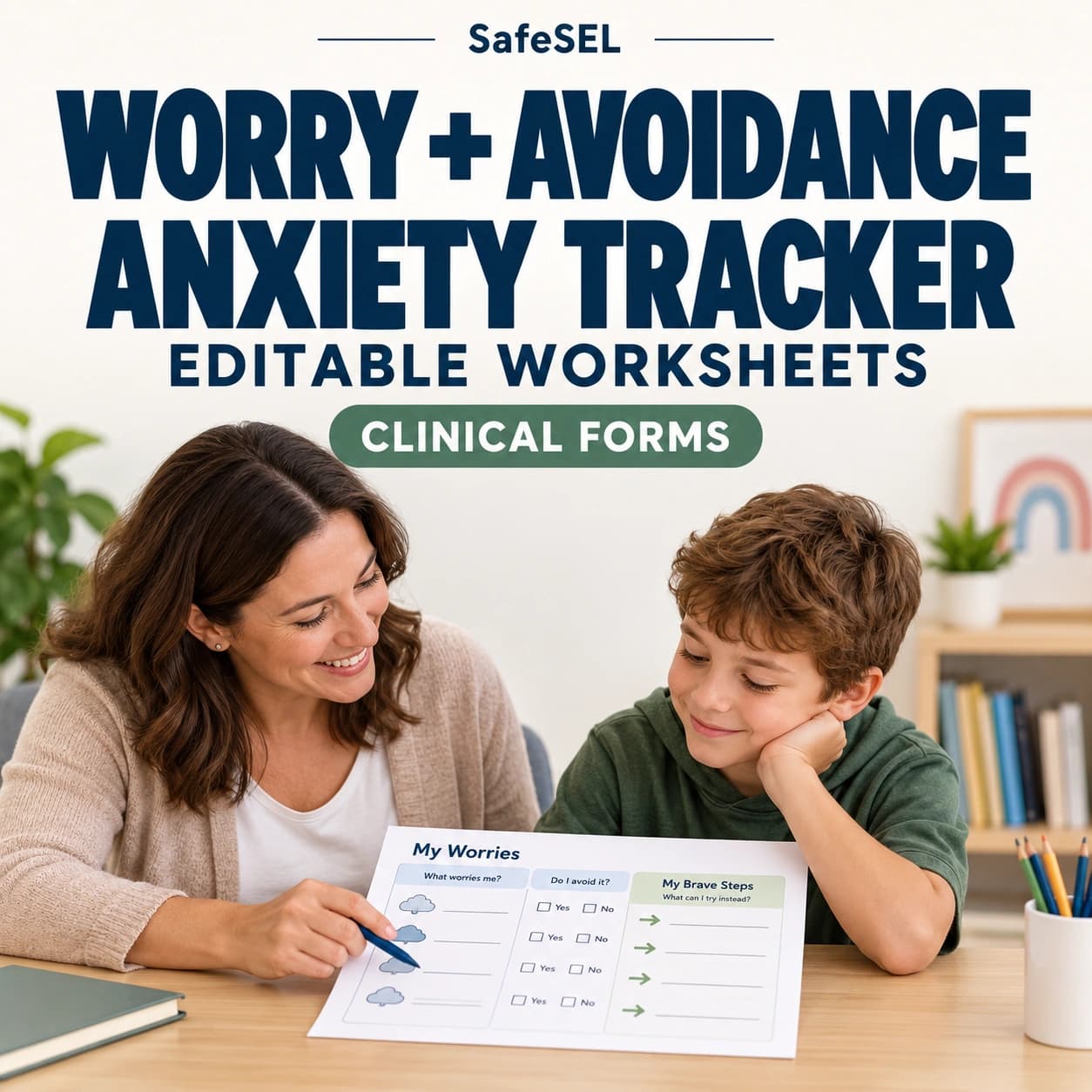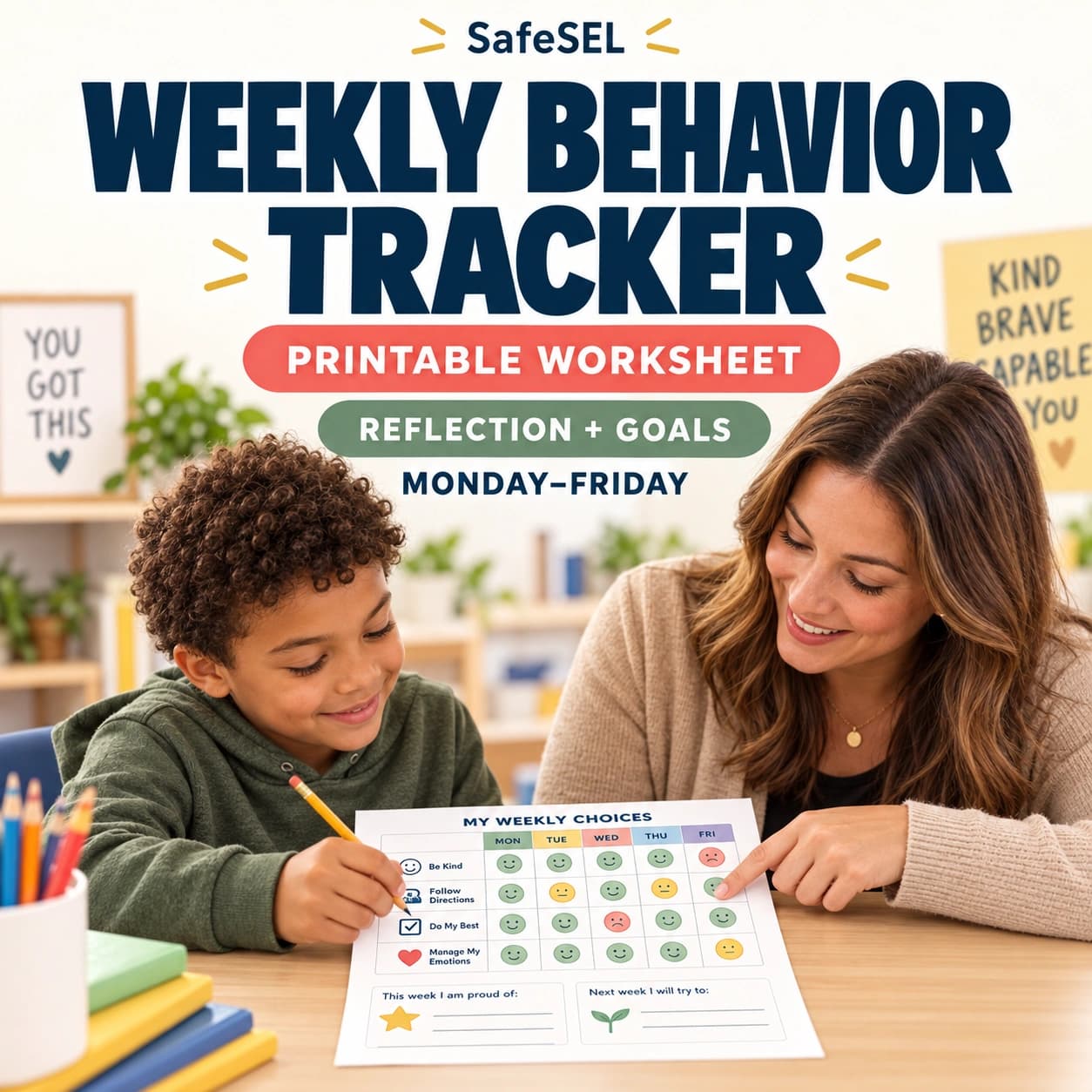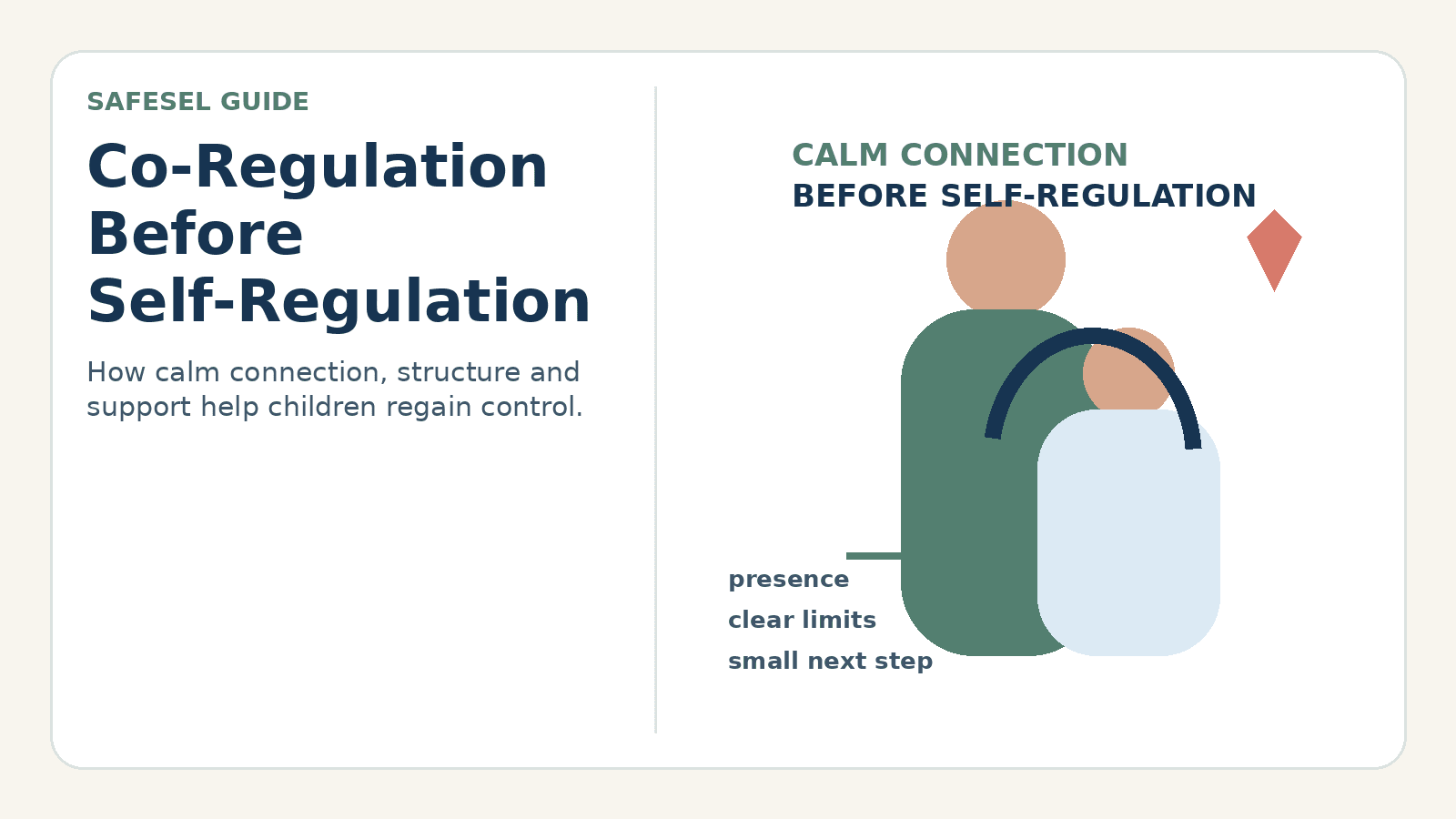
A worry tracker can help a family or therapist see patterns that are hard to notice in the moment. It can also become unhelpful if the child is asked to record every anxious thought, stomach sensation, heartbeat change, or request for reassurance throughout the day.
The purpose of tracking is to guide one practical decision—not to make anxiety the center of the child’s attention.
In brief
Use a worry tracker for a specific question, a limited period, and a small number of variables. Track situations, responses, avoidance, reassurance, and what happened next rather than cataloguing every sensation. Review the information at a planned time, identify one pattern, and choose one small change. Stop or simplify tracking if it increases distress, checking, or preoccupation.
Decide what you want to learn
Before giving the child a tracker, write the question in one sentence.
Useful questions include:
- What happens before school-morning stomachaches?
- Which reassurance questions repeat at bedtime?
- When does the child leave class because of worry?
- Does a brief supported break help the child return?
- Which situations are being avoided?
- Does anxiety decrease only after an adult gives a guarantee?
- What helps the child continue even while anxious?
An unfocused instruction such as “track your anxiety this week” is usually too broad.
Track patterns, not every symptom
A practical tracker may include five fields:
- Situation: What was happening?
- Worry prediction: What did anxiety say might happen?
- Response: What did the child or adult do?
- Short-term result: Did anxiety decrease, stay the same, or increase?
- Later result: Did the child continue, avoid, return, or need more reassurance?
This structure captures the cycle rather than only symptom intensity.
Example:
Situation — Worry prediction — Response — Short-term result — Later result
--- — --- — --- — --- — ---
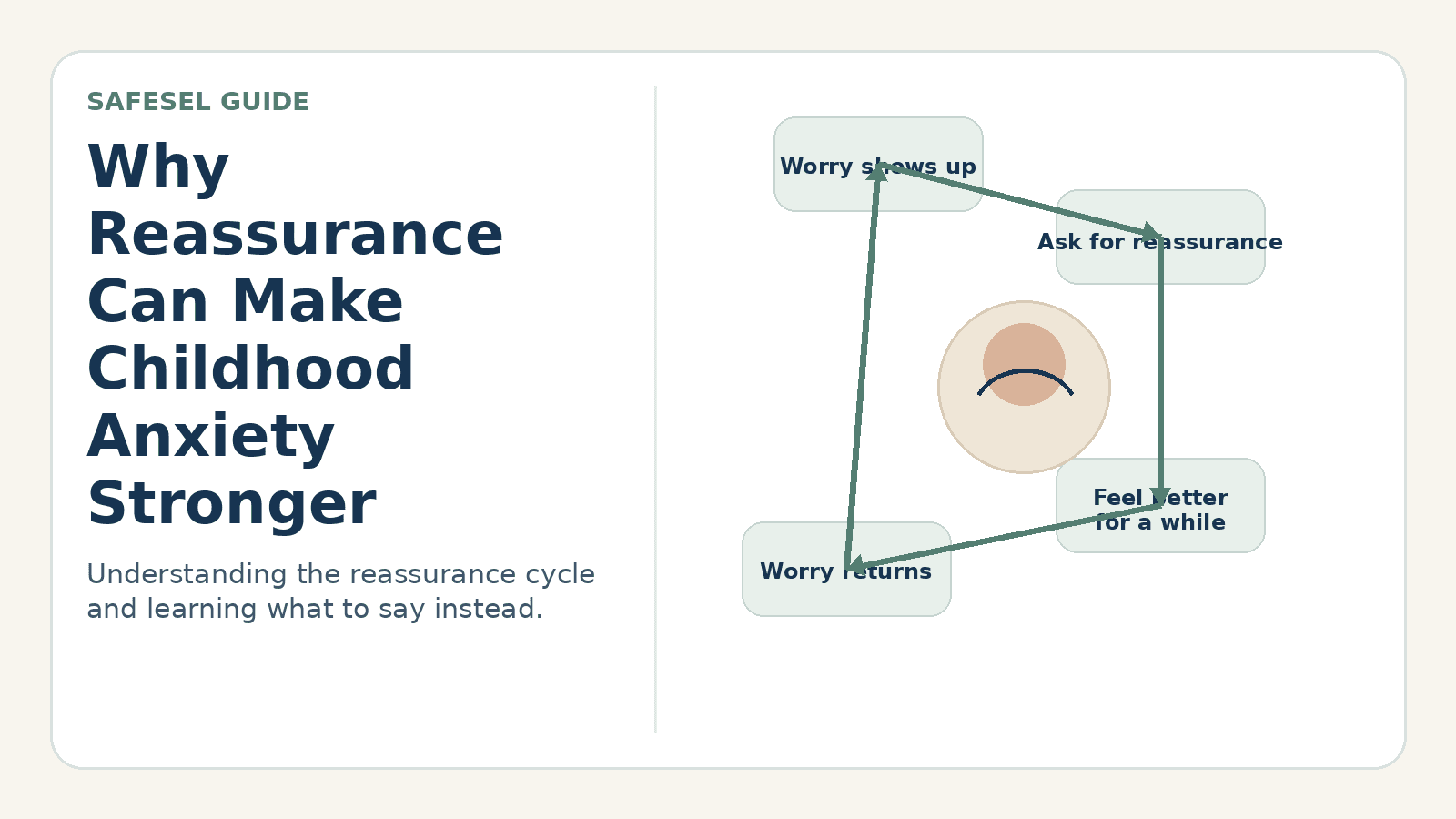
Bedtime — “I might be sick during the night” — Asked parent five times for reassurance — Felt better for a few minutes — Asked again and delayed sleep
School arrival — “I won’t cope if my friend is absent” — Entered with teacher and used a plan card — Anxiety stayed high at first — Joined class after ten minutes
The second example shows that successful coping does not require anxiety to disappear immediately.
Why too much monitoring can backfire
Some children already pay intense attention to internal sensations and threat cues. Frequent tracking can unintentionally increase:
- body scanning;
- repeated checking;
- requests for adults to confirm ratings;
- worry about whether anxiety is “getting worse”;
- pressure to report accurately;
- avoidance of normal sensations;
- family conversations dominated by symptoms.
This does not mean that self-monitoring is always harmful. Monitoring is commonly used in cognitive behavioral work to clarify situations, thoughts, feelings, and behavior. The key is that tracking has a defined therapeutic or educational purpose and is reviewed in context.
Use a narrow tracking window
Choose one of these formats.
Event-based tracking
Complete one brief entry only when the target situation occurs.
Example:
Track the first reassurance question at bedtime and what happens after the adult responds.
Time-limited tracking
Track for three to seven days, then stop and review.
Sampled tracking
Record one example per day rather than every episode.
Adult-led observation
An adult records environmental and behavioral patterns without repeatedly asking the child to monitor internal sensations.
This can be useful when the child is young, distressed by tracking, or has difficulty identifying internal states.
Do not make the child responsible for perfect data
The child does not need to remember every detail. The tracker is not a compliance task.
Use language such as:
“We are collecting a few clues, not trying to record everything.”
“It is okay to write ‘not sure.’”
“You can tell me and I can write.”
“We will do this for four days and then decide whether it helped.”
Avoid consequences for incomplete tracking. Missing data may itself indicate that the task is too demanding, poorly timed, or not meaningful to the child.
Be careful with intensity ratings
A 0–10 scale can be useful, but it should not become the main focus.
Consider using three or four concrete levels:
- noticeable but able to continue;
- difficult and needing support;
- very strong and choices narrowing;
- overwhelmed or unable to continue safely.
Pair the rating with function:
“What were you able to do at that level?”
A child who rates anxiety as 8 and still enters class may be making important progress. A lower number is not the only sign of improvement.
Track adult responses too
Anxiety patterns are relational. A child’s tracker alone may miss how adult responses affect the cycle.
Adults can note whether they:
- gave repeated reassurance;
- changed the plan;
- allowed complete avoidance;
- offered a supported approach step;
- prompted a coping strategy;
- reduced unnecessary demands;
- helped the child return;
- discussed the worry for a long time.
This is not about blaming parents or teachers. It identifies which responses provide short-term relief and which support longer-term coping.
Review at a planned time
Do not analyse every entry immediately. Choose a predictable review time, such as:
- once at the end of the day;
- during a weekly counseling session;
- after the three-day tracking period;
- before planning the next brave step.
During review, ask only a few questions:
- What pattern do we notice?
- What seems to keep the cycle going?
- What helped the child continue?
- What is one small change to test?
Avoid reviewing the tracker as proof that the child’s worry is irrational.
Turn the pattern into one experiment
Tracking should lead to action.
Example: repeated bedtime reassurance
Pattern:
- the child asks whether they will be sick;
- the parent guarantees that they will not;
- relief lasts briefly;
- the question returns.
Possible experiment:
- agree on one calm response;
- write the response on a card;
- after the first answer, the parent points to the card rather than generating new reassurance;
- the child uses one planned coping action;
- review what happened after three nights.
Example: leaving class during difficult work
Pattern:
- anxiety rises when independent writing begins;
- the child asks to go to the nurse;
- work is avoided;
- anxiety returns during the next writing task.
Possible experiment:
- reduce the first task chunk;
- allow a brief supported break;
- use a return timer;
- complete one small section;
- review whether return became more manageable.
The goal is not to prove the child can cope without support. It is to find support that increases participation rather than unintentionally maintaining avoidance.
Signs that tracking is becoming unhelpful
Simplify or stop the tracker when:
- the child checks the body more often because of the form;
- anxiety ratings become a repeated reassurance topic;
- the child fears completing the page incorrectly;
- the family discusses anxiety throughout the day;
- the child avoids activities to make tracking easier;
- the worksheet produces data but no practical change;
- the child experiences the tracker as surveillance;
- adults use it to challenge or disprove the child’s experience.
You can replace detailed tracking with a simple adult observation or a single weekly reflection.
Adaptations for different needs
For children who dislike writing
- use checkboxes;
- allow voice notes;
- let an adult scribe;
- use one-word entries;
- choose from picture options.
For children with strong body-focused anxiety
Track situation and action first. Include only the first noticeable body cue rather than a full symptom inventory.
For children who seek certainty
Avoid asking them to decide whether the worry was “true.” Instead compare:
- the prediction;
- what actually happened;
- what they did to cope;
- what remains uncertain.
For school use
Keep entries private and brief. Do not require students to record sensitive worries publicly or complete the form as a condition of receiving support.
When to seek additional support
Consider professional evaluation when anxiety is persistent, severe, or interfering with school attendance, sleep, eating, social participation, medical care, or family functioning. Seek prompt help when there are safety concerns, self-harm thoughts, severe panic symptoms, trauma concerns, or a major change in behavior or functioning.
A worry tracker can clarify a pattern, but it cannot diagnose an anxiety disorder or rule out medical, developmental, sensory, learning, or environmental factors.
Related SafeSEL resources
SafeSEL anxiety tools may include:
- a focused worry pattern tracker;
- reassurance and avoidance trackers;
- body-sign maps;
- thought-checking pages;
- circle-of-control worksheets;
- uncertainty practice;
- brave-step plans;
- parent and school support plans.
Use tracking as a short bridge to a decision, not as an ongoing requirement to monitor every anxious experience.
Sources and further reading
- Anxiety and Depression in Children — Centers for Disease Control and Prevention
- Social Anxiety Disorder: Recognition, Assessment and Treatment—Recommendations — National Institute for Health and Care Excellence
- D., & Ollendick, T. H. Cognitive Behavioral Therapy for Anxiety Disorders in Youth — Seligman, L
- T., et al. Cognitive Behavioral Therapy for Children and Adolescents With Anxiety Disorders — Stiede, J
- M., et al. The Importance of Practicing at Home During and Following CBT for Childhood Anxiety — Klein, A