Panic-like episodes and escalating worry can overlap, but adults can still observe onset, body symptoms, thoughts, duration, and what restores functioning without attempting to diagnose from one event.
This article is educational rather than diagnostic. A single behavior rarely identifies one cause. The same outward response can reflect anxiety, anger, sensory strain, communication barriers, physical symptoms, peer conditions, developmental expectations, or several factors at once. Adults should use patterns, context, the child’s perspective, and appropriate professional assessment when needed.
In brief
Do not decide from the final behavior alone. Compare what happened before it, what the child appeared to need or avoid, how the child responded to changes in the environment, and what happened after the incident. Use the comparison to choose a safer first response—not to apply a diagnosis.
Side-by-side comparison
Question — Pattern A / first side — Pattern B / second side
--- — --- — ---
Onset — Panic-like symptoms may rise very rapidly and feel sudden, even when a trigger is not obvious. — Escalating worry often builds through repeated predictions, questions, checking, or avoidance.
Body experience — Breathlessness, racing heart, dizziness, trembling, nausea, or feeling unreal may dominate. — Body tension and stomach discomfort may grow alongside increasingly detailed worry.
Thinking — The child may fear immediate catastrophe, loss of control, fainting, or dying. — The child may focus on a future event, mistake, separation, evaluation, or uncertainty.
Adult priority — Screen medical and immediate safety concerns and help the child orient to the present. — Reduce debate and reassurance loops while guiding the next manageable action.
The columns are not rigid categories. Children can move between patterns, and both sides can occur in one event. The practical value of the table is to slow down an adult’s conclusion and identify what information is still missing.
What adults can observe before responding
Look at timing, setting, people, sensory conditions, demands, recent stress, physical symptoms, repeated questions, avoidance, peer power, and the first observable change. Record direct observations separately from interpretation. “Covered ears and moved away when the bell sounded” is more useful than “overreacted.” “Asked whether the teacher was angry six times” is more useful than “attention seeking.”
Ask what changed when adults reduced stimulation, clarified a rule, offered factual information once, moved peers, allowed a structured break, or provided a concrete first step. A response that helps in one context does not prove a universal explanation, but it can improve the next plan.
A practical decision process
1. Check urgent medical and safety indicators first
Use the child’s real setting rather than teaching the skill only as an abstract idea. Review whether the step improved safety, access, communication, recovery, or participation. Visible distress can remain while the plan is still helping.
2. Use a calm description of what is observable
Separate what the adult controls from what the child is being asked to practise. Write down what happens before the step, what the adult says or changes, and what the child can do next. This makes the plan teachable and prevents it from becoming a vague expectation such as “cope better.”
3. Reduce rapid questioning during peak distress
Make this step concrete enough that two adults would implement it in a similar way. If the step consistently ends all contact with the task, add a realistic return path. If it overwhelms the child or ignores safety and access, reduce or redesign it.
4. Help the child orient to place, time, and one physical action
Plan for an imperfect attempt and decide how the child can return. If the step consistently ends all contact with the task, add a realistic return path. If it overwhelms the child or ignores safety and access, reduce or redesign it.
5. Document patterns without diagnosing
Plan for an imperfect attempt and decide how the child can return. Coordinate the language used by the adults involved. Inconsistent reassurance, limits, or exit rules can become part of the maintaining pattern.
6. Seek assessment when episodes recur or impair functioning
Explain the purpose briefly so support does not feel like a hidden test. If the step consistently ends all contact with the task, add a realistic return path. If it overwhelms the child or ignores safety and access, reduce or redesign it.
Worked examples
Example 1
A child suddenly reports chest tightness, shaking, and fear of fainting in a crowded assembly. Staff follow health procedures and reduce stimulation before later reviewing the pattern.
Example 2
Another child asks ten increasingly detailed questions before a trip, checks the weather repeatedly, and refuses to pack. Adults use the existing uncertainty plan rather than answering each new version.
Helpful language
- “I am checking safety first.”
- “Your body is sending a strong alarm; we only need the next minute right now.”
- “You do not have to explain everything while the alarm is high.”
- “We will look at the pattern later, not diagnose this in the moment.”
These phrases are starting points, not scripts that must be repeated mechanically. The adult should sound natural, keep language short during high arousal, and return to fuller discussion when the child has enough access to listen and respond.
Common mistakes
- Assuming every physical symptom is anxiety. This can hide the function of the behavior, increase shame or pressure, or make the support harder to review.
- Telling the child to take deep breaths when breathing focus worsens distress. This can hide the function of the behavior, increase shame or pressure, or make the support harder to review.
- Debating whether the fear is logical during the peak. This can hide the function of the behavior, increase shame or pressure, or make the support harder to review.
- Using one episode to label the child. This can hide the function of the behavior, increase shame or pressure, or make the support harder to review.
Developmental and accessibility considerations
For ages 4–6, use short language, pictures, modeling, and adult-guided action. For ages 7–9, use concrete comparisons, a small number of choices, and simple review questions. For ages 10–12, protect privacy and invite the child to help distinguish patterns and design supports.
Allow pointing, drawing, typing, role-play, AAC, or adult scribing when speech or writing is not the skill being assessed. Consider disability access, language, culture, health, trauma exposure, and school or family context. A child should not have to perform calmness, eye contact, or verbal insight to access safety.
How to monitor whether the response is helping
- Episodes are medically and clinically reviewed when indicated
- The child can use one agreed orienting action
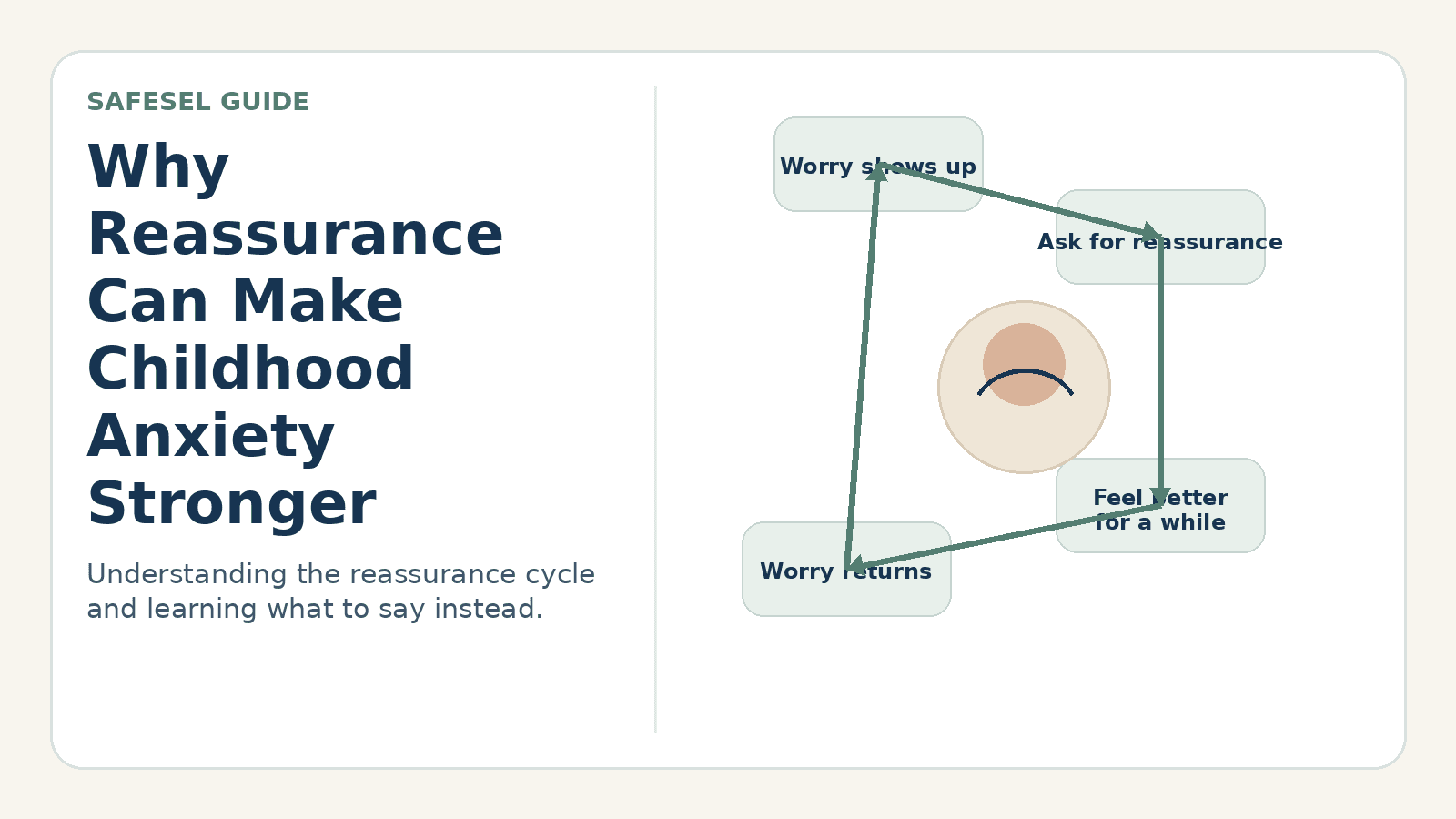
- Adults respond consistently instead of escalating the reassurance cycle
Review several opportunities rather than judging one incident. Progress may include earlier communication, safer behavior, shorter recovery, a successful return, less repetitive reassurance, improved access, or clearer adult coordination.
When additional support is appropriate
Seek individualized support when the pattern is persistent, worsening, appears across settings, or substantially limits attendance, sleep, eating, health, learning, relationships, or ordinary activities. Recurrent panic-like symptoms, significant aggression, credible threats, unexplained physical symptoms, suspected bullying, or marked changes in functioning deserve prompt assessment.
Use emergency, safeguarding, medical, or school safety procedures for immediate danger, serious aggression, suicidal statements, suspected abuse, or acute medical symptoms. A comparison article or worksheet is not a crisis plan.
Related SafeSEL resources
- Parent pillar: Childhood Anxiety: Practical Support Without Reinforcing Avoidance
- Suggested product line: Anxiety worksheets / Parent anxiety handouts / Brave Steps resources
- Suggested free resource: Support-or-Avoidance Checklist
Before publication, replace these planning labels with one exact product URL, one exact free resource, one parent or pillar article, and two or three related articles with clearly different search intentions.