Trust after repeated outbursts is rebuilt through safety, accountability, predictable change, and many ordinary experiences—not through one apology, forced forgiveness, or a promise that it will never happen again.
This article is educational rather than diagnostic. A single behavior rarely identifies one cause. The same outward response can reflect anxiety, anger, sensory strain, communication barriers, physical symptoms, peer conditions, developmental expectations, or several factors at once. Adults should use patterns, context, the child’s perspective, and appropriate professional assessment when needed.
In brief
A useful plan combines understanding with action. Define the pattern precisely, protect safety and access, teach a small set of relevant skills, create repeated real-world practice, and review whether functioning expands. The goal is not perfect emotional control or permanent comfort.
A framework for understanding the pattern
Question — Pattern A / first side — Pattern B / second side
--- — --- — ---
Safety — People affected need protection, boundaries, and confidence that adults will act. — Reconnection should not be forced before safety is restored.
Accountability — The child acknowledges specific impact at a developmentally appropriate level. — Responsibility is different from global shame.
Repair — Actions may include restitution, restoring space, replacing items, changing routines, or respecting distance. — The person harmed has a voice in boundaries.
Consistency — Trust grows when the prevention plan is used over time. — Adults should notice change without demanding immediate closeness.
The framework should remain a working hypothesis. Adults should update it when new information appears rather than defend the first explanation. Consider the child’s age, health, communication, sensory profile, relationships, family circumstances, school demands, and recent changes.
Assessment before intervention
Begin with observable sequences: setting, demand, people, first cue, adult response, immediate outcome, delayed outcome, and the child’s later account. Screen for medical concerns, bullying, safeguarding, disability access, and acute safety needs where relevant. Identify whether the primary goal is safety, attendance, participation, communication, gradual approach, recovery, or repair.
Avoid collecting data without a decision question. A brief pattern tracker across several meaningful opportunities is usually more useful than continuous surveillance of mood and behavior.
Core implementation steps
1. Name the specific impact without character labels
Keep the first version small, observable, and possible to review. If the step consistently ends all contact with the task, add a realistic return path. If it overwhelms the child or ignores safety and access, reduce or redesign it.
2. Ask what safety or distance is needed
Explain the purpose briefly so support does not feel like a hidden test. Invite the child’s perspective in a developmentally appropriate way. The plan remains an adult responsibility, but it should not be built without information from the person using it.
3. Choose a proportionate repair
Keep the first version small, observable, and possible to review. Invite the child’s perspective in a developmentally appropriate way. The plan remains an adult responsibility, but it should not be built without information from the person using it.
4. Change the pattern that led to repeated harm
Make this step concrete enough that two adults would implement it in a similar way. Coordinate the language used by the adults involved. Inconsistent reassurance, limits, or exit rules can become part of the maintaining pattern.
5. Support the harmed child separately
Separate what the adult controls from what the child is being asked to practise. If the step consistently ends all contact with the task, add a realistic return path. If it overwhelms the child or ignores safety and access, reduce or redesign it.
6. Track consistency over time
Explain the purpose briefly so support does not feel like a hidden test. If the step consistently ends all contact with the task, add a realistic return path. If it overwhelms the child or ignores safety and access, reduce or redesign it.
7. Allow relationships to recover at different speeds
Explain the purpose briefly so support does not feel like a hidden test. Coordinate the language used by the adults involved. Inconsistent reassurance, limits, or exit rules can become part of the maintaining pattern.
Worked examples
Example 1
A sibling whose belongings were repeatedly damaged receives secure storage and permission to decline play. The child who caused damage contributes to replacement and practises a leave-the-room plan.
Example 2
A student who shouted threats does not return through a forced group apology. Safety review, individual accountability, and gradual peer re-entry occur first.
Home, school, and professional roles
At home, adults can keep routines predictable, reduce repetitive debate, practise one skill in ordinary situations, and preserve connection after difficult moments. At school, staff can adjust access, use discreet cues, preserve learning goals, create clear re-entry, and coordinate language. Professionals can help distinguish function, assess severity, design graded or skills-based practice, and review barriers that a generic worksheet cannot address.
The child should not be responsible for coordinating the adults. Plans should identify who does what, when information is shared, what remains private, and when the approach will be reviewed.
The four phases of rebuilding trust
Trust usually returns in phases rather than through one conversation.
Phase 1: Protection and predictability
The first task is to stop repeated harm and make adult action predictable. This may require closer supervision, separate storage, changed routines, restricted access to a room or object, or a temporary pause in shared activities. These steps are not revenge. They protect the people affected and create conditions in which later repair can have meaning.
Adults should explain the boundary in specific language: what is restricted, why it is restricted, and what conditions will be reviewed. Avoid indefinite statements such as “You can never be trusted again.”
Phase 2: Reliable accountability
The child begins to complete concrete responsibilities: contributing to replacement, respecting requested distance, following a safety plan, or using the agreed exit before escalation. Adults notice completion without demanding that the harmed person respond warmly.
Accountability should be repeated and ordinary. A dramatic promise is less informative than several weeks of using the plan when frustrated.
Phase 3: Limited shared access
Shared activities can restart in structured, lower-risk forms. The harmed child or sibling should have meaningful input and should not be required to provide private access, lend valued belongings, or participate without supervision simply because an apology occurred.
The plan might begin with a short shared activity in a common space, clear rules, and an adult nearby. Review what made the activity safe enough and what still needs protection.
Phase 4: Flexible relationship recovery
Over time, the relationship may require fewer external controls. Trust becomes more flexible when the child who caused harm consistently respects boundaries, handles disappointment more safely, and accepts that other people can say no or need time.
Recovery does not have to restore the relationship to its previous level. Some relationships become close again; others remain more limited. The goal is safety, dignity, and realistic access—not a required emotional ending.
Signs that trust is rebuilding
Look for patterns rather than declarations:
- the safety plan is used before harm;
- boundaries are respected without repeated pressure;
- repair obligations are completed;
- the child accepts supervision or limited access without retaliation;
- the harmed person reports greater safety;
- adults need fewer emergency interventions;
- shared activities expand voluntarily.
If safety improves only when one person constantly gives in, monitors the other child, or hides valued belongings without adult help, trust has not yet been adequately rebuilt.
Helpful adult language
- “I am responsible for the impact, not a bad person forever.”
- “You do not have to forgive or reconnect immediately.”
- “Trust will come from what happens repeatedly next.”
- “Repair includes changing the plan, not only saying sorry.”
Good language validates the child’s experience without confirming every feared interpretation, excusing unsafe behavior, or demanding emotional performance. During escalation, use fewer words. During review, use curiosity and concrete examples.
Common mistakes
- Forcing hugs or forgiveness. This can hide the function of the behavior, increase shame or pressure, or make the support harder to review.
- Making the harmed child reassure the child who caused harm. This can hide the function of the behavior, increase shame or pressure, or make the support harder to review.
- Using shame as accountability. This can hide the function of the behavior, increase shame or pressure, or make the support harder to review.
- Accepting a dramatic apology without changing prevention. This can hide the function of the behavior, increase shame or pressure, or make the support harder to review.
Measuring meaningful progress
- Safety boundaries are respected
- Repair obligations are completed
- The prevention plan is used consistently
- Relationship participation increases voluntarily
Also consider whether the child’s world is expanding or narrowing. Improvement may mean attending, remaining, communicating, recovering, returning, repairing, or accepting a manageable amount of uncertainty. It does not require the child to report no anxiety, anger, disappointment, or sensory discomfort.
When additional or urgent support is needed
Seek individualized assessment when symptoms or behaviors are persistent, severe, worsening, occur across settings, or interfere substantially with education, sleep, eating, health, family life, relationships, or development. Involve relevant medical, mental-health, developmental, disability, and school professionals as indicated.
Use urgent local procedures for credible threats, serious physical aggression, suicidal statements, inability to maintain safety, suspected abuse, severe bullying, or acute medical symptoms. Educational resources do not replace crisis assessment or a formal safety plan.
Understanding escalation without excusing harm
Anger is an emotion; aggression, threats, destruction, humiliation, and coercion are behaviors that require clear limits. Understanding the sequence does not remove responsibility. It helps adults choose prevention, safety, and teaching that are more likely to change the pattern than shame or unrelated punishment.
Map the earliest signs rather than beginning only with the most dangerous moment. A child may become rigid, argumentative, fast-moving, silent, physically tense, focused on unfairness, or unable to tolerate correction before an outburst. The earlier the plan begins, the less adult language and physical intervention may be required.
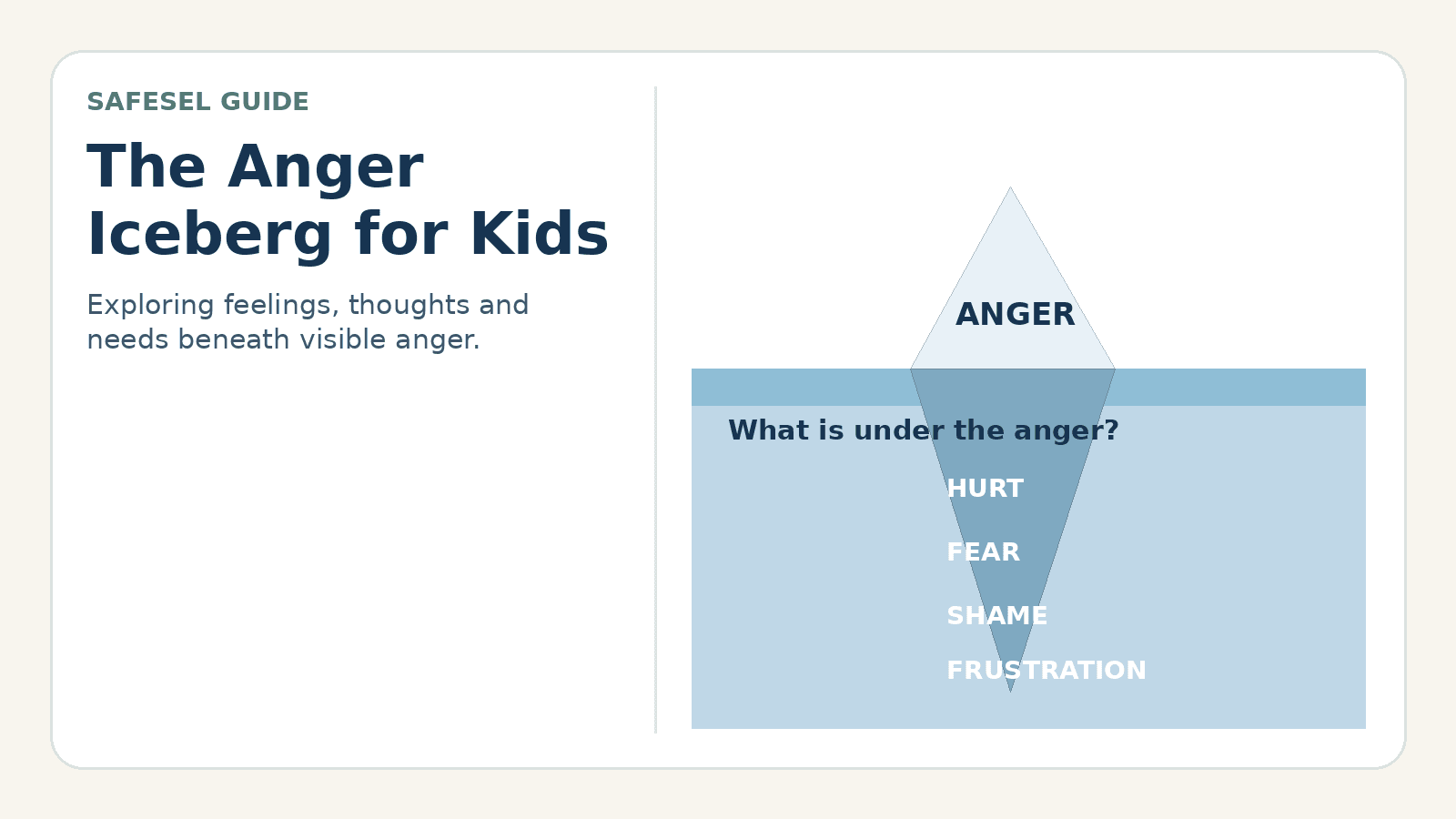
Consider blocked goals, perceived injustice, shame, anxiety, sensory overload, fatigue, hunger, communication difficulty, peer provocation, and learned interaction patterns. More than one factor can be present. The goal is not to select a single permanent explanation but to identify what can be changed and which skill is missing in that situation.
Components of an anger and repair plan
A robust plan includes:
- known high-risk settings and triggers;
- environmental prevention;
- an early communication phrase or signal;
- adult language during escalation;
- specific safety actions and adult roles;
- rules for space, breaks, and return;
- direct consequences connected to impact;
- repair and restitution;
- rehearsal of an alternative response;
- monitoring and review.
The plan should state what adults will not do: argue publicly, threaten impossible consequences, use physical punishment, force immediate apologies, or require the harmed person to reconcile. It should also state when emergency or specialist procedures are activated.
Reviewing responsibility and trust
After regulation improves, review the event in manageable parts. Ask what happened, what the child noticed, what impact occurred, and what response could be used earlier. Keep responsibility specific: “You threw the controller and it broke” is more useful than “You ruin everything.”
Trust is rebuilt through repeated safe actions. An apology can be meaningful, but it does not automatically restore access, replace damaged property, or require another person to forgive. Allow the person harmed to need time, distance, or additional boundaries.
Practical questions adults often ask
Should there always be a consequence after an outburst?
There should always be an adult response to unsafe behavior and meaningful impact, but that response is not always an added punishment. Immediate safety action, temporary restriction connected to risk, repair, restitution, changing supervision, and practising an alternative may all be appropriate. The response should be proportionate, understandable, and linked to what happened. Basic needs and legitimate disability or regulation supports should not be removed as punishment.
What if the child says the outburst was not their fault?
Begin by separating explanation, intention, and impact. A peer may have provoked the child, an adult may have handled the situation poorly, and the child may still be responsible for throwing an object. Multiple people can have responsibilities in one event. Do not force a global confession. Ask what part the child controlled, what support was missing, and what repair is now possible.
When is an apology useful?
An apology is useful when it is voluntary enough to be meaningful, identifies the impact, and is accompanied by action when needed. It is less useful when demanded during peak anger, scripted for public display, or used to pressure the harmed person into immediate forgiveness. Younger children may begin with a short repair action before they can produce a nuanced verbal apology.
How can adults protect siblings or peers without permanently excluding the child?
Safety may require distance, supervision, restricted access to objects, or separate activities. Explain the conditions for return clearly and review them. The harmed child should not be required to resume closeness quickly. At the same time, provide the child who caused harm with a structured path to practise safer participation and rebuild access through consistent behavior.
Publication checklist for this guide
Confirm that the article includes urgent safety exceptions, rejects physical and humiliating punishment, distinguishes anger from aggression, and protects the rights of people affected. Avoid implying that co-regulation removes accountability or that a repair conversation is sufficient for serious repeated violence.
A two-week implementation cycle
For the first week, change only one or two parts of the plan. Record the situation, the earliest cue, the support used, and the child’s next action across a small number of relevant opportunities. Keep ordinary successful moments in the sample so the review is not built only from crises.
At the end of the week, compare what adults expected with what actually happened. Decide whether the barrier was task size, timing, adult language, sensory load, social context, unclear return, or insufficient practice. Keep the parts that improved access or safety.
During the second week, adjust one variable. This might mean making the step slightly smaller, moving the prompt earlier, using a more private cue, clarifying the return task, or reducing one unnecessary reassurance response. Avoid changing the entire plan after one difficult day.
At the review, decide whether to continue, fade support, redesign the step, or seek additional assessment. Document the reason for the decision in plain language. A useful plan should become clearer over time, not collect more rules indefinitely.
Related SafeSEL resources
- Parent pillar: Anger in Children: Safety, Skills, and Repair
- Suggested product line: Anger worksheets / Scenario cards / Anger toolkit
- Suggested free resource: Repair Conversation Guide
Before publication, replace these planning labels with one exact product URL, one exact free resource, one parent or pillar article, and two or three related articles with clearly different search intentions.
Sources and further reading
- Violent Behavior in Children and Adolescents — AACAP
- Threats by Children: When Are They Serious? — AACAP
- What’s the Best Way to Discipline My Child? — HealthyChildren.org
- Children and Mental Health: Is This Just a Stage? — NIMH
- Get Help Now — StopBullying.gov
- What Is the CASEL Framework? — CASEL