A social story can make an unfamiliar friendship situation more predictable, but it should not be used to prescribe one socially acceptable response or place all responsibility for repair on one child.
Social stories for friendship problems can explain an unfamiliar situation and give a child a few realistic choices. They cannot make another child behave kindly or resolve bullying by changing the targeted child’s response. Before choosing a story, ask what information is missing and who needs to act.
A useful story might explain how to ask to join a game, what a friend may mean by wanting space or how to repair an interruption. It should not promise that everyone will include the child if they follow the script. Relationships involve more than one person, and adult support and responsibility remain part of the plan.
Social story examples: joining, taking turns and repairing
Friendship social stories work best when the example answers a particular question. For joining play, describe how to ask and what to do if the answer is no. For taking turns, show how a child knows when a turn begins and ends. For repair, explain a possible action after harm without promising immediate forgiveness. These social story examples need different endings because they teach different information.
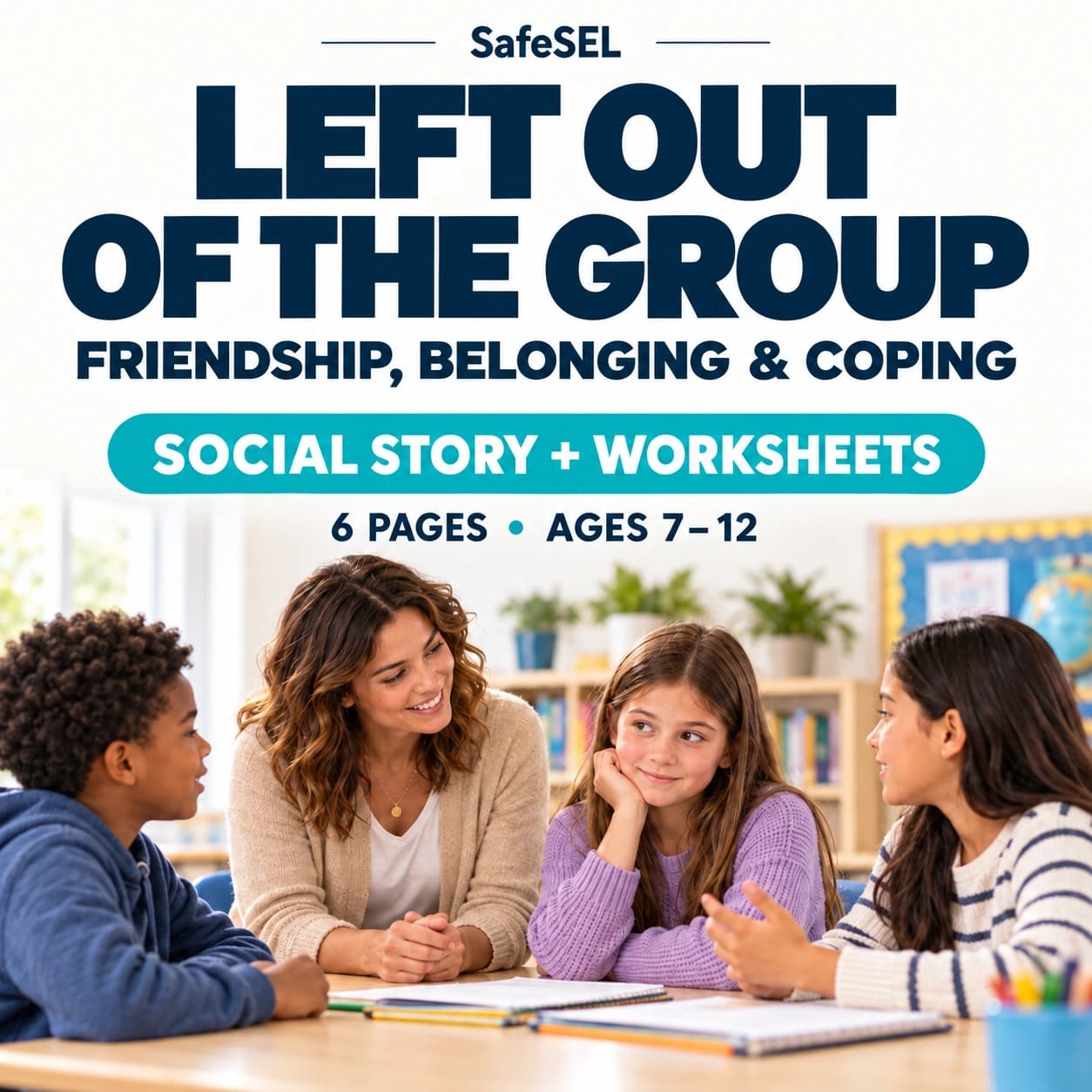
Printable social stories and friendship worksheets can complement each other: read a short narrative, then draw or discuss one option for a real situation. Social skills worksheets should not become a test of whether a child accepts unfair treatment. When choosing social narratives, check that adults have responsibilities too and that the child can request help, decline or take space.
Distinguish a close friendship from a controlling friendship
A clear context
Choose one situation rather than a general instruction to be a good friend. ‘Joining the drawing table after lunch’ is specific enough to describe who is there, how a child can approach and what choices are available. Check that the description matches the actual setting. A script about taking turns will not help if one child controls the materials and adults do not intervene.
Several viewpoints without pretending to read minds
Describe possibilities: a child may want to finish a drawing before talking, may not hear a question or may prefer a different game. Use ‘might’ when motives are unknown. Ask the child whether another explanation fits. Do not use the narrative to tell them that a hurtful event was harmless before the facts are understood.
Options rather than one required performance
Include choices the child can actually use: ask to join, suggest a role, wait briefly, choose another activity or get adult help. A child should not have to smile, make eye contact, accept touch or keep approaching someone who has said no. The goal is usable information and respectful action, not an emotional performance.
Accurate adult responsibility
Name how adults will help. For example: ‘If someone keeps taking my materials, I can tell the teacher. The teacher can help us use the shared supplies fairly.’ Avoid a story in which the child must handle repeated harm alone through better manners. Adults also need to address supervision, accessibility and group rules.
Age-respectful language and design
Use words and pictures the child understands without making the page feel babyish. Read one section together and invite corrections. Some children prefer a spoken discussion, a comic strip or a brief role-play. Finishing every page is not necessary if one example answers the question. A story is a delivery format; its usefulness depends on fit and what happens afterward.
A worked example: a friend wants to play with someone else
Illustrative example: Amira wants her usual friend to play the same game every day. A narrative can explain that friends sometimes choose different activities and that disappointment is allowed. It can offer a concrete response: ‘Okay, I’ll draw today. Maybe we can play later.’ It should not require Amira to feel happy or promise the friend will return tomorrow.
After reading, practise one short exchange with an adult. At the next opportunity, notice whether Amira could communicate her preference and choose an available activity. If peers are deliberately humiliating or isolating her, the next step is adult intervention—not repeated practice accepting exclusion.
When stories are the wrong first response: bullying or coercion
Bullying or coercion is a safety concern, never something to rehearse or increase in difficulty. Investigate repeated targeted harm, threats and power differences using the school’s procedures. A narrative can explain how to seek help, but it cannot replace protection or a response to the people causing harm.
Stories are also poorly matched when the obstacle is pain, inaccessible communication, overwhelming noise or a rule the child cannot carry out. Change the barrier. More reading does not make an unavailable option available.
Review the real interaction
Ask whether the story clarified something, gave a usable option or helped the child request support. Include the child’s account. Quiet compliance is not proof that a friendship problem is solved. Keep a helpful story, adapt an inaccurate one and stop using a story that becomes a punishment or repeated argument.
Evidence for social narratives does not mean every printable follows a studied approach. Use these resources as educational supports. When distress or communication difficulties substantially affect daily life, seek individualized help from a qualified mental health or communication professional as appropriate. Seek prompt adult action for unsafe situations rather than waiting for the child to master a worksheet.
Social story or visual schedule?
Related guidance for the next step
Sources and further reading
- Social Stories — The Gray Center
- CASEL Framework — Collaborative for Academic, Social, and Emotional Learning
- What Is Bullying? — StopBullying.gov
- Support the Children Involved — StopBullying.gov
- UDL Guidelines — CAST
- Use Multiple Media for Communication — CAST