A useful Thought Detective worksheet helps children separate a situation from an automatic thought, check the available evidence and practise a more balanced thought without demanding forced positivity.
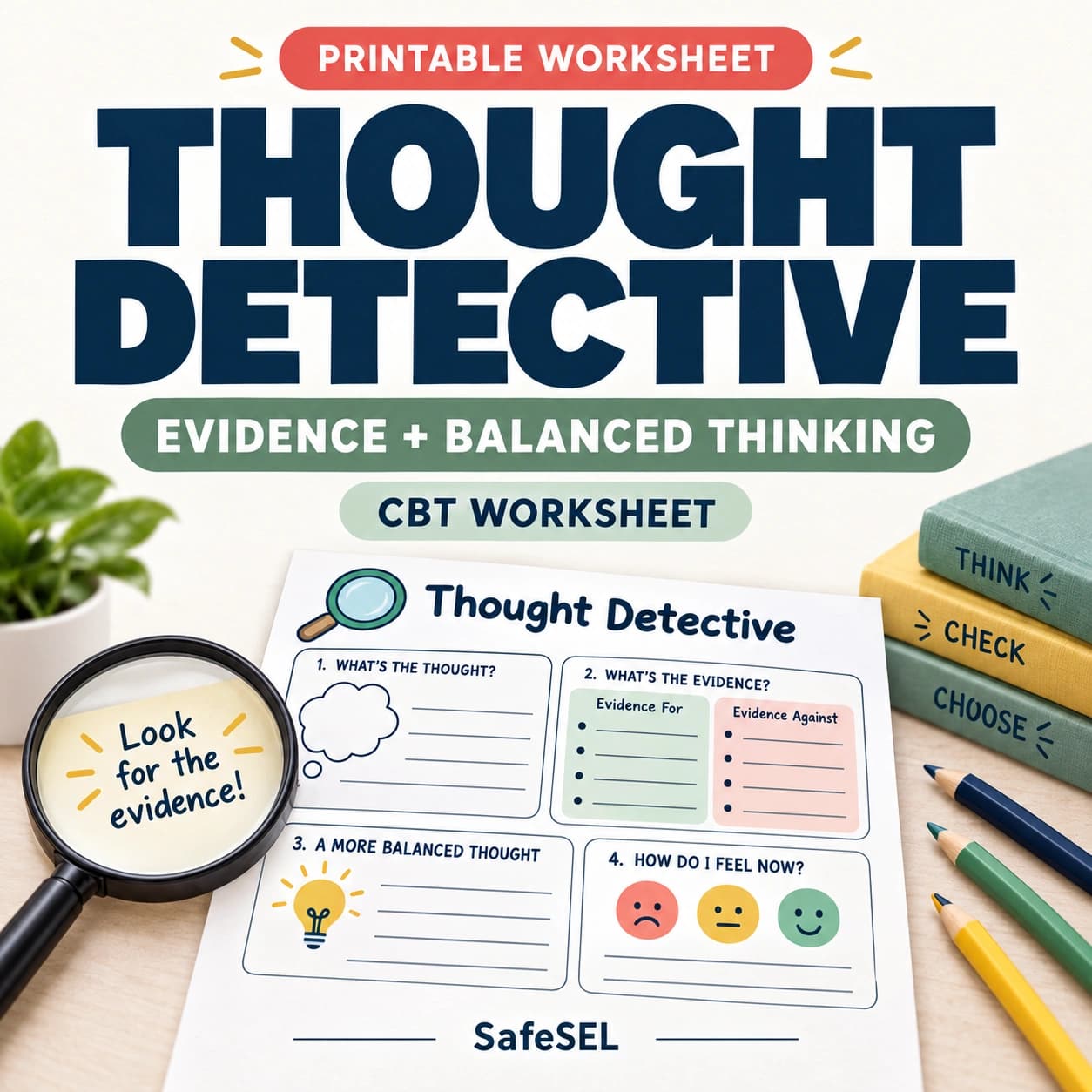
A thought detective worksheet is a CBT-informed tool that helps a child slow down and examine the meaning they gave to a situation. The goal is not to prove that a child is “thinking incorrectly.” It is to make an automatic thought visible enough to check, compare with the available evidence and connect to a workable next step.
The most useful worksheets teach a repeatable process rather than asking for positive thinking. They separate what happened from what the child predicted or assumed, make room for uncertainty and end with a balanced thought or small behavioral experiment. The worksheet is a teaching aid—not a diagnosis, a test of honesty or a substitute for individualized care.
Choosing an emotion worksheet or a thought detective page
An emotion worksheet helps a child name or describe a feeling. An evidence worksheet asks a different question: what information supports a prediction, and what information does not fit it? When comparing mental health worksheets for students, decide which of those skills the child needs before choosing the design. Worksheets for elementary students should make the distinction visible without requiring an adult-sized written explanation.
A speech bubble worksheet can capture the thought in a child's own words before moving to evidence. Be cautious with positive thinking worksheets for students that require an upbeat ending: a credible answer may be 'I do not know yet, but I can ask.' The useful outcome is a fairer interpretation and a workable action, not a cheerful sentence in every box.
How to review a CBT worksheet without grading the answer
The five core skills a thought detective worksheet should teach
1. Separate the situation, thought, feeling and action
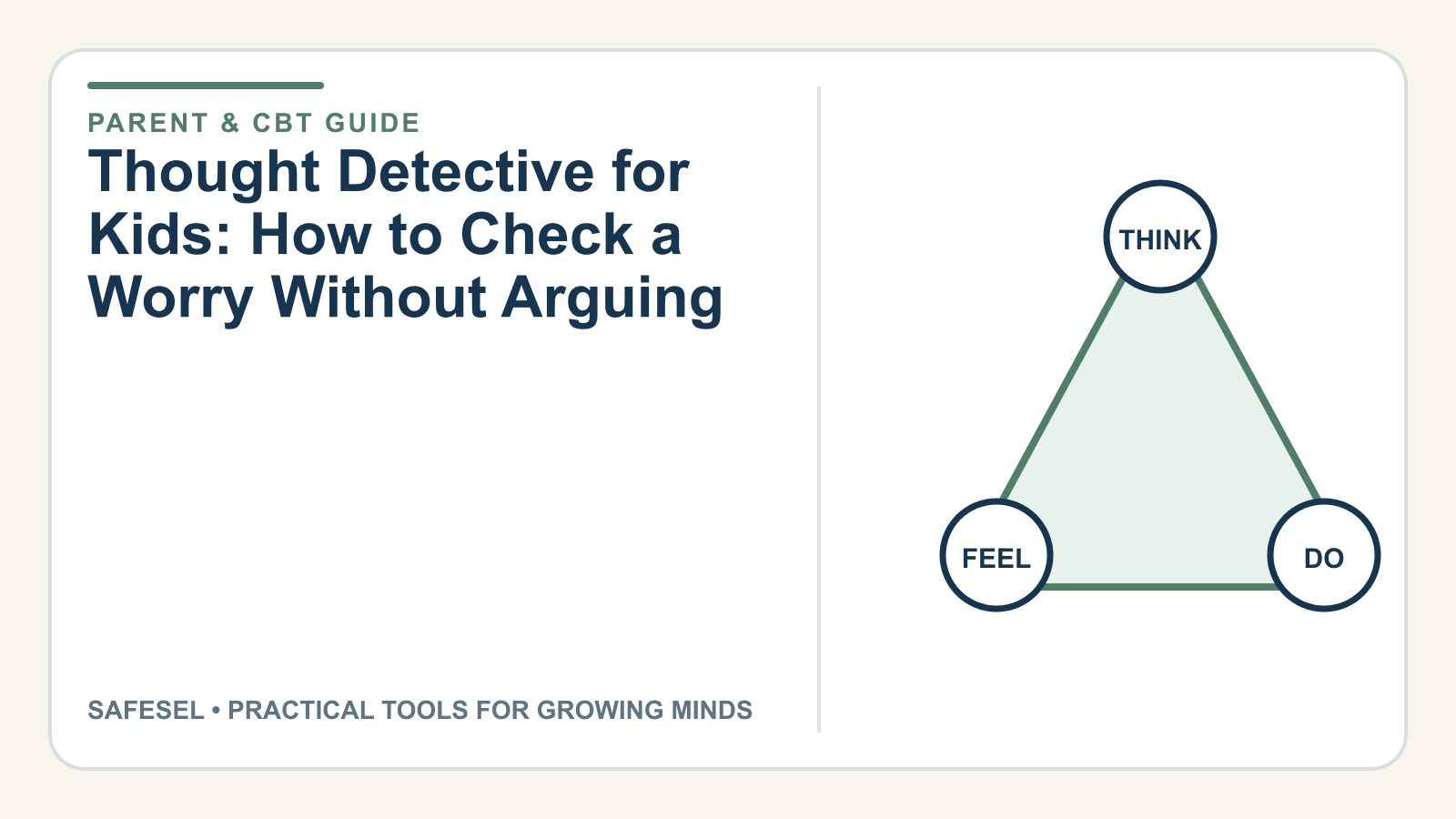
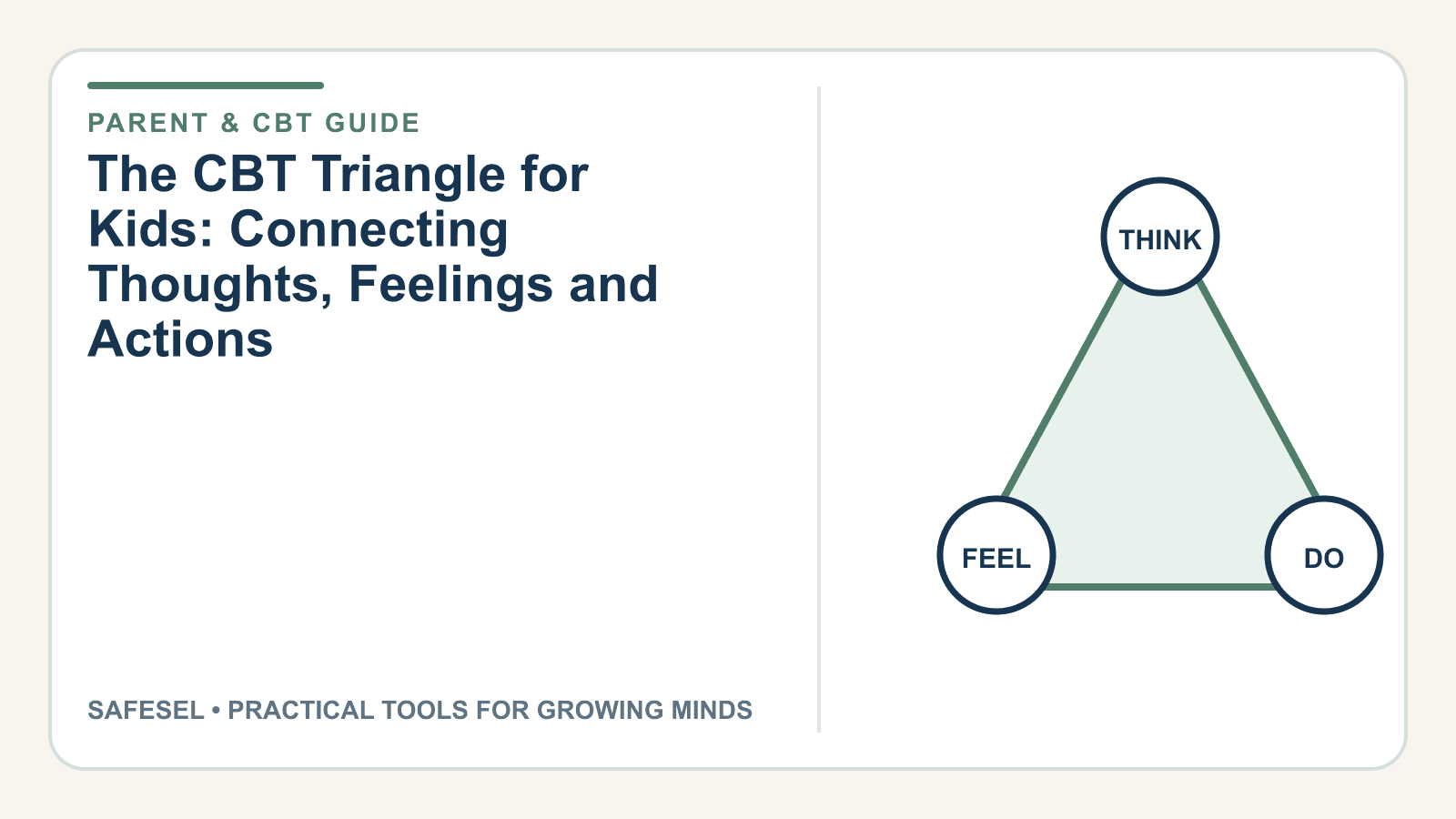
Children often experience these parts as one event: “She ignored me, so nobody likes me, I felt awful and I walked away.” A clear worksheet gives each part its own space. Start with the observable situation, then record the thought, emotion and action. This prevents adults from treating an interpretation as a fact and helps the child see where a different response may become possible.
2. Capture the child’s exact thought
Useful thought work begins with the child’s own words. “I was upset” is a feeling; “I will get every answer wrong” is a prediction. Prompts such as “What did your mind say would happen?” or “What did that moment seem to mean?” are often easier than asking why. Younger children may point to choices, draw a speech bubble or dictate the sentence to an adult.
3. Distinguish facts from predictions and interpretations
A fact is something a camera or neutral observer could verify. Predictions and interpretations may still be understandable, but they contain uncertainty. “The teacher returned my paper” is observable. “The teacher thinks I am stupid” is an interpretation. The skill is not to dismiss the interpretation; it is to label it accurately enough to investigate.
4. Check evidence fairly
A strong worksheet asks for evidence that supports the thought and evidence that does not fully fit it. This should not become an argument in which the adult supplies the “correct” answer. Look for specific information: what happened on other occasions, what the person actually said, whether there are alternative explanations and what remains unknown.
5. Build a balanced thought and choose a next step
Balanced thoughts are credible, specific and useful. “Everything will be perfect” is usually less believable than “I may make a mistake, and I can ask for help or correct one part.” The final box should connect the new thought to an action: ask one question, check the instructions, greet the friend again or test the prediction in a safe way.
Worked example: “My friend did not say hello”
- Situation: I said hello at the classroom door and my friend walked past.
- Automatic thought: She is angry with me and does not want to be my friend.
- Feeling and intensity: worried, 8 out of 10.
- Evidence that fits: she did not answer me.
- Evidence that does not fully fit: the hallway was noisy; she was speaking to a teacher; we played together yesterday.
- Balanced thought: I do not know why she missed my greeting. I can check later instead of deciding what it means now.
- Next step: say hello again at recess or ask, “Did you hear me this morning?”
The balanced thought does not promise that the friendship is fine. It replaces certainty with a more accurate statement and gives the child a respectful way to gather information.
What good worksheet design looks like
- One clear question per step, with enough white space to reduce visual load.
- A short emotion scale or visual choice rather than requiring a long written explanation.
- Optional ways to respond: speak, point, draw, type or use an adult as a scribe.
- A worked example that is separate from the child’s private experience.
- A final action box so the exercise transfers beyond the page.
Length should match the learning goal. One situation completed collaboratively is usually more useful than several pages completed for compliance. Select only the sections needed for the current skill.
How to introduce the worksheet without creating a debate
Teach the process when the child is regulated enough to think and communicate. Model it first with a neutral adult example, then try a fictional or low-stakes scenario. Ask permission before using a personal event and explain that the child may leave out private details that are not necessary for the skill.
- Start collaboratively: “Can we investigate what your mind predicted?”
- Validate the emotion without confirming an untested conclusion: “It makes sense that this felt worrying. Let’s separate what we know from what we are guessing.”
- Offer genuine choices about format and which section to complete.
- Stop if the exercise becomes the main source of conflict; return later or use a spoken version.
Common mistakes to avoid
Forced positivity
Replacing “I will fail” with “I will definitely succeed” teaches reassurance rather than flexible thinking. A better alternative acknowledges both uncertainty and coping: “This may be difficult, and I can start with one question or ask for clarification.”
Cross-examining the child
Rapid questions can feel like an adult is trying to win. Curiosity works better than correction. Pause, reflect the child’s meaning and examine one piece of evidence at a time.
Using the worksheet during peak distress
When a child is highly activated, prioritize safety, lower stimulation and co-regulation. Reflection and cognitive work usually belong after the child can access language and attention again.
Requiring every box
Completion is not the outcome. The outcome is whether the child can notice a thought, hold more than one explanation and choose a useful action with gradually less support.
Developmental and accessibility adjustments
For younger children, use pictures, speech bubbles and two concrete alternatives. Older children can work with probability, cognitive biases and behavioral experiments. Adapt reading level, motor demands, sensory load and communication method without lowering the underlying goal. Do not require eye contact, extensive writing or disclosure of sensitive information as proof of learning.
How to tell whether the worksheet is helping
Review change across several real situations. Useful signs include identifying the automatic thought more quickly, distinguishing facts from predictions, generating more than one explanation and taking a constructive next step. Record whether the child completed the skill independently, with a prompt or only with adult modeling.
If anxiety, low mood, intrusive thoughts or behavioral difficulties are persistent, worsening or significantly interfere with school, sleep, relationships or daily functioning, seek an individualized evaluation from a qualified health or mental-health professional. A printable can support practice, but it cannot determine the cause of a child’s difficulty or replace treatment.
If you are choosing among printable formats, the CBT worksheets guide helps you compare tools around the skill you want to practice. Keep the child’s next action, rather than the number of completed pages, as the goal.
Related guidance for the next step
Sources and further reading
- Treating Children’s Mental Health with Therapy — Centers for Disease Control and Prevention (2026)
- Psychotherapies — National Institute of Mental Health (2024)
- Psychotherapies for Children and Adolescents — American Academy of Child and Adolescent Psychiatry (2017)