A child may complete the journey to an activity and still freeze at the entrance because the final transition makes the feared situation immediate. Adults can respond more effectively when they separate the immediate task—safety, transition, communication, or support—from the later task of teaching. The aim is not to remove every difficult feeling. It is to make the next safe and learnable step clearer.
Three priorities for the adult
1. Protect safety and access
Reduce talking, stand beside rather than in front of the child, and offer the preplanned first step. The adult’s first response should reduce the number of moving parts rather than introduce a full lesson.
2. Keep the limit understandable
Do not drag, shame, or surprise the child; do not automatically leave at the first spike if a safe graded step is possible. State what must stop and what remains available. Avoid making the child guess how to regain adult support.
3. Preserve a path back
Later, record the exact step completed and choose the next practice target. A path back may involve returning to the activity, restoring an item, checking impact, or using a clearer message.
Why the pattern can repeat
Uncertainty and prediction
Anxiety tries to obtain certainty about what will happen and whether the child will cope. A child may complete the journey to an activity and still freeze at the entrance because the final transition makes the feared situation immediate.
Short-term relief
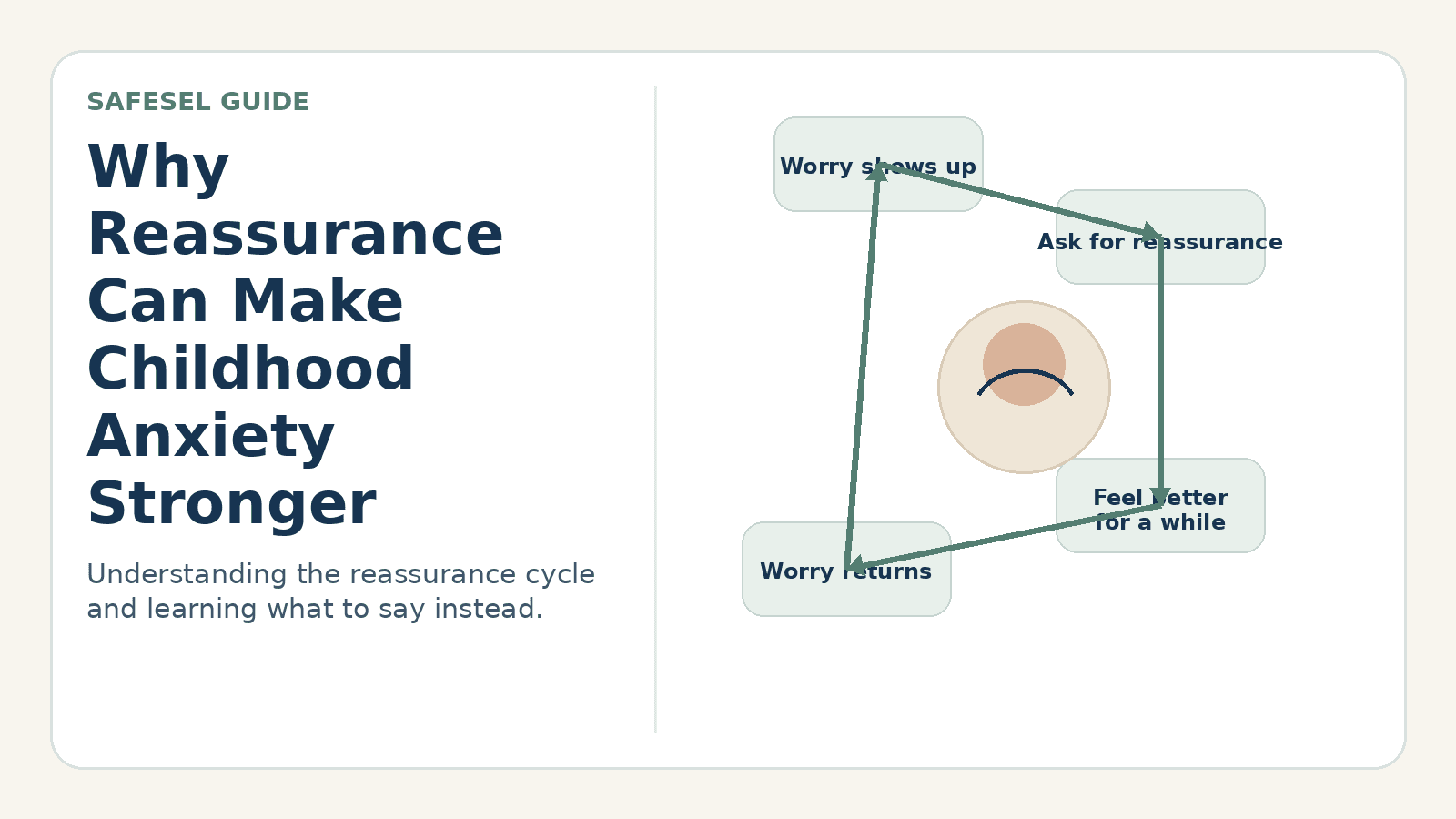
Avoidance, repeated reassurance, checking, or adult rescue can reduce distress immediately. That relief is powerful, but it can also prevent the child from learning that discomfort can rise and fall without the feared outcome occurring.
The size of the step
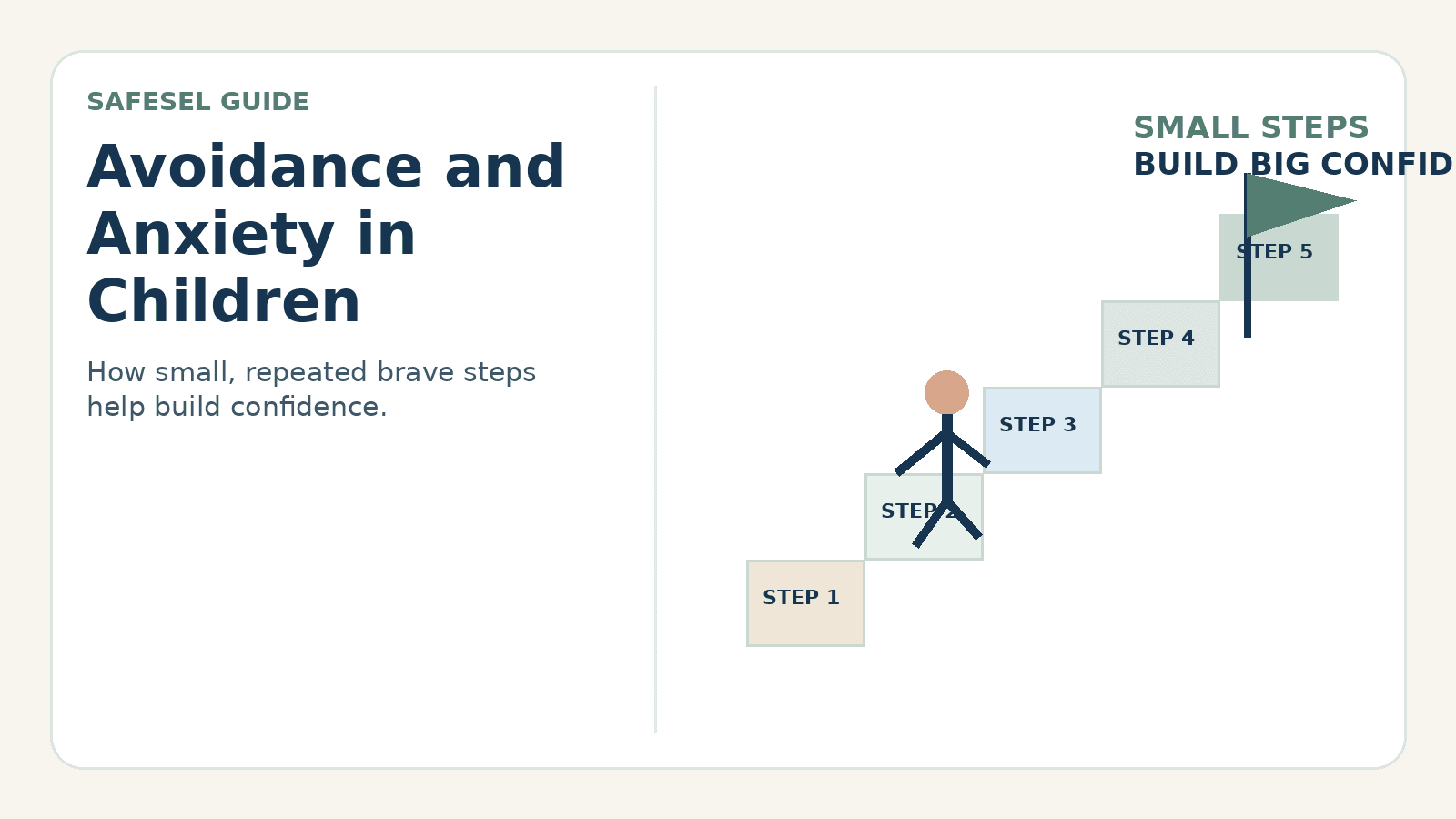
A step can be developmentally reasonable and still be too large for this child today. Good support does not remove every challenge; it adjusts the approach so that practice remains possible. use a graded sequence such as approach the door, stand inside for one minute, greet one adult, then reassess.
Real-world conditions
Anxiety should not be used to explain away actual problems such as bullying, pain, unsafe facilities, or unclear adult procedures. Before building a practice plan, adults should check the context: preview the entrance, identify a contact person, choose a low-crowd arrival time, and agree on the first action inside.
Questions that clarify the plan
Use these questions with adults first; not all of them need to be asked directly to the child.
- What exactly happened immediately before the first sign?
- What did the child believe was being lost, threatened, demanded, or decided?
- Which skill did the situation require?
- What information was only in adult speech and could be made visible?
- Did the adult response reduce or increase uncertainty and load?
- What was the route back to participation?
- Was there a real safety, access, health, or peer problem that still needs action?
Examples worth comparing include: freezing outside sports practice; refusing to enter a club room; or sitting in the car before a lesson.
A one-page plan
Early cue: Choose one sign from this list: adult pressure or public attention, unclear drop-off, past bullying or humiliation, physical symptoms requiring medical assessment.
Adult response: reduce talking, stand beside rather than in front of the child, and offer the preplanned first step.
Child option: use a graded sequence such as approach the door, stand inside for one minute, greet one adult, then reassess.
Boundary: do not drag, shame, or surprise the child; do not automatically leave at the first spike if a safe graded step is possible.
Return: later, record the exact step completed and choose the next practice target.
Keeping the plan short makes it easier for different adults to use consistently.
A realistic example
Consider Ava. In one recent situation, freezing outside sports practice. The adult’s first impulse is to explain why the reaction is unnecessary. Instead, the adult uses the agreed first move: reduce talking, stand beside rather than in front of the child, and offer the preplanned first step. This does not solve the whole problem, but it lowers the number of demands in the moment.
Later, when Ava is more available, they review another example: refusing to enter a club room. The adult does not ask for a perfect account. They identify one cue, practice one replacement response, and restate the boundary: do not drag, shame, or surprise the child; do not automatically leave at the first spike if a safe graded step is possible. The next attempt is measured by whether the plan was used earlier or more safely—not by whether the child felt no distress.
Words that combine support and clarity
- “We are not deciding the whole hour. The step is the doorway.”
- “I will walk in with you to the agreed point.”
- “You can feel anxious and take one small step.”
- “If the plan is too large, we will shrink it—not abandon every future attempt.”
Practice without pressure
Choose a low-intensity version of the situation. Explain the plan in less than one minute, demonstrate the first step, and let the child practice once or twice. Do not repeat until performance deteriorates. The aim is familiarity, not mastery in one session.
For younger children, use a picture or physical cue. For ages 7–9, offer two concrete options. For ages 10–12, invite the child to edit the wording and decide how adults will prompt discreetly.
What adults should stop doing
- Avoid ten-minute persuasive speeches at the door. This can increase shame, confusion, dependence on adult rescue, or escalation without teaching a usable alternative.
- Avoid threatening loss of all activities. This can increase shame, confusion, dependence on adult rescue, or escalation without teaching a usable alternative.
- Avoid letting multiple adults crowd the child. This can increase shame, confusion, dependence on adult rescue, or escalation without teaching a usable alternative.
- Avoid calling the attempt a failure if the child completed a smaller step. This can increase shame, confusion, dependence on adult rescue, or escalation without teaching a usable alternative.
Decision guide
What adults observe — A possible interpretation — A useful next response
--- — --- — ---
Child exits the car but stops — The final approach is the difficult step — Use a micro-goal
Child enters then runs out — Duration may be too large — Practice brief entry and planned exit
Fear is linked to a specific person or event — Safety investigation may be needed — Do not treat it only as anxiety
Signs that the plan is helping
- the first cue is noticed earlier;
- the adult uses fewer prompts;
- the child uses a safer response even while still upset;
- the difficult period becomes shorter or less disruptive;
- return or repair happens with less shame;
- the child can describe one part of the plan later.
When to seek additional support
Additional support may be helpful when the pattern is frequent, worsening, or substantially interferes with school, sleep, health, friendships, or family functioning. Seek prompt professional advice when there is persistent aggression, property destruction, severe avoidance, repeated panic, significant toileting or medical symptoms, or a marked change from the child’s usual functioning. Do not assume that avoidance is anxiety when the child may be reporting pain, bullying, unsafe conditions, or another real problem.
Related SafeSEL resources
- Parent guide: Childhood Anxiety: Practical Support Without Reinforcing Avoidance
- Suggested product line: Anxiety worksheets / Parent anxiety handouts / Brave Steps resources
- Free practice resource: Worry Pattern Tracker
Sources and further reading
- Separation Anxiety — American Academy of Pediatrics
- Help Your Child Manage Anxiety — American Academy of Pediatrics
- What to Do (and Not Do) When Children Are Anxious — Child Mind Institute
- 10 Tips for Parenting Anxious Kids — Child Mind Institute
- Fears & Phobias in Children — American Academy of Pediatrics
- School Avoidance — American Academy of Pediatrics