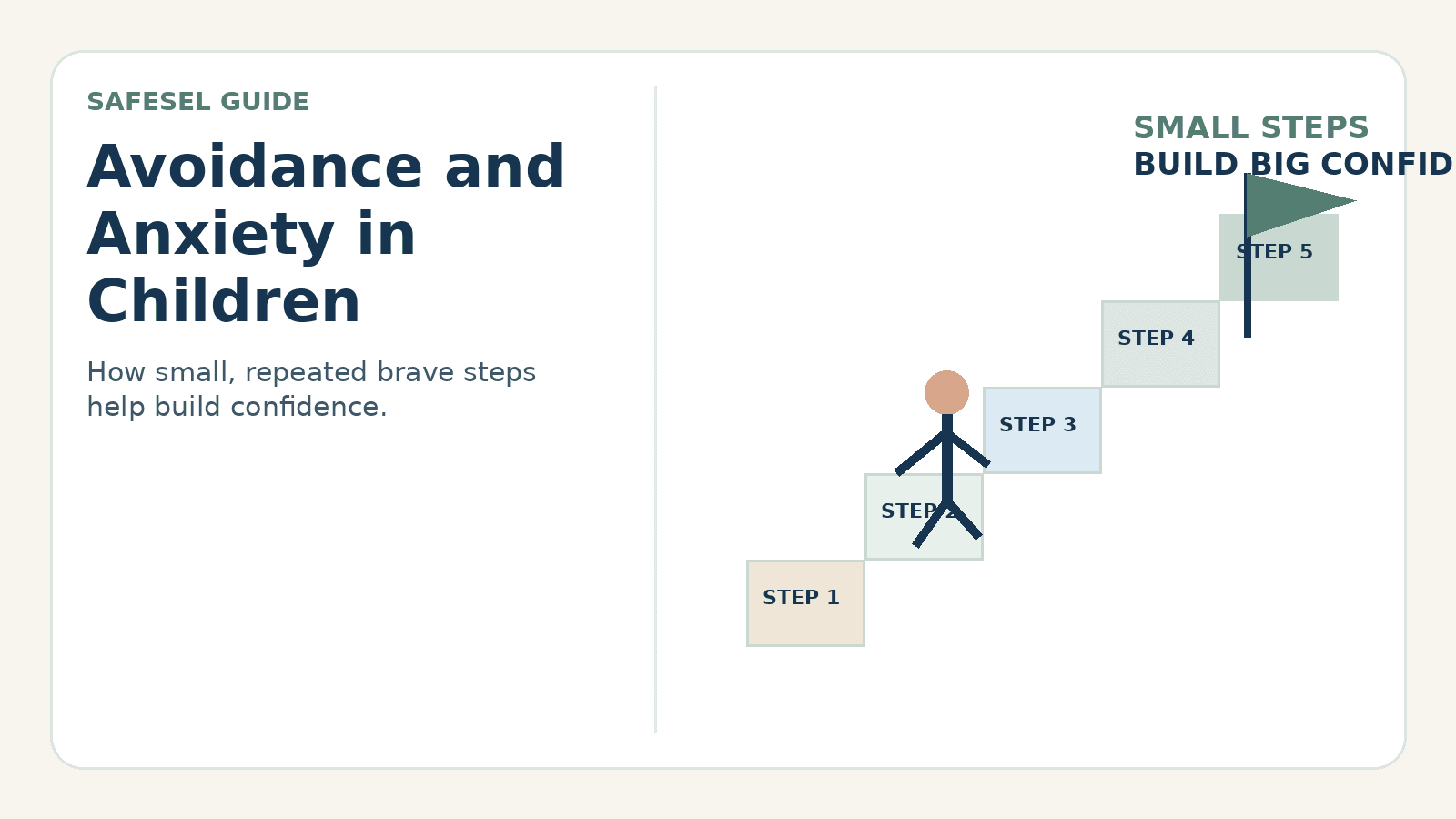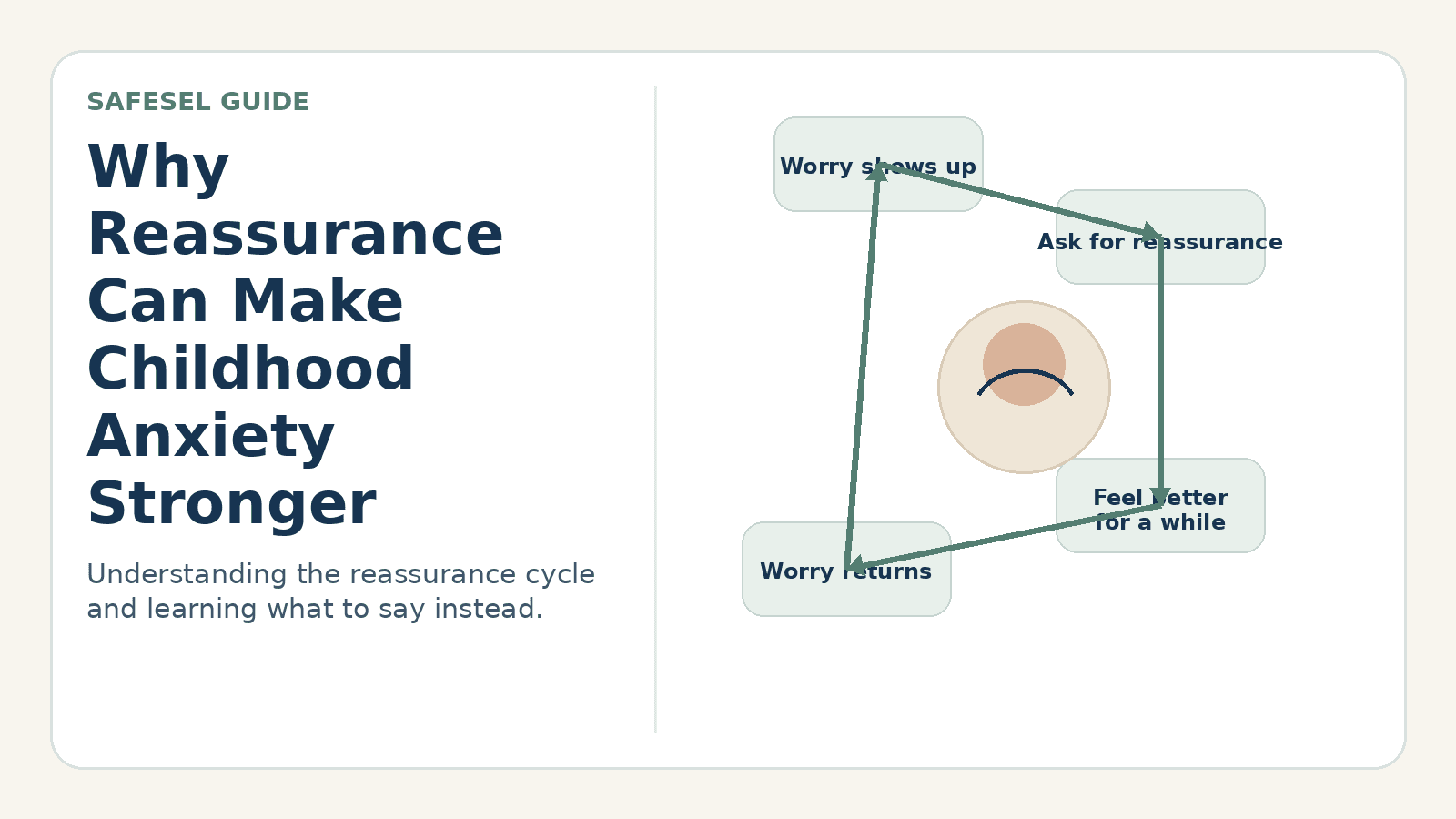
Children do not need adults to approve every reaction, and adults do not need to eliminate every uncomfortable emotion. They do need a response that is clear enough to use under pressure. Bedtime worry can expand because the environment is quiet, separation increases, and repeated questions temporarily reduce uncertainty. The relief can make the question cycle more likely the next night. The sections below focus on what adults can do and what the child can practice.
In brief
First, answer new, practical questions once and identify repeated reassurance questions as part of the worry loop. Next, teach the child to record the thought, use one coping statement, and return attention to the bedtime routine. The central goal is to respond supportively without creating an endless reassurance ritual and preserve a predictable sleep routine. Bedtime remains bedtime; serious concerns can be discussed, but repeated checking does not need unlimited answers.
Misconception: the child already knows better, so more pressure should work
Knowledge during a calm conversation does not guarantee access to the same knowledge under stress. Bedtime worry can expand because the environment is quiet, separation increases, and repeated questions temporarily reduce uncertainty. The relief can make the question cycle more likely the next night. A more effective response identifies what the child must notice, remember, communicate, inhibit, or tolerate in the real moment.
Reality: the plan needs prevention, action, and return
Prevention
Set a regular worry time earlier in the evening, reduce stimulating content, and use a brief written plan for common concerns. Prevention is not the same as removing every challenge. It makes the challenge understandable and appropriately sized.
Action
Answer new, practical questions once and identify repeated reassurance questions as part of the worry loop. Follow with a clear boundary: bedtime remains bedtime; serious concerns can be discussed, but repeated checking does not need unlimited answers. If the child cannot choose, offer the smallest number of options.
Return
The next day, review the pattern and adjust the plan rather than conducting a long analysis during the night. A return step protects learning and responsibility without trying to teach through peak distress.
What may be maintaining the pattern
Uncertainty and prediction
Anxiety tries to obtain certainty about what will happen and whether the child will cope. Bedtime worry can expand because the environment is quiet, separation increases, and repeated questions temporarily reduce uncertainty. The relief can make the question cycle more likely the next night.
Short-term relief
Avoidance, repeated reassurance, checking, or adult rescue can reduce distress immediately. That relief is powerful, but it can also prevent the child from learning that discomfort can rise and fall without the feared outcome occurring.
The size of the step
A step can be developmentally reasonable and still be too large for this child today. Good support does not remove every challenge; it adjusts the approach so that practice remains possible. teach the child to record the thought, use one coping statement, and return attention to the bedtime routine.
Real-world conditions
Anxiety should not be used to explain away actual problems such as bullying, pain, unsafe facilities, or unclear adult procedures. Before building a practice plan, adults should check the context: set a regular worry time earlier in the evening, reduce stimulating content, and use a brief written plan for common concerns.
A practical example
Consider Eli. In one recent situation, “What if you forget to wake me?.” The adult’s first impulse is to explain why the reaction is unnecessary. Instead, the adult uses the agreed first move: answer new, practical questions once and identify repeated reassurance questions as part of the worry loop. This does not solve the whole problem, but it lowers the number of demands in the moment.
Later, when Eli is more available, they review another example: “What if I get sick tonight?.” The adult does not ask for a perfect account. They identify one cue, practice one replacement response, and restate the boundary: bedtime remains bedtime; serious concerns can be discussed, but repeated checking does not need unlimited answers. The next attempt is measured by whether the plan was used earlier or more safely—not by whether the child felt no distress.
Adult language
- “That sounds like the worry asking for another answer.”
- “We answered that once; now use the bedtime plan.”
- “Write it on the morning list if it still matters tomorrow.”
- “I will check on you at the agreed time.”
What to monitor for two weeks
- Compulsive checking or rituals — note whether this factor appears before, during, or after the difficult moment. It may change the timing, size, or type of support needed.
- Sleep deprivation — note whether this factor appears before, during, or after the difficult moment. It may change the timing, size, or type of support needed.
- Frightening media — note whether this factor appears before, during, or after the difficult moment. It may change the timing, size, or type of support needed.
- Worries about real family instability or safety — note whether this factor appears before, during, or after the difficult moment. It may change the timing, size, or type of support needed.
Include examples such as “What if you forget to wake me?”, “What if I get sick tonight?”, “Are you sure the door is locked?.” Look for clusters by time, person, demand, location, and body state. Do not collect data to prove that the child is difficult; collect only information that could change the plan.
What not to do
- Avoid answering the same question dozens of times. This can increase shame, confusion, dependence on adult rescue, or escalation without teaching a usable alternative.
- Avoid threatening the child for being awake. This can increase shame, confusion, dependence on adult rescue, or escalation without teaching a usable alternative.
- Avoid introducing complex coping exercises at midnight. This can increase shame, confusion, dependence on adult rescue, or escalation without teaching a usable alternative.
- Avoid promising certainty that no one can provide. This can increase shame, confusion, dependence on adult rescue, or escalation without teaching a usable alternative.
Age-sensitive support
Ages 4–6
Use pictures, one-step language, modeling, and more adult participation. Choose one phrase from the plan and one concrete action. Young children may need the adult to begin the action with them rather than explain it first.
Ages 7–9
Use short reflection, limited choices, and visible sequences. Children in this range can often compare two options and practice a script, but may still need reminders in the real situation.
Ages 10–12
Protect privacy and involve the child in designing the plan. Ask what support feels respectful, agree on how adults will check in, and make responsibility proportionate rather than public or humiliating.
Quick decision guide
What adults observe — A possible interpretation — A useful next response
--- — --- — ---
Question is new and solvable — Information may be appropriate — Answer briefly
Question repeats after reassurance — The cycle is being reinforced — Label the loop and return to the plan
Worry includes safety or self-harm — Immediate assessment is required — Stay with the child and seek urgent help
Measuring a useful outcome
Use a brief review after two or three attempts:
- Earlier cue: Did the child or adult notice the pattern sooner?
- Safer action: Was there less harm, less intensity, or a more appropriate exit?
- Participation: Could the child stay involved or return more effectively?
- Support level: Did the child need the same amount of adult help?
- Repair: Was impact addressed without prolonged shame?
The aim is not a perfectly calm performance. The aim is a more workable sequence. If there is no improvement, change one variable—timing, task size, cue, environment, or adult wording—rather than adding more consequences.
When to seek additional support
Additional support may be helpful when the pattern is frequent, worsening, or substantially interferes with school, sleep, health, friendships, or family functioning. Seek prompt professional advice when there is persistent aggression, property destruction, severe avoidance, repeated panic, significant toileting or medical symptoms, or a marked change from the child’s usual functioning. Do not assume that avoidance is anxiety when the child may be reporting pain, bullying, unsafe conditions, or another real problem.
Related SafeSEL resources
- Parent guide: Childhood Anxiety: Practical Support Without Reinforcing Avoidance
- Suggested product line: Anxiety worksheets / Parent anxiety handouts / Brave Steps resources
- Free practice resource: Worry Pattern Tracker
Sources and further reading
- Help Your Child Manage Anxiety — American Academy of Pediatrics
- What to Do (and Not Do) When Children Are Anxious — Child Mind Institute
- 10 Tips for Parenting Anxious Kids — Child Mind Institute
- Fears & Phobias in Children — American Academy of Pediatrics
- School Avoidance — American Academy of Pediatrics