← All guides
Anger

How to Respond When a Child Becomes Angry After Screen Time Ends

Practical steps for how to respond when a child becomes angry after screen time ends: what to notice, what to say, and how to build a safer, more usable

Written bySafeSEL Editorial TeamEducational content team

The behavior in this situation can look deliberate from the outside. Yet the same outward reaction can come from very different combinations of stress, skill demand, social meaning, and past learning. Stopping digital media requires children to shift attention, tolerate an unfinished reward loop, and move from a highly stimulating activity to a less stimulating demand. The practical question is: what response protects safety and dignity while helping the child do something different next time?

In brief

First, keep the limit short and neutral—do not add a lecture while the child is struggling to disengage. Next, rehearse saving, saying goodbye to peers, turning off the device, and moving to the next activity in the same order. The central goal is to make the ending predictable, reduce negotiation at the transition, and teach a repeatable exit routine. Do not return the device because anger became intense; adjust the future plan when calm.

Separate the problem into three layers

Layer 1: immediate safety and access

Keep the limit short and neutral—do not add a lecture while the child is struggling to disengage. If the child cannot use language or choices, the adult should carry more of the structure temporarily. The child can take over parts of the plan later.

Layer 2: the environment

Use agreed stopping points, visible timers, disabled autoplay, and a clear next activity rather than announcing the limit unexpectedly. A plan that ignores timing, noise, uncertainty, body state, or task design may ask the child to compensate for a preventable barrier.

Layer 3: the learnable skill

Rehearse saving, saying goodbye to peers, turning off the device, and moving to the next activity in the same order. The skill should be rehearsed outside the crisis and connected to a cue the child can recognize.

Four possible contributors

The meaning of the event

Anger often grows around what the event seems to mean: unfairness, loss of control, disrespect, rejection, or not being heard. Stopping digital media requires children to shift attention, tolerate an unfinished reward loop, and move from a highly stimulating activity to a less stimulating demand.

Skills available in the moment

The child may understand the family rule when calm but lose access to language, inhibition, and problem-solving as arousal rises. This is why more explanation during the peak often produces more argument rather than more understanding.

The surrounding load

Noise, time pressure, hunger, fatigue, previous conflict, and unclear expectations can lower the threshold for escalation. A useful plan therefore includes the environment: use agreed stopping points, visible timers, disabled autoplay, and a clear next activity rather than announcing the limit unexpectedly.

What the response has taught

If escalation sometimes delays the demand, changes the answer, brings several adults into a debate, or becomes the only route to being heard, the pattern can become more likely. This does not mean the child is calculating every reaction; it means the sequence around the behavior matters.

An observation map

Before — During — After

--- — --- — ---

Note the setting, body state, expectation, and recent stress. — Record the first cue, adult wording, choices, and safety concerns. — Record recovery time, return, repair, and what the child says later.

Pay special attention to autoplay or endless-scroll content, no agreed stopping point, screen use when hungry or overtired, online social pressure to remain. These factors do not prove a diagnosis; they help adults choose a more precise response.

A practical response protocol

1. Prepare the environment before the difficult moment

Use agreed stopping points, visible timers, disabled autoplay, and a clear next activity rather than announcing the limit unexpectedly. Keep the action specific: another adult should be able to see what was offered, what the child did, and what happened next.

2. Make the first thirty seconds simpler

Keep the limit short and neutral—do not add a lecture while the child is struggling to disengage. Use the same wording for several attempts so the support becomes predictable rather than another changing demand.

3. Hold the boundary without turning it into a debate

Do not return the device because anger became intense; adjust the future plan when calm. The step should be small enough to use, but meaningful enough to move the child toward participation or safety.

4. Practice the replacement skill when calm

Rehearse saving, saying goodbye to peers, turning off the device, and moving to the next activity in the same order. Keep the action specific: another adult should be able to see what was offered, what the child did, and what happened next.

5. Return for repair and learning

Review what made stopping hard, restore any affected responsibility, and revise the transition plan. Use the same wording for several attempts so the support becomes predictable rather than another changing demand.

Example in context

Consider Noah. In one recent situation, a game ends in the middle of a round. The adult’s first impulse is to explain why the reaction is unnecessary. Instead, the adult uses the agreed first move: keep the limit short and neutral—do not add a lecture while the child is struggling to disengage. This does not solve the whole problem, but it lowers the number of demands in the moment.

Later, when Noah is more available, they review another example: friends are still online when the family limit arrives. The adult does not ask for a perfect account. They identify one cue, practice one replacement response, and restate the boundary: do not return the device because anger became intense; adjust the future plan when calm. The next attempt is measured by whether the plan was used earlier or more safely—not by whether the child felt no distress.

Phrases for the difficult moment

  • “The screen is ending; the feeling can be big and the limit stays.”
  • “Choose: finish this round now or save at the next safe point within five minutes.”
  • “I will help with the transition, not restart the game.”
  • “We will review the plan tomorrow, not during the argument.”

Phrases or approaches that tend to backfire

  • Avoid repeated countdowns that become negotiations. This can increase shame, confusion, dependence on adult rescue, or escalation without teaching a usable alternative.
  • Avoid turning off the device without warning unless safety requires it. This can increase shame, confusion, dependence on adult rescue, or escalation without teaching a usable alternative.
  • Avoid adding unrelated consequences. This can increase shame, confusion, dependence on adult rescue, or escalation without teaching a usable alternative.
  • Avoid using screens as the only reliable calming tool. This can increase shame, confusion, dependence on adult rescue, or escalation without teaching a usable alternative.

Quick reference table

What adults observe — A possible interpretation — A useful next response

--- — --- — ---

Anger begins before the timer — Anticipatory frustration is building — Use one reminder and a chosen exit action

The child says the game cannot be stopped — There may be a real round or save constraint — Plan around natural stopping points next time

The child becomes unsafe — The issue is now safety, not screen rules — Secure the environment and postpone teaching

A two-week practice plan

Days 1–3: Observe and simplify

Collect two or three examples without trying to fix every part at once. Identify the earliest cue and remove one avoidable barrier. Agree on the exact first adult sentence.

Days 4–7: Rehearse the first response

Practice rehearse saving, saying goodbye to peers, turning off the device, and moving to the next activity in the same order. Keep practice under five minutes. Use the same cue and stop while the child is still successful.

Week 2: Use the plan in a real situation

Prompt early, not after the behavior is already at maximum intensity. Afterward, record whether the child noticed sooner, accepted support, used a safer action, or returned more effectively.

End-of-week review

Keep what helped. If there was no change, revise one component: the step size, the timing, the environmental support, the available choice, or the adult wording. Do not respond to poor results by making the same plan more forceful.

What success does not require

Success does not mean that the child never protests, worries, becomes disappointed, or needs adult support. It does not require a perfectly calm voice or a completed worksheet. A useful first outcome may be one safer action, a shorter delay, a clearer request, a smaller amount of adult rescue, or a more complete return. Measuring only the absence of emotion encourages adults to overlook meaningful skill growth and may pressure children to hide distress rather than manage it.

Developmental adaptations

Ages 4–6

Use pictures, one-step language, modeling, and more adult participation. Choose one phrase from the plan and one concrete action. Young children may need the adult to begin the action with them rather than explain it first.

Ages 7–9

Use short reflection, limited choices, and visible sequences. Children in this range can often compare two options and practice a script, but may still need reminders in the real situation.

Ages 10–12

Protect privacy and involve the child in designing the plan. Ask what support feels respectful, agree on how adults will check in, and make responsibility proportionate rather than public or humiliating.

Questions adults often ask

Should I ignore the anger?

No. Ignore neither the feeling nor safety. Reduce attention to provocative arguing if appropriate, while responding to distress, boundaries, and any harm.

Should there be a consequence?

Sometimes a practical consequence or repair is appropriate. It should be related to the impact and delivered after regulation, not designed to intensify shame.

What if the child refuses to discuss it later?

Keep the review short, use observations rather than interrogation, and begin with the smallest action needed for safety or repair.

Reviewing progress

Use a brief review after two or three attempts:

  • Earlier cue: Did the child or adult notice the pattern sooner?
  • Safer action: Was there less harm, less intensity, or a more appropriate exit?
  • Participation: Could the child stay involved or return more effectively?
  • Support level: Did the child need the same amount of adult help?
  • Repair: Was impact addressed without prolonged shame?

The aim is not a perfectly calm performance. The aim is a more workable sequence. If there is no improvement, change one variable—timing, task size, cue, environment, or adult wording—rather than adding more consequences.

When to seek additional support

Additional support may be helpful when the pattern is frequent, worsening, or substantially interferes with school, sleep, health, friendships, or family functioning. Seek prompt professional advice when there is persistent aggression, property destruction, severe avoidance, repeated panic, significant toileting or medical symptoms, or a marked change from the child’s usual functioning. Threats with a specific target, method, time, access to weapons, or inability to commit to immediate safety require urgent assessment.

Related SafeSEL resources

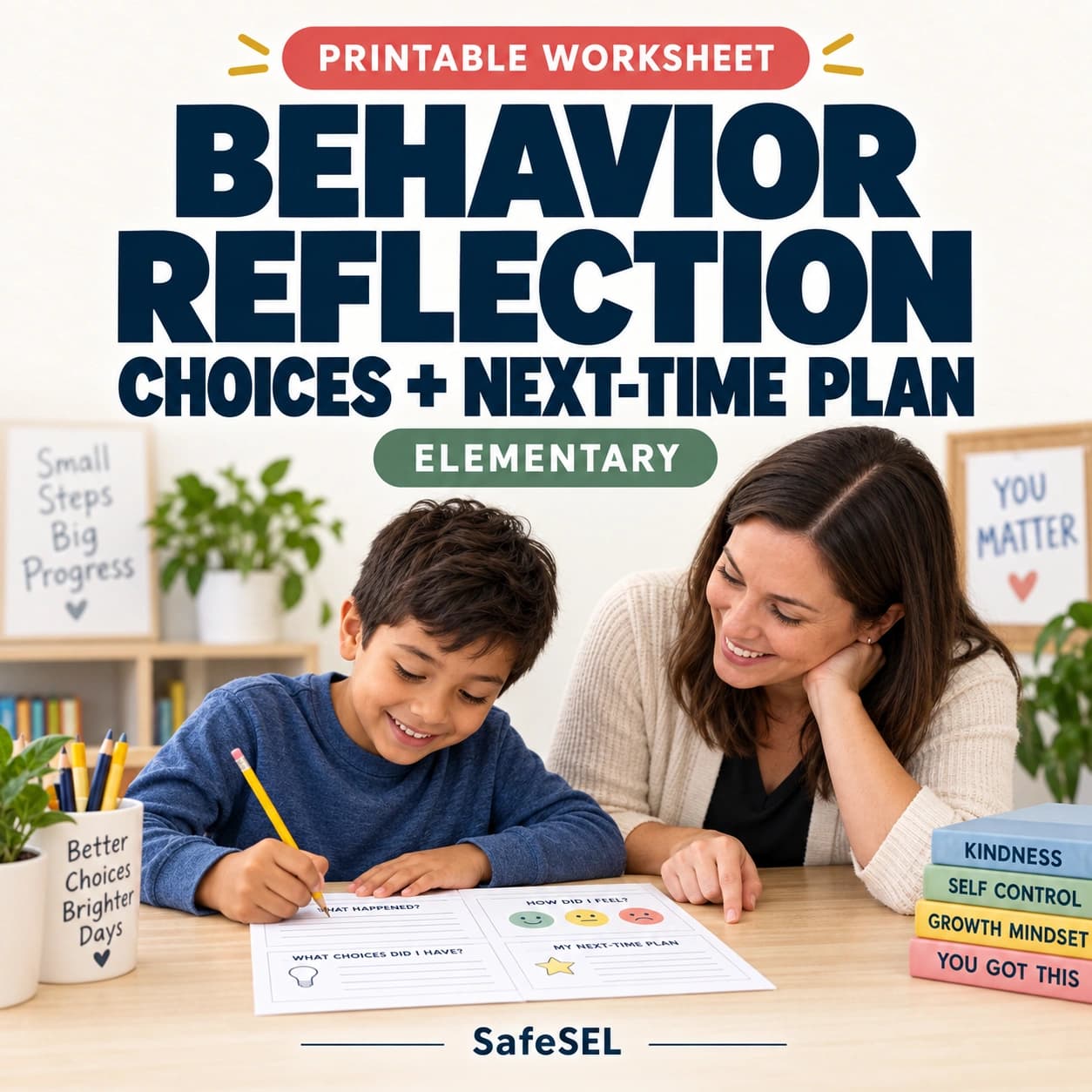
  • Parent guide: Anger in Children: Safety, Skills, and Repair
  • Suggested product line: Anger worksheets / Scenario cards / Anger toolkit
  • Free practice resource: Anger Trigger and Repair Sheet

Sources and further reading

  1. Family Media Plan — American Academy of Pediatrics
  2. Screen Time & Temper Tantrums — American Academy of Pediatrics
  3. What's the Best Way to Discipline My Child? — American Academy of Pediatrics
  4. Angry Kids: Dealing With Explosive Behavior — Child Mind Institute
  5. What Is the CASEL Framework? — CASEL
  6. Violent Behavior in Children and Adolescents — AACAP
SafeSEL printables

Related resources

View all Anger products →
Continue reading

Related articles

How to Respond to Revenge Talk After a Friendship Conflict

Practical steps for how to respond to revenge talk after a friendship conflict: what to notice, what to say, and how to build a safer, more usable

Read guide →

What to Do When a Child Becomes Furious After Hearing “No”

Practical steps for what to do when a child becomes furious after hearing “no”: what to notice, what to say, and how to build a safer, more usable

Read guide →

When a Child Explodes Because a Sibling Touched Their Belongings

Practical steps for when a child explodes because a sibling touched their belongings: what to notice, what to say, and how to build a safer, more usable

Read guide →