← All guides
Anger

How to Use Anger Scenario Cards Without Turning Them Into a Behavior Quiz

Use anger scenario cards for discussion, rehearsal, and flexible problem-solving—without testing children for one correct behavior

Written bySafeSEL Editorial TeamEducational content team

Scenario cards can help children slow down, consider context, and rehearse what they might do in a difficult moment. They become much less useful when adults treat them like a test with one approved answer.

A card that says, “Someone cuts in front of you in line,” should not lead only to: “What is the right choice?” It can open a richer discussion about body signals, interpretations, safety, assertive communication, flexibility, and what to do if the first strategy does not work.

In brief

Use anger scenario cards to explore multiple safe and realistic responses, not to check whether a child can repeat an adult-approved coping skill. Ask what the child notices, what information is missing, what different people might think, and which response fits the level of risk. Rehearse one action and discuss what could happen next.

Why scenario cards can work

A hypothetical situation creates a little distance. A child may be more willing to discuss a fictional conflict than a recent event that still carries shame, anger, or fear.

Scenario work can support several social-emotional skills:

  • recognising emotional and physical cues;
  • identifying possible triggers;
  • considering more than one interpretation;
  • generating response options;
  • predicting consequences;
  • using assertive language;
  • making safe decisions;
  • repairing after a mistake.

These skills align with broader areas of self-awareness, self-management, relationship skills, and responsible decision-making described in the CASEL framework.

The card itself, however, does not teach these skills automatically. The adult’s questions and the way disagreement is handled matter more than the number of cards completed.

The behavior-quiz trap

Scenario cards turn into behavior quizzes when adults:

  • ask only, “What should you do?”;
  • praise the expected phrase and reject other answers immediately;
  • assume the situation contains all necessary information;
  • treat calm behavior as the only acceptable outcome;
  • ignore power differences, safety, bullying, or repeated provocation;
  • use the activity after an incident to make the child admit fault;
  • record answers as proof of whether the child “knows better.”

A child may know the expected answer and still be unable to use it under stress. Another child may reject the expected answer because it does not feel safe or realistic.

For example, “Tell the person to stop” may be reasonable during mild teasing. It may be insufficient when a child is being repeatedly targeted by several peers. In that case, seeking adult protection is not a failure of independence.

Use a five-part discussion structure

Instead of looking for one correct answer, move through five questions.

1. What do we know—and what do we not know?

Read the card and separate facts from assumptions.

Scenario:

“A classmate laughs after you answer a question incorrectly.”

Known:

  • the child answered incorrectly;
  • the classmate laughed.

Unknown:

  • whether the laugh was directed at the child;
  • whether this has happened before;
  • whether the classmate was laughing at something else;
  • whether other students joined in;
  • how safe the child feels in that class.

This prevents the activity from teaching children to dismiss their perception or automatically assume hostile intent.

Useful prompts:

“What information would help us understand the situation?”
“What are two possible explanations?”
“Would your response change if this had happened every day?”

2. What might the child notice inside?

Invite the child to identify possible thoughts, body signs, impulses, and emotions.

Possible responses include:

  • hot face;
  • tight chest;
  • wanting to shout;
  • thinking, “Everyone thinks I’m stupid”;
  • feeling embarrassed and angry at the same time;
  • wanting to leave or hide.

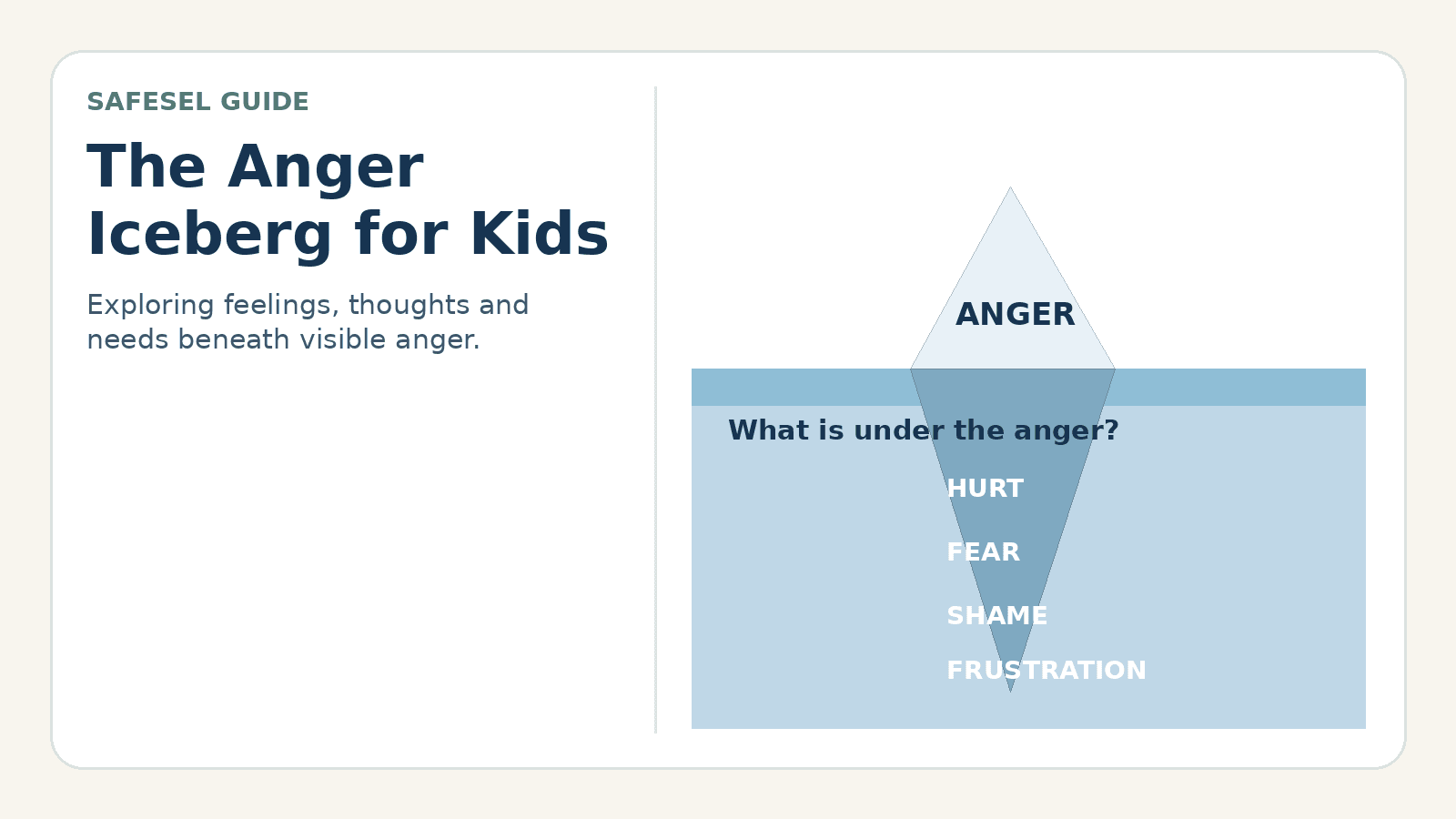
Do not insist on a single emotion. Anger may coexist with shame, fear, disappointment, or hurt.

3. What is the immediate goal?

The best response depends on the goal.

Possible goals:

  • stay physically safe;
  • stop the interaction;
  • get accurate information;
  • complete the class task;
  • ask for adult help;
  • protect a relationship;
  • return later to repair.

A child who cannot identify the goal may choose the most emotionally satisfying action rather than the most useful one.

Ask:

“What matters most in the next two minutes?”

4. What are two or three realistic options?

Generate several responses without initially labelling them good or bad.

For the classroom example, options might include:

  • pause and continue the task;
  • say, “Please stop. That’s not funny to me”;
  • move seats if permitted;
  • tell the teacher privately;
  • check later whether the laugh was directed at them;
  • shout an insult;
  • leave without explanation.

Then evaluate each option using clear criteria:

  • Is it safe?
  • Is it likely to help the goal?
  • What might happen next?
  • Does it respect the child and other people?
  • Is adult support needed?

The point is not to pretend every option is equally helpful. The point is to make the reasoning visible.

5. Rehearse one response and the next step

Choose one realistic response and practise it briefly.

For example:

“Please stop. I’m trying to answer.”

Then add a contingency:

“If it happens again, I will tell the teacher privately.”

Children benefit from practising what to do if the first action does not solve the problem. One-line advice such as “use your words” often fails because it does not include a next step.

Three effective ways to use the cards

Method 1: discussion without role-play

Best when the child is new to the skill, tired, self-conscious, or uncomfortable performing.

Process:

  1. Read one card.
  2. Identify missing information.
  3. Name possible feelings and body signs.
  4. Choose the immediate goal.
  5. Compare two responses.
  6. End after one useful insight.

One card discussed well is often more valuable than ten cards completed quickly.

Method 2: role-play with a pause button

Best when the child understands the idea but needs behavioural rehearsal.

Process:

  1. Assign roles.
  2. Act for 10–20 seconds.
  3. Either person can say “pause.”
  4. Identify what the child noticed.
  5. try a different response;
  6. switch roles if appropriate.

Do not force role-play when it is highly embarrassing or evokes a recent harmful event.

Method 3: response sorting

Create categories such as:

  • safe and likely to help;
  • safe but may not solve it;
  • needs adult support;
  • likely to make the situation worse;
  • depends on more information.

Place possible responses into categories and discuss disagreements. The “depends” category is important because social situations are rarely simple.

Adult language that keeps the activity collaborative

Try:

“There may be more than one useful answer.”
“What would make that response easier to use in real life?”
“What might the other person do next?”
“Would this still be a good plan if the problem kept happening?”
“Do we need an adult-safety option here?”
“Which response fits this child—not an imaginary perfectly calm child?”

Avoid:

“You know the right answer.”
“Why didn’t you do that yesterday?”
“No, try again.”
“The correct answer is to walk away.”

Walking away can be useful, but it is not always possible, safe, or sufficient.

Adjust the complexity by age

Ages 7–9

  • use one or two characters;
  • keep the event concrete;
  • offer two possible responses to compare;
  • allow drawing or acting with figures;
  • focus on one body cue and one action;
  • avoid long written explanations.

Ages 10–12

  • include mixed motives and incomplete information;
  • discuss group dynamics, loyalty, privacy, and digital communication;
  • ask how power or repeated behavior changes the response;
  • let the child challenge unrealistic wording;
  • include repair and follow-up.

Make the scenarios representative and respectful

A strong card set should include more than obvious rule-breaking. Include situations involving:

  • being corrected;
  • losing and waiting;
  • misunderstood jokes;
  • unfairness;
  • exclusion;
  • sensory overload;
  • accidental mistakes;
  • group chats;
  • pressure to join in;
  • needing a break;
  • repairing after the child’s own harmful action.

Avoid portraying one communication style, facial expression, or level of eye contact as the universal “correct” social behavior. The goal is safe, respectful participation—not performance of a narrow social norm.

Do not use scenario cards to investigate serious incidents

A hypothetical card is not an appropriate substitute for direct safeguarding procedures when there may be:

  • bullying;
  • abuse;
  • discrimination;
  • threats;
  • coercion;
  • serious aggression;
  • repeated targeting;
  • a significant power imbalance.

In those situations, adults must gather information, protect the child, and follow school or organizational procedures. Do not convert a real safety concern into a mutual “conflict-solving” exercise before the facts are understood.

How to connect card practice to real life

At the end of the activity, choose one small transfer goal.

Examples:

  • notice when hands start to clench;
  • use one sentence to ask for space;
  • tell an adult after the second repeated incident;
  • wait ten seconds before replying in a game;
  • return later for a repair conversation.

Then decide how adults will prompt the skill without embarrassing the child. A private gesture, visual cue, or agreed phrase is usually more useful than a public reminder to “use your coping skills.”

Review the goal after several opportunities. Ask what made it easier or harder rather than treating one unsuccessful attempt as proof that the activity failed.

When to seek additional support

Seek individualized support when anger, aggression, withdrawal, or peer conflict is frequent, severe, prolonged, or significantly affecting school, home life, friendships, or safety. A qualified professional can help assess whether anxiety, learning needs, sensory factors, trauma, developmental differences, mood difficulties, family stress, or other factors may be contributing.

Scenario cards support teaching and rehearsal. They do not diagnose the cause of behavior or replace a comprehensive plan.

Related SafeSEL resources

Scenario cards are most useful when they are part of a broader sequence:

  1. notice the situation and internal signals;
  2. define the immediate goal;
  3. compare realistic options;
  4. rehearse language or action;
  5. plan what to do if the problem continues;
  6. review and repair when needed.

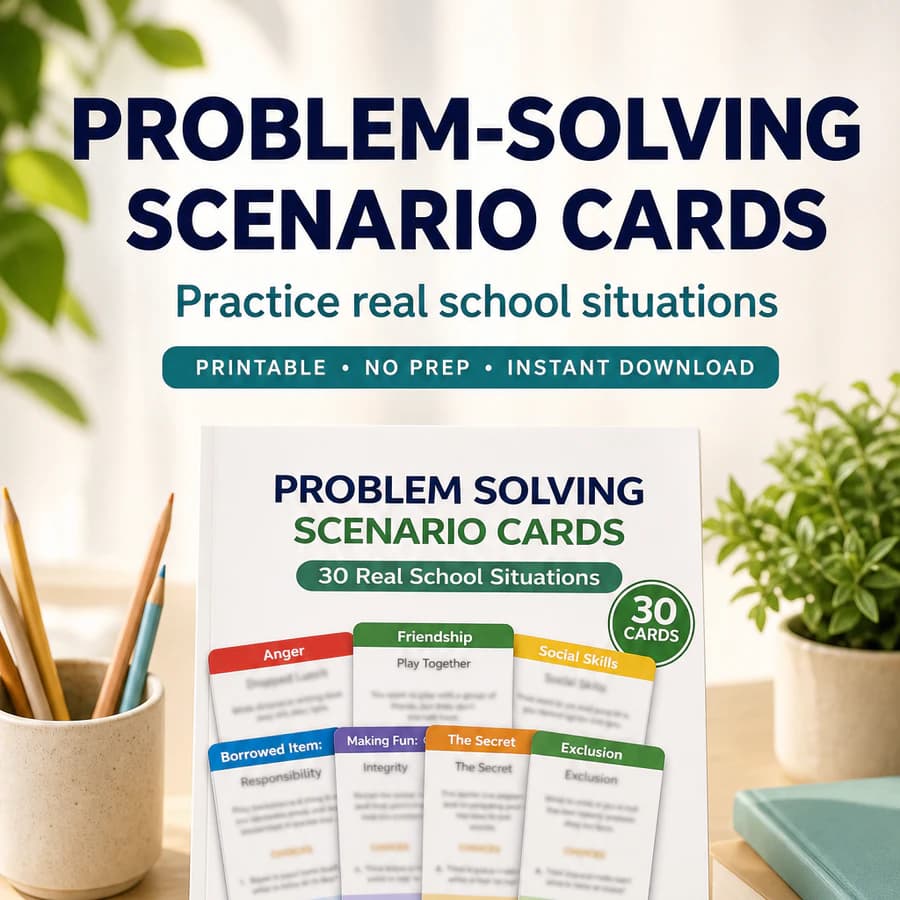
SafeSEL anger, friendship, conflict, and coping card sets can be used for individual sessions, small groups, classroom discussion, or parent-child practice when the adult facilitation remains collaborative.

Sources and further reading

  1. What Is the CASEL Framework? — Collaborative for Academic, Social, and Emotional Learning
  2. What Is SEL? — Collaborative for Academic, Social, and Emotional Learning
  3. Temper Tantrums and Outbursts — American Academy of Child and Adolescent Psychiatry
  4. Emotion Dysregulation Resource Center — American Academy of Child and Adolescent Psychiatry
  5. About Children’s Mental Health — Centers for Disease Control and Prevention
SafeSEL printables

Related resources

View all Anger products →
Continue reading

Related articles

How to Use SEL Scenario Cards in Classroom Discussion

Scenario cards work best as a rehearsal space, not a quiz about the “correct” feeling. A short fictional situation lets students notice different perspectives, compare choices, and practise language before a similar moment happens in…

Read guide →

What an Anger Management Toolkit for Children Should Actually Teach

A useful anger toolkit should teach awareness, safety, coping, problem-solving, communication, and repair—not simply tell children to calm

Read guide →

How to Use Friendship Conflict Cards for Discussion, Role-Play, and Repair

Use friendship conflict cards for discussion, role-play, and repair without turning the activity into a morality test or forced personal

Read guide →