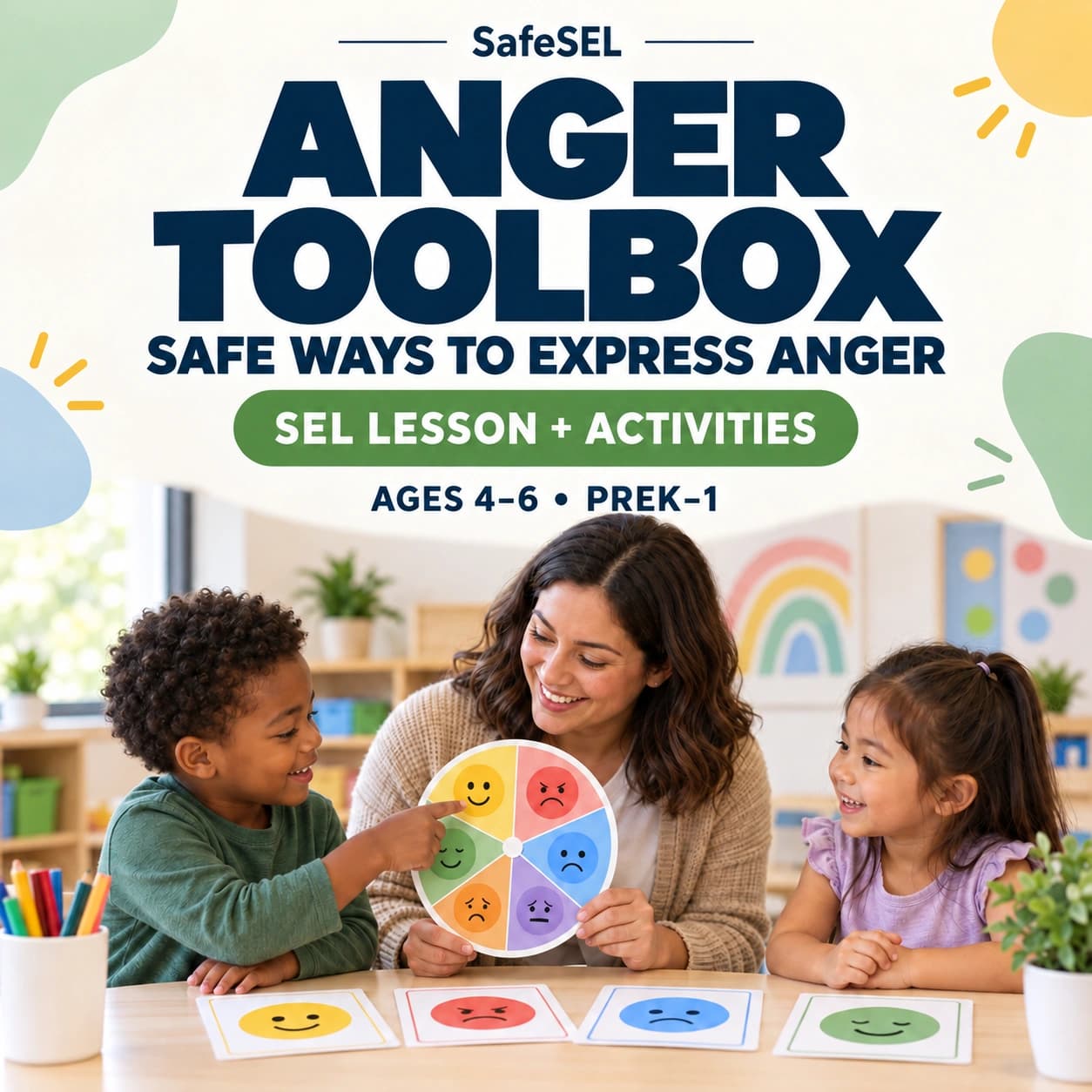
A large packet is not automatically a complete anger toolkit. Fifty pages that repeat “take a deep breath” may offer less value than ten carefully sequenced tools that help a child notice escalation, stay safe, communicate, solve a problem, and repair harm.
The best way to judge a toolkit is not by page count. Ask whether it teaches a coherent set of skills that can be practised in real situations.
In brief
A useful anger management toolkit should teach at least six areas: understanding anger, noticing early signs, creating safety, matching coping strategies to the child’s state, communicating and problem-solving, and repairing after an outburst. It should include developmental adaptations, adult guidance, realistic examples, and tools that do not rely entirely on reading or writing.
Anger is not the same as harmful behavior
Anger is an emotion. Yelling, hitting, threatening, breaking objects, insulting, leaving, freezing, or refusing are possible behaviors that may occur when anger is present, but the feeling itself is not misconduct.
A strong toolkit should help adults communicate both parts:
“It is okay to feel angry. It is not okay to hurt someone. We will help you find a safer action.”
This distinction prevents the material from becoming a program for emotional suppression. The goal is not a child who never appears angry. The goal is earlier awareness, safer responses, more flexible problem-solving, and meaningful repair.
Skill 1: understanding what anger does
Children benefit from a simple explanation of anger as a signal that something feels wrong, unfair, threatening, blocked, embarrassing, painful, or overwhelming.
A toolkit can explore:
- common situations that activate anger;
- how anger may protect against shame, fear, disappointment, or hurt;
- how thoughts influence intensity;
- how tiredness, hunger, pain, noise, or repeated stress can reduce coping capacity;
- how anger differs from aggression.
Avoid universal statements such as “anger is always a secondary emotion.” Anger can occur alongside other feelings, but it does not always hide one specific emotion.
Useful formats include:
- short psychoeducation pages;
- anger iceberg exercises used cautiously;
- situation-thought-feeling-action maps;
- examples showing different pathways to similar behavior.
Skill 2: noticing early warning signs
Many children receive coping advice too late. If adults intervene only after objects are being thrown, the child has little opportunity to use a newly learned worksheet strategy.
The toolkit should help identify:
- body signs;
- changes in voice or movement;
- repeated phrases;
- urges;
- narrowed thinking;
- environmental triggers;
- early behaviors that adults can notice.
The goal is to create an individualized escalation map, not force the child into a standard “anger thermometer.”
A useful sequence might be:
- settled and available;
- bothered but still flexible;
- anger building and choices narrowing;
- unsafe or overwhelmed;
- recovering and needing reduced demands;
- ready to review or repair.
Each level should connect to adult actions and child options.
Skill 3: creating safety before reflection
A complete toolkit must include what to do when anger becomes unsafe. This section is often missing from decorative coping packets.
A safety plan may identify:
- which behaviors require immediate adult intervention;
- where the child and others can move;
- how adults reduce language and demands;
- which objects may need to be moved;
- how the child can signal for space;
- who supports siblings or classmates;
- how re-entry will happen;
- when emergency or professional help is needed.
Safety planning should not depend on the child completing a worksheet during the crisis.
The adult guide should emphasize calm, clear limits:
“I will not let you hit. I am moving back and giving you space. We will talk when it is safer.”
Skill 4: matching coping strategies to the state
A toolkit should offer more than a generic list of coping skills. It should help adults and children match the strategy to the function and level of activation.
When physical intensity is rising
Possible tools:
- safe heavy movement;
- paced breathing if tolerated;
- cold water or a temperature change;
- pushing hands against a wall;
- moving to a lower-stimulation space;
- using a pre-agreed break signal.
When the child feels misunderstood
Possible tools:
- a “let me explain” card;
- writing or typing before speaking;
- repeating back what each person heard;
- asking for a private conversation.
When the child is stuck on unfairness
Possible tools:
- identify what can be changed now;
- separate fairness from sameness;
- choose whether to request, negotiate, accept, or seek help;
- postpone the discussion until regulation improves.
When shame follows a mistake
Possible tools:
- normalize mistakes without minimizing impact;
- use a brief self-compassion statement;
- focus on the next repair action;
- avoid public processing.
A toolkit should help the child build a small personal plan rather than memorize every strategy.
Skill 5: assertive communication
“Use your words” is too vague. Children need specific sentence structures and rehearsal.
A toolkit might include:
- “I’m getting too upset to answer. I need a minute.”
- “Please stop touching my things.”
- “I thought you meant ___. Is that what you meant?”
- “I disagree, but I can say it without insulting you.”
- “I need help because this keeps happening.”
- “Can we solve this privately?”
It should also distinguish assertiveness from aggression and passive compliance.
A child is not required to discuss every conflict immediately. Sometimes the safest communication is to leave with adult support and return later.
Skill 6: problem-solving after the peak
Once the child is regulated enough to think flexibly, the toolkit should support problem-solving.
A simple model:
- Define the current problem in neutral language.
- Identify the child’s goal.
- Generate two or three possible actions.
- Consider safety and likely consequences.
- Choose one plan.
- Decide what to do if it does not work.
This process should be demonstrated with realistic scenarios, not only blank pages.
For example:
Problem: “My brother keeps taking the controller before my turn is finished.”
Possible plan:
- agree on a visible timer;
- store the controller with an adult between turns;
- use a one-sentence request;
- pause the game if grabbing begins.
Skill 7: repair and return
A toolkit is incomplete if it ends when the child becomes calm. Anger may have affected relationships, property, learning, or trust.
Repair should be proportionate and related to the impact.
Possible steps:
- check safety;
- listen to what happened without a courtroom-style interrogation;
- name the impact;
- choose a repair action;
- complete an interrupted responsibility when appropriate;
- plan for the next similar situation;
- allow the affected person to set boundaries.
A forced apology is not the only form of repair. Replacing an item, restating a message, helping restore the space, or giving someone time can be more meaningful.
Skill 8: adult co-regulation and response planning
Children do not practise anger skills in isolation. A strong toolkit includes guidance for adults on:
- using fewer words during escalation;
- validating emotion without approving harm;
- avoiding public power struggles;
- setting safety limits;
- deciding when to pause a demand;
- returning to the original expectation later;
- prompting skills privately;
- reviewing patterns across settings;
- avoiding shame-based consequences.
Without this section, adults may unintentionally use child worksheets as the whole intervention while their own responses remain inconsistent.
Skill 9: generalization and progress monitoring
Knowing a skill in a worksheet does not guarantee using it in a playground, classroom, sibling conflict, or online game.
The toolkit should include ways to practise across contexts:
- role-play;
- scenario cards;
- visual reminders;
- home-school shared language;
- brief review after ordinary frustrations;
- planned practice with losing, waiting, or correction;
- tracking use of one target skill.
Measure progress in functional terms, such as:
- the child notices one warning sign earlier;
- unsafe behavior happens less often;
- recovery becomes shorter;
- the child uses a break signal;
- the child returns to the task;
- repair requires fewer adult prompts.
Do not measure success only as “no anger.”
What formats should be included?
A balanced toolkit may contain:
- short teaching pages;
- body maps;
- trigger and context trackers;
- escalation maps;
- coping cards;
- visual choice boards;
- scenario cards;
- problem-solving sheets;
- repair guides;
- parent or teacher handouts;
- progress-monitoring pages;
- age adaptations;
- low-writing alternatives.
The materials should not all require long written responses. Children may need drawing, circling, sorting, speaking, role-play, pointing, or adult scribing.
What to avoid in an anger toolkit
Be cautious with products that:
- describe anger as a bad emotion;
- promise to stop outbursts quickly;
- rely on forced reflection immediately after incidents;
- use public behavior charts as the main strategy;
- present one coping skill as universal;
- contain dozens of nearly identical pages;
- ignore safety and repair;
- confuse obedience with regulation;
- use diagnostic language without appropriate assessment;
- require extensive reading or handwriting with no adaptations.
A buyer’s checklist
Before choosing a toolkit, ask:
- Does it teach a sequence rather than isolated activities?
- Does it separate feelings from unsafe behavior?
- Are safety and adult response included?
- Can strategies be individualized?
- Does it include communication and repair?
- Are there realistic examples?
- Can children respond without extensive writing?
- Are age adaptations available?
- Does it avoid shame and forced disclosure?
- Can the tools be used at home, school, or in counseling without pretending they replace treatment?
When to seek additional support
An educational toolkit is not sufficient when outbursts involve significant aggression, self-harm, threats, serious property destruction, persistent irritability, abrupt changes in functioning, or major impairment across settings. Frequent or severe anger can have many possible contributors, including anxiety, trauma, learning difficulties, sensory needs, developmental differences, mood problems, family stress, sleep difficulties, pain, or medical factors.
A qualified professional can help assess the full pattern and create an individualized plan.
Related SafeSEL resources
SafeSEL anger resources are designed to cover multiple stages of the process: recognising warning signs, understanding patterns, choosing coping actions, practising responses with scenarios, solving problems, and repairing relationships. Adults can select the specific pages needed rather than requiring a child to complete an entire packet.
Sources and further reading
- Emotion Dysregulation Resource Center — American Academy of Child and Adolescent Psychiatry
- Temper Tantrums and Outbursts — American Academy of Child and Adolescent Psychiatry
- Impairing Emotional Outbursts: Parents’ Medication Guide — American Academy of Child and Adolescent Psychiatry
- What Is the CASEL Framework? — Collaborative for Academic, Social, and Emotional Learning
- About Children’s Mental Health — Centers for Disease Control and Prevention