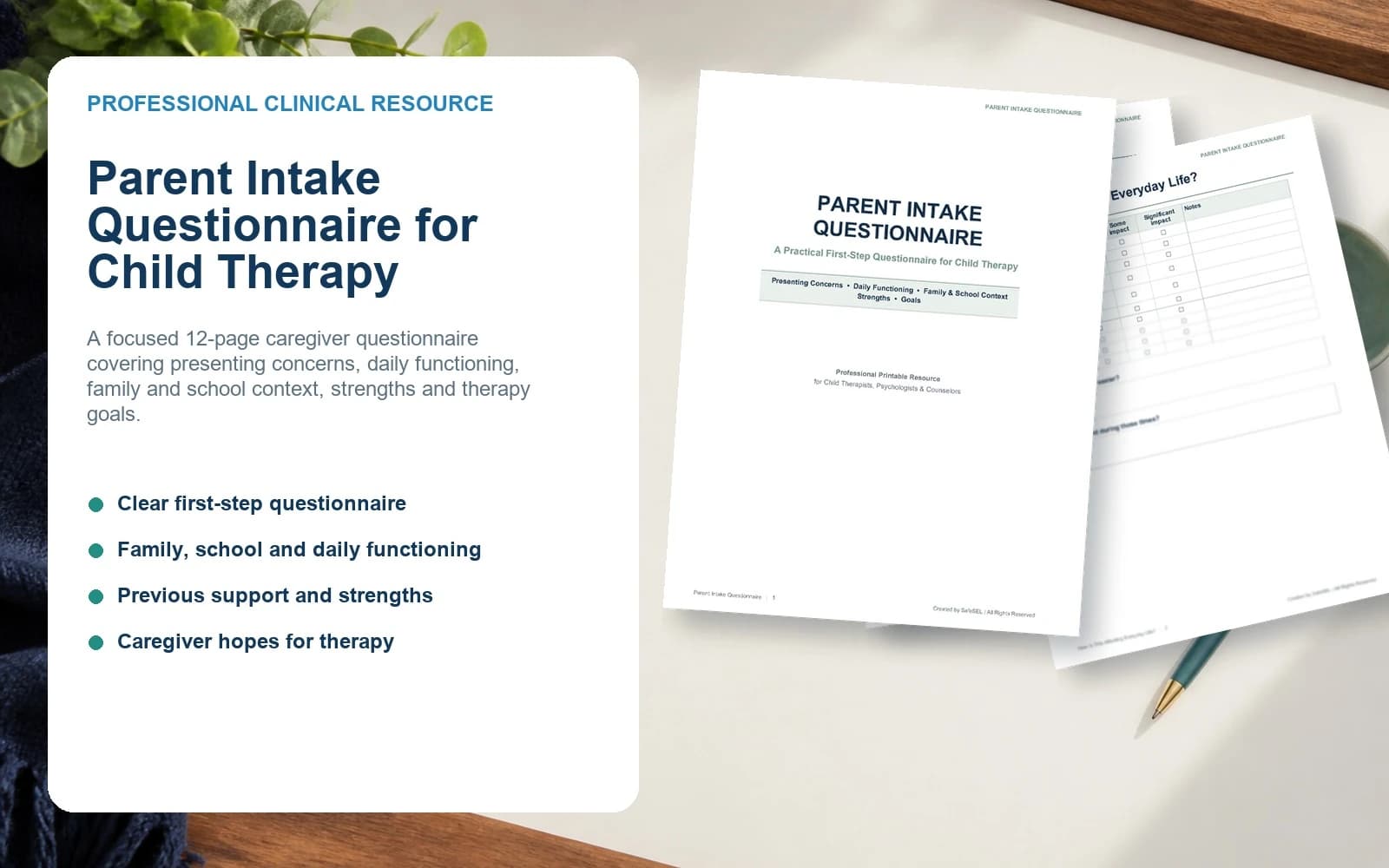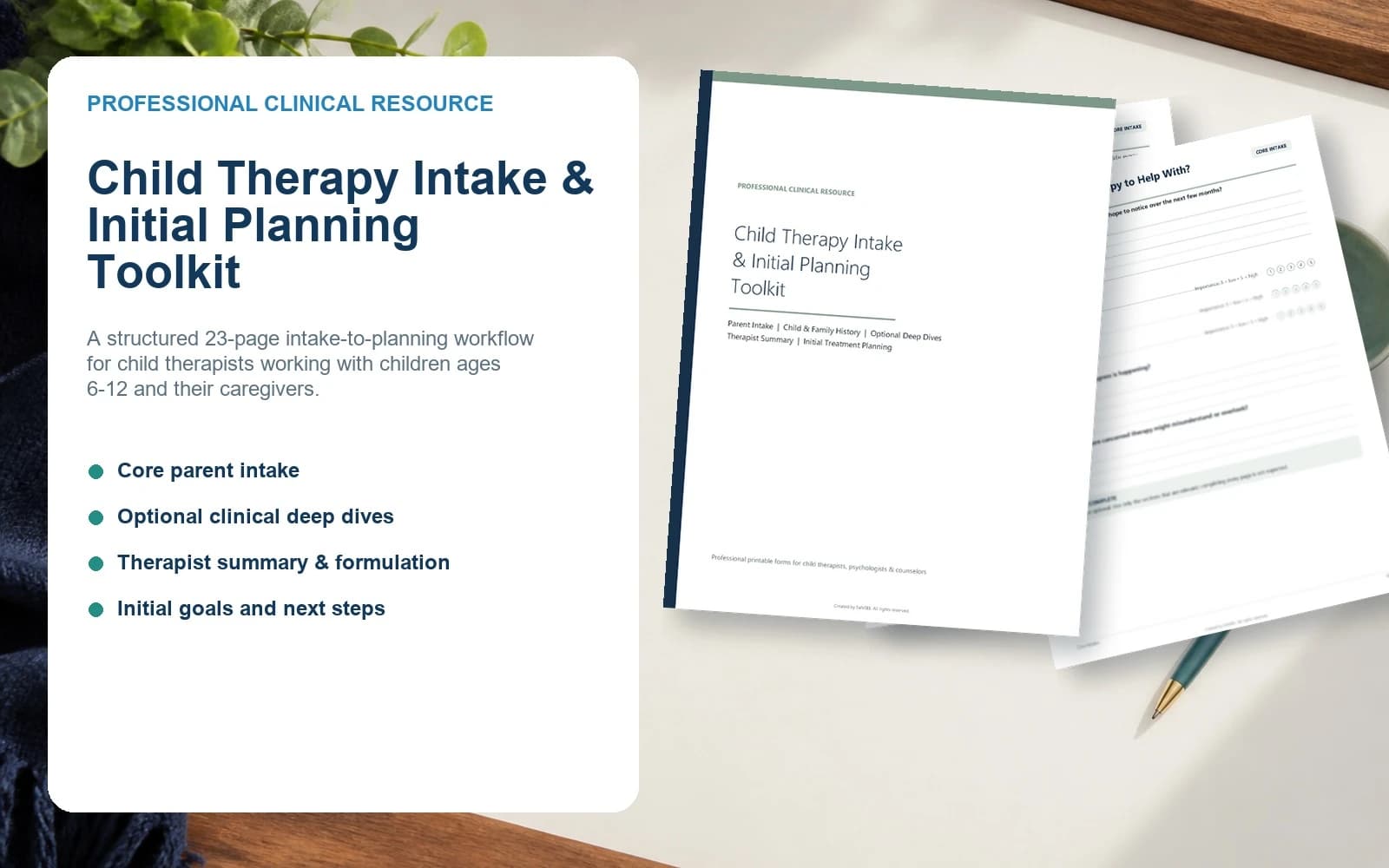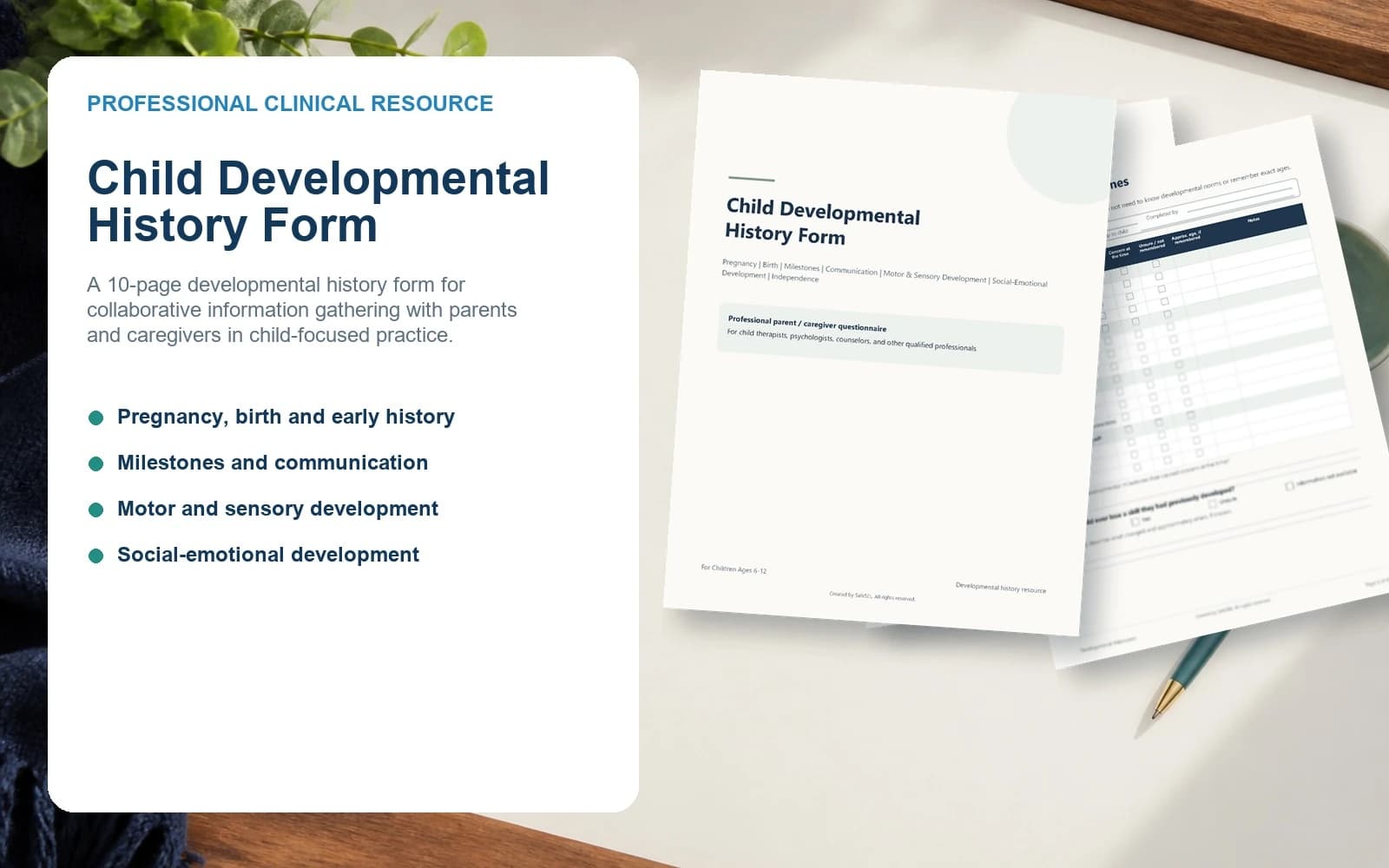
A child’s developmental history is a structured account of early development, communication, motor and sensory patterns, health, sleep, learning, relationships, emotional development, family context and previous support. Its purpose is to understand the child over time and identify questions for assessment or planning. It is not a diagnostic test, and exact milestone dates should never be interpreted without context.
Explain the purpose before asking detailed questions
Tell caregivers why the history is relevant, which questions are optional, how the information will be stored and who may access it. Some topics can feel sensitive or blaming when introduced without explanation. A collaborative opening improves accuracy and gives caregivers permission to say that they do not know or remember.
Using an intake questionnaire without inventing a developmental timeline
An intake questionnaire should make uncertainty visible. If a caregiver remembers that a skill emerged “around the time we moved,” record that wording instead of converting it into an exact month. With appropriate authorization, other records may clarify the sequence; conflicting accounts should remain attributed to their sources.
Clinical assessment forms also need room for changes after the original history was taken. Note what changed, who reported it and when. A new difficulty does not prove that an earlier developmental difference caused it. Bring unresolved questions into assessment and formulation rather than treating the completed form as a final explanation.
1. Pregnancy, birth and early health
- Pregnancy and birth factors that caregivers believe may be relevant
- Prematurity, neonatal care, early medical needs or feeding concerns
- Early sleep, settling and regulation patterns
- Hearing, vision, medication, pain, seizures or other health history
Collect this information proportionately. A detail in early history does not automatically explain a current difficulty, and its relevance may require medical or multidisciplinary input.
2. Motor and self-care development
- Gross-motor development, balance, coordination and movement confidence
- Fine-motor skills and everyday tool use
- Toileting, dressing, eating and other self-care routines
- Variation across settings and the amount of support needed
Instead of asking only “When did the child walk?”, ask how movement developed, whether skills were consistent, what opportunities were available and whether any loss of skill occurred.
3. Speech, language and communication
- Early sounds, words and phrase development where remembered
- Understanding language and following everyday communication
- Expressing needs, ideas and emotions
- Conversation, nonverbal communication and communication repair
- Languages used at home, school and in the community
Multilingual development should not be treated as a deficit. Record language exposure and communication across languages, and seek appropriately qualified assessment when language questions are clinically significant.
4. Sensory patterns and regulation
- Responses to sound, light, touch, clothing, food, movement and crowds
- Sensory-seeking patterns and preferred regulating activities
- How sensory demands affect participation, sleep, learning or relationships
- What environmental adjustments or supports help
Describe observable responses and context rather than assigning meaning from one preference. Sensory experiences can interact with health, anxiety, communication, environment and development.
5. Play, relationships and social development
- Early play interests and how play changed over time
- Comfort with adults, peers, groups and unfamiliar people
- Shared attention, imitation, turn-taking and imaginative play
- Friendship patterns, conflict and experiences of belonging
- Situations in which social participation is easier or harder
Avoid measuring social development against one preferred social style. Focus on access, communication, reciprocity, safety, distress and the child’s own experience.
6. Emotional and behavioral development
- How the child signals distress, excitement, fear, frustration and need for help
- Recovery patterns and the role of adult co-regulation
- Response to change, uncertainty, limits, feedback and separation
- Changes in behavior associated with transitions, loss or stress
- Contexts where regulation is stronger and what may support it
7. Learning and school history
- Early learning experiences and transition into school
- Attendance, participation, attention and task demands
- Literacy, numeracy and any identified learning needs
- School relationships, accommodations and previous assessments
- Differences between home and school functioning
8. Family, culture and environment
Development occurs within relationships, culture, opportunity and material conditions. Ask about caregiving arrangements, family strengths, languages, community, significant transitions, stressors and access to support. Do not interpret missing opportunities as inability or use one cultural norm as the developmental standard.
Ask about patterns, not isolated dates
Milestone ages are most useful when combined with the quality of the skill, consistency, progression, context and support required. Ask whether a skill appeared and remained, whether it generalized, and whether there has been any regression or loss. When dates are approximate, document that clearly.
Use neutral follow-up questions such as “What did that look like at the time?” and “What helped the child participate?” These prompts usually produce more clinically useful detail than asking caregivers to defend an estimate or compare the child with a sibling. Note the source of information and avoid converting a remembered approximation into false precision.
Include strengths and adaptive development
Ask how the child communicates successfully, what they enjoy, which relationships feel safe, how they solve problems and what environments help them participate. Strengths influence both interpretation and planning; they are not merely a reassuring final question.
What a developmental history cannot establish
A history form is not equivalent to developmental surveillance, validated screening, medical evaluation or multidisciplinary assessment. It can organize reported information and identify areas that need clarification, but it cannot establish developmental status or diagnosis on its own.
Integrate developmental information with other evidence using A Practical Framework for Child Therapy Assessment.
Frequently asked questions
What if a caregiver cannot remember milestone dates?
Record estimates and uncertainty. Focus on the sequence, quality and context of development, and use other authorized sources when they are relevant and available.
Should a teacher complete the same developmental form?
Usually not. Teachers can provide valuable current observations, but a separate school-context form is often more appropriate than asking them to reconstruct early developmental history.
Should developmental history be updated?
Yes. Add meaningful new information, changes in functioning and newly available records rather than treating the intake version as permanently complete.
An editable developmental history form
Gather developmental information in a structured A4, US Letter and editable format with the Child Developmental History Form.
Compare all professional child therapy forms and templates.
Related guide: Between-Session Practice in Child Therapy: A Guide for Parents and Therapists
Example entry: recording an uncertain milestone date
A useful form entry separates the reported event, the source and the degree of certainty. For example: “Caregiver recalls first independent steps at about 14–16 months; exact month not remembered. Recorded at intake; no contemporaneous record reviewed.” This is an example of documentation, not a statement about whether that timing is typical.
Do not turn an approximate memory into a precise date or interpret a single entry as a diagnosis. If clarification matters to the assessment, note what record or other source could help and obtain the appropriate permission before seeking it. Preserve differences between informants instead of silently choosing one account.
Sources and further reading
- Developmental Surveillance and Screening Patient Care — American Academy of Pediatrics (2024)
- Record Keeping Guidelines — American Psychological Association (2024)
- Clinical Practice Guidelines, Updates and Parameters — American Academy of Child and Adolescent Psychiatry (2026)