The most useful parent intake questions for child therapy cover the reason for seeking support, the child’s strengths, the pattern and impact of current concerns, developmental and health history, family and school context, previous support, safety information and hopes for therapy. The questions should organize a respectful conversation—not function as an interrogation, standardized test or automatic diagnosis.
How to structure a parent intake questionnaire
A practical questionnaire works in layers. Begin with essential information needed to understand the referral and provide safe care. Add optional sections for developmental, behavioral, family, health or school detail when they are relevant. This prevents a long form from becoming a barrier and helps the therapist give attention to what the caregiver actually writes.
1. Reason for seeking support
- What prompted you to seek support at this time?
- What is the main concern in your own words?
- When did you first notice this pattern?
- Where, when and with whom is it most likely to occur?
- How is it affecting the child’s daily life, relationships or participation?
- What would feel meaningfully different if support were helping?
Ask for examples rather than labels. “Becomes silent and leaves the room when corrected” gives more usable information than “is defiant.” When a caregiver uses a broad label, ask what they observe before, during and after the situation.
2. Strengths, interests and protective factors
- What does your child enjoy or feel confident doing?
- When does your child seem most comfortable or engaged?
- Who does your child trust and seek for support?
- What helps after a difficult moment?
- What has the family, school or child already tried that helped even a little?
Strengths are not an optional positive ending. They affect engagement, formulation and treatment planning. A child’s interests, relationships, routines and successful environments can show what conditions support participation.
3. Pattern, triggers and functional impact
- How often does the concern occur, and how long does it usually last?
- What tends to happen immediately before it?
- What does the child do, say or communicate during the situation?
- How do adults and peers usually respond?
- What happens afterward, including recovery time?
- Where is the pattern less noticeable or absent?
These questions support contextual understanding without assuming causation. Similar behavior may reflect different needs, learning histories, sensory demands, expectations or relationship dynamics.
4. Development, health and daily functioning
- Were there pregnancy, birth or early health factors that feel relevant?
- How did speech, communication, movement and self-care skills develop?
- Are sleep, eating, pain, medication, hearing or vision currently relevant?
- How does the child respond to noise, touch, movement, change or busy environments?
- What level of support is needed for routines and independence?
When a fuller history is needed, use the companion guide How to Take a Child’s Developmental History.
5. Family and cultural context
- Who is important in the child’s family and caregiving system?
- Which languages are used, and how does the child prefer to communicate?
- Have there been recent changes, losses, separations, moves or stressors?
- What beliefs, values or community contexts should the therapist understand?
- Are there practical barriers that could affect attendance or follow-through?
Use inclusive wording and allow caregivers to describe their family rather than forcing it into one assumed structure. Ask only for information that has a clear care, safety or planning purpose.
6. School, peers and participation
- What does the child enjoy or find difficult at school?
- How do they manage transitions, group work, correction and unstructured time?
- What do teachers notice, and what support is already in place?
- How are friendships, conflict and belonging currently experienced?
- Is school attendance, learning or access being affected?
7. Previous and current support
- What services, assessments or accommodations have been used?
- What was useful, unhelpful or difficult to access?
- Which professionals are currently involved?
- What records or observations may be relevant, and is there authority to obtain them?
- What would the family like this therapist to do differently?
8. Safety and safeguarding
Ask proportionately about current risk, exposure to harm, abuse or neglect concerns, self-harm, aggression, access to dangerous items and immediate safety planning. Explain the limits of confidentiality and follow local procedures. A generic questionnaire cannot replace direct risk assessment or safeguarding action.
9. Goals and expectations
- What does the caregiver hope the child will understand, do or experience differently?
- What does the child want help with, if known?
- What role does the caregiver expect to have?
- How will the family recognize meaningful progress?
- What questions or concerns do they have about therapy?
How to review the answers
Read the questionnaire before the meeting, identify areas requiring clarification and begin by checking the caregiver’s priorities. Reflect back what you understood, invite correction and distinguish observation from interpretation. Do not treat unanswered questions as resistance; they may reflect uncertainty, privacy concerns, literacy, language, overwhelm or lack of access to information.
Place the questionnaire within a complete intake workflow using Child Therapy Intake Process: From First Contact to Initial Plan.
Connect therapy intake questions to treatment planning
An intake questionnaire is useful when the clinician follows up on the answers. Among the questions therapists ask should be what the caregiver most wants understood, which detail needs clarification and what the child’s own view adds. Do not assume a completed form means that everyone agrees on the concern.
For example, a caregiver may write ‘refuses homework.’ Follow up with the task, timing, instructions and what happens when help is available. That information is more useful for treatment planning than replacing the phrase with a diagnostic label before assessment.
Frequently asked questions
How long should a parent intake questionnaire be?
Long enough to capture essential information, but short enough to complete accurately. A concise core plus optional clinical sections is often more usable than one compulsory long form.
Should a general questionnaire include diagnostic scoring?
Not unless it is a validated instrument used by a practitioner who is qualified to administer and interpret it. A general intake form should not imply standardized scoring.
Can parents complete the form digitally?
Yes, when collection, transmission, storage and access meet the practitioner’s privacy, security and jurisdictional obligations. Offer another route when digital completion is inaccessible.
An editable parent intake resource
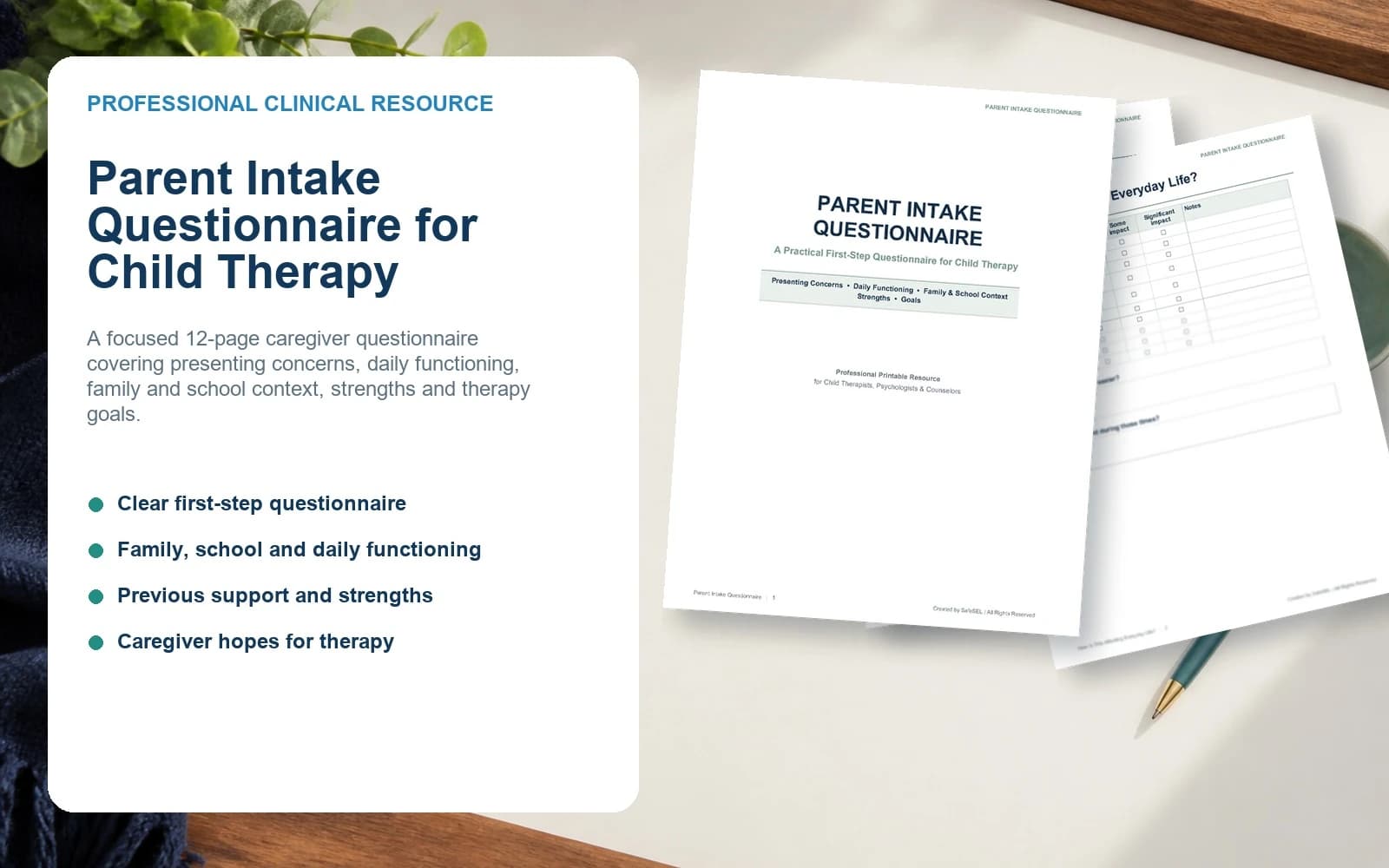
Use a focused 12-page caregiver questionnaire in A4, US Letter and editable formats with the Parent Intake Questionnaire for Child Therapy.
Browse the complete professional resource line for child therapists.
Related guidance for the next step
Sources and further reading
- Record Keeping Guidelines — American Psychological Association (2024)
- Developmental Surveillance and Screening Patient Care — American Academy of Pediatrics (2024)
- Information Related to Mental and Behavioral Health — U.S. Department of Health and Human Services (2026)