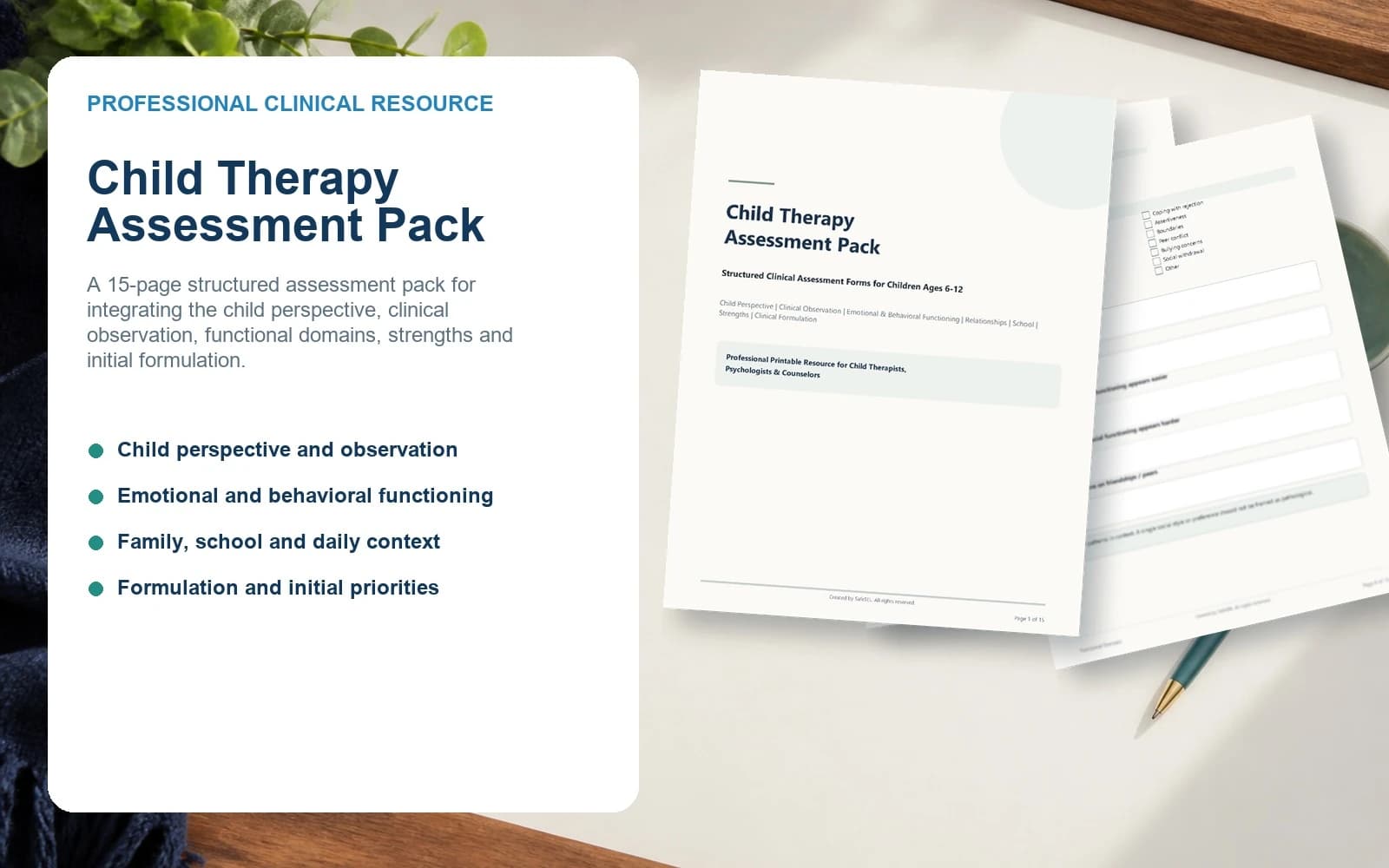
A child therapy assessment should define the referral question, gather relevant information from more than one perspective, examine functioning across contexts, identify strengths and risk, consider development and culture, and produce a working formulation that guides decisions. Assessment is iterative. A general assessment form can organize the process, but it is not a diagnostic instrument.
Begin with the decision—not the tool
Clarify what the assessment must help decide. Is the purpose service fit, therapy planning, risk understanding, progress review, diagnostic evaluation or referral? These tasks overlap but are not interchangeable. The scope, methods and required competence should match the actual question.
- Define the referral question in observable, functional terms.
- Identify immediate safety, safeguarding and medical priorities.
- Choose information sources that can answer the question.
- Gather and compare perspectives and contexts.
- Develop a provisional formulation with alternatives and uncertainty.
- Agree on actions, communication and review points.
Choosing therapy intake forms that answer the referral question
Therapy intake forms collect information; they do not decide what it means. A useful set of therapy intake questions might ask what changed, where the difficulty occurs, what support is already available and what the child wants adults to understand. Separate those answers from observations made during the appointment.
For example, a caregiver may report that homework never starts, while the child describes not understanding the instructions. Assessment and treatment planning should investigate that difference rather than turn either account into a label. Choose therapy tools for therapists that allow attributed notes, uncertainty and a review plan, not only tick-box conclusions.
Gather the child’s perspective
Use developmentally appropriate conversation, play, drawing, observation, rating or structured choices. Ask what the child thinks is happening, what feels difficult, what helps and what they want adults to understand. Avoid requiring immediate verbal disclosure or treating silence as lack of insight.
Gather caregiver and family information
Explore the presenting concern, timeline, settings, daily impact, family understanding, developmental history, health, previous support, strengths and hopes. A caregiver’s account is essential contextual evidence, but it remains one perspective and should be clarified collaboratively.
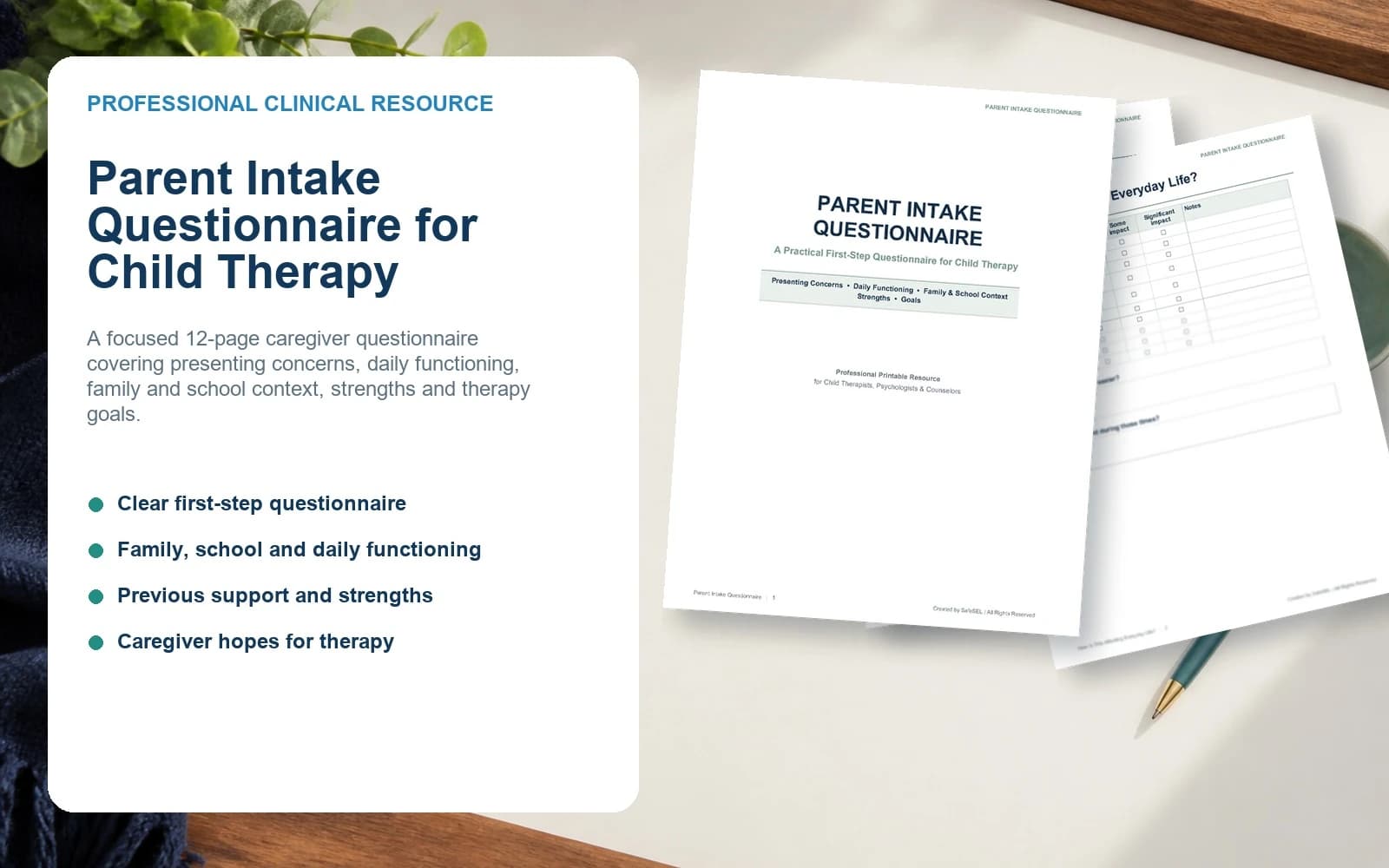
Use a focused question bank with Parent Intake Questions for Child Therapy.
Use school and other contextual information selectively
Where appropriate and authorized, school or other professional information can show how demands, relationships and support differ across settings. Ask for concrete observations, antecedents, participation and existing adjustments—not only labels or global judgments.
Match each source to the assessment question
More information is not automatically better information. A teacher may be well placed to describe classroom participation but not early development; a caregiver may know the child’s history but not what happens during independent school work; the child may describe internal experience that adults cannot observe. State what each source can and cannot answer, then gather only what is relevant, authorized and proportionate.
Assess functioning across relevant domains
- Emotional experience, expression and regulation
- Behavior, safety and recovery after difficult moments
- Relationships, communication and belonging
- Family routines, caregiving context and stressors
- School access, participation and learning
- Sleep, health, pain, sensory experiences and medication
- Daily living, independence and transitions
- Strengths, interests and protective relationships
Record the level of adult support and environmental structure needed. A child who succeeds with predictable support is demonstrating a supported skill, not necessarily the same level of independent performance.
Use observation thoughtfully
Document what was observed, in which context, during what task and with what support. Separate description from interpretation. One appointment is a small sample affected by novelty, rapport, expectations and environment; it may not represent typical functioning.
Distinguish four layers of evidence
- Report: what the child, caregiver, teacher or another source says
- Observation: what the practitioner directly notices in a defined context
- Interpretation: what the information may mean
- Hypothesis: an explanation that remains open to testing and revision
Integrate differences rather than averaging them away
Disagreement between child, caregiver and school reports can be clinically informative. It may reflect different environments, relationships, demands, expectations, timing or access to support. Describe the difference and ask what conditions may account for it instead of deciding immediately which source is correct.
Build a working formulation
A practical formulation links presenting needs with relevant developmental, relational, environmental and maintaining factors while identifying strengths and uncertainty. It should explain why the current plan is reasonable and what evidence would lead to a different decision.
- What is happening and what is the functional impact?
- What may have increased vulnerability or triggered change?
- What appears to maintain the current pattern?
- What protects the child or family?
- What alternative explanations remain possible?
- What information, consultation or referral is still needed?
End assessment with communication and action
Explain the working understanding in accessible language, identify immediate safety or referral needs, agree on priorities and document what was communicated. If evidence is insufficient, say what remains unknown and how it may be clarified. Assessment should leave the child and caregivers with an understandable next step.
Translate the formulation into goals using How to Write a Child Therapy Treatment Plan.
Common assessment errors
- Choosing a form before defining the assessment question
- Treating one informant or one session as the whole picture
- Using deficit-only language and overlooking protective factors
- Presenting hypotheses as facts
- Allowing documentation volume to substitute for clinical reasoning
- Ending without decisions, communication or a review plan
Frequently asked questions
Is a child therapy assessment pack a diagnostic test?
No. General forms organize information. Diagnosis requires appropriate qualifications, validated methods where indicated, professional standards and jurisdiction-specific requirements.
How long should assessment take?
The scope should match the referral question, complexity, risk and available evidence rather than a fixed number of sessions.
Can assessment continue after treatment begins?
Yes. Formulation, risk understanding and goals often change as new information and therapeutic observation become available.
A structured assessment resource
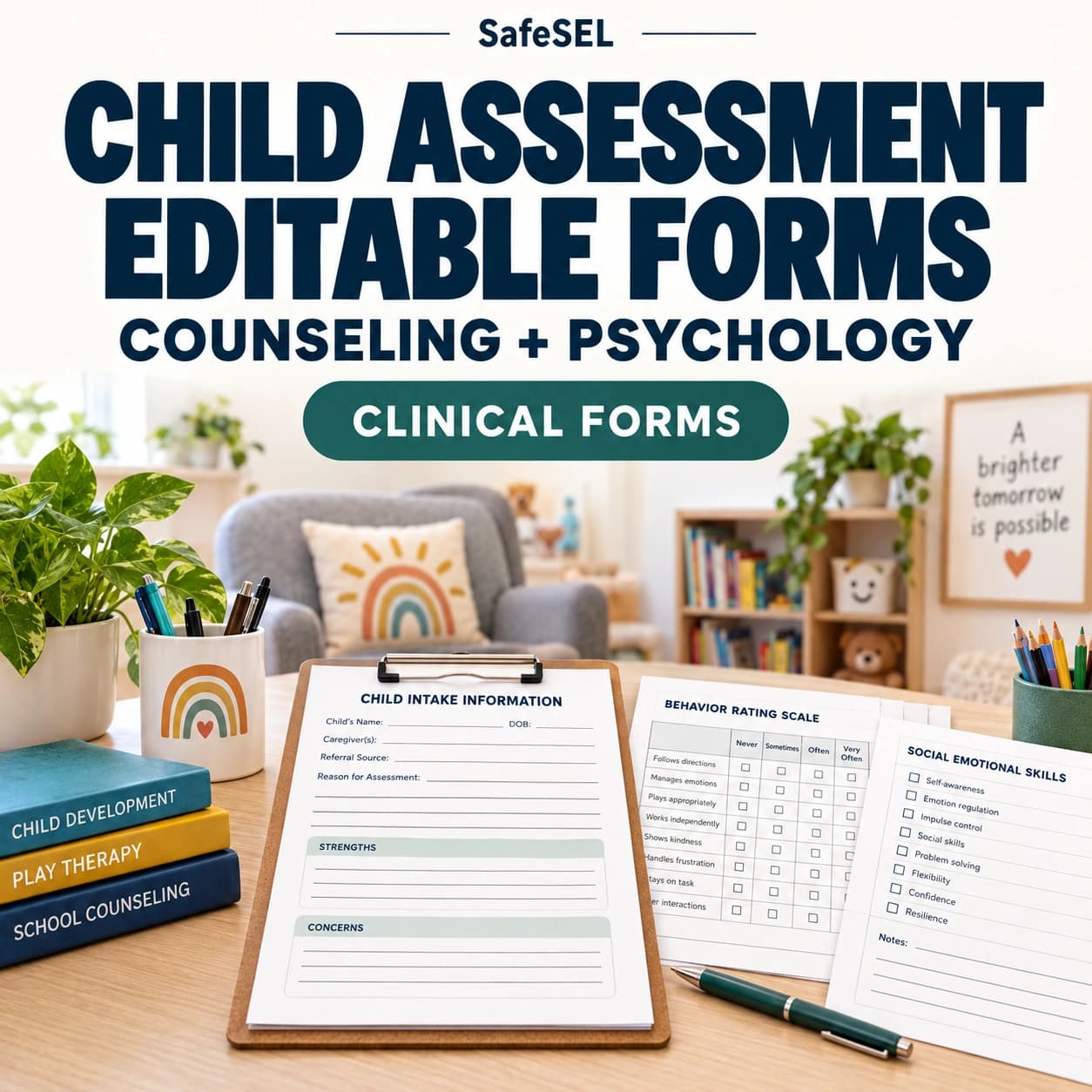
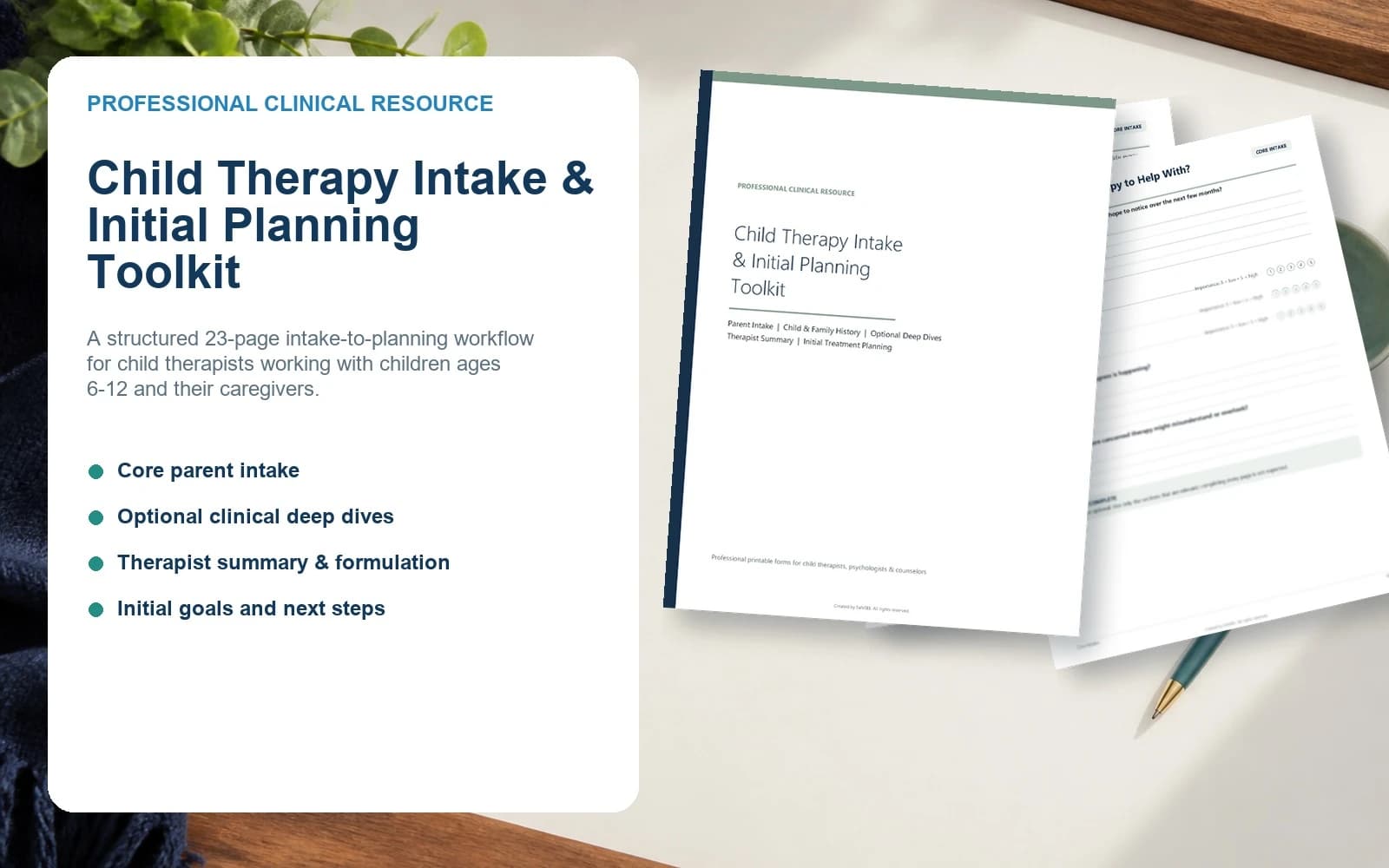
Organize child perspective, observation, functional domains, strengths and initial formulation with the Child Therapy Assessment Pack.
Browse the full SafeSEL professional resource line.
Related guide: How to Take a Child’s Developmental History
Related guide: When a Child Knows What to Do but Cannot Start the Task
Sources and further reading
- Clinical Practice Guidelines, Updates and Parameters — American Academy of Child and Adolescent Psychiatry (2026)
- Record Keeping Guidelines — American Psychological Association (2024)
- Developmental Surveillance and Screening Patient Care — American Academy of Pediatrics (2024)