Neurodiversity-affirming goals focus on safety, autonomy, communication, access, self-understanding, meaningful participation and quality of life. They do not make appearing neurotypical, suppressing harmless regulation or complying without understanding the default measure of progress.
Separate difference from harm or barrier
A behavior may be unusual without being dangerous or impairing. Clarify whether the concern involves pain, exclusion, communication failure, loss of access, exhaustion, safety or another meaningful impact.
Include the child’s priorities and communication
Use the child’s preferred communication methods and enough processing time. Supported decision-making may be needed; caregiver goals matter, but they should not automatically replace the child’s experience.
Write goals around function and access
- Communicate a need or boundary in an accessible way
- Recognize and recover from overload with support
- Increase access to a valued activity
- Identify accommodations that reduce unnecessary demand
- Build self-advocacy without requiring disclosure in unsafe contexts
Review environmental mismatch
Ask what sensory, social, language, timing or executive demands are creating the barrier. A plan that teaches only the child while leaving an inaccessible environment unchanged may misidentify the problem.
Monitor cost as well as visible success
A child may complete a task while experiencing substantial distress, masking or delayed exhaustion. Include the child’s report, recovery needs and sustainability when judging benefit.
Test every goal with three questions
- Does this goal reduce harm or improve access to something the child values?
- Can the environment change instead of placing the whole burden on the child?
- What will success cost in effort, masking, distress and recovery time?
A goal such as “maintain eye contact for five minutes” may make a child look more typical without improving communication. A functional alternative might be “show the communication partner that a message was received using an accessible response.” The second goal permits speech, gesture, text, AAC or another reliable mode and measures the outcome that actually matters.
Write paired child-and-environment goals
If a child is learning to identify overload, the adults should also learn to recognize early signs and provide a workable exit or regulation option. If a child is practicing self-advocacy, the setting must respond safely when the child says no or asks for an accommodation. Skills cannot compensate for an environment that punishes their use.
Example: replacing compliance with access
Instead of “complete all group activities without refusal,” a collaborative plan may identify which groups are valued, what sensory and communication supports are needed, how the child can opt out safely and what gradual participation looks like. Progress can then be measured through access, recovery and self-advocacy rather than silent endurance.
Review goals with the child in an accessible format
Use concrete language, visual options, supported decision-making and enough time. Record disagreement rather than smoothing it out. Caregiver priorities, school requirements and clinical judgment all matter, but the child’s experience should remain visible in the formulation and review.
Related SafeSEL guides
When a Child Says “I Don’t Know” in Therapy — widen communication without pressure
Gifted and Twice-Exceptional Children in Therapy — consider uneven profiles and masked support needs
Progress data should include the child’s internal experience
Observable completion can improve while wellbeing worsens. A child may attend a noisy group every week by masking distress and then need hours to recover. Add measures such as perceived effort, recovery time, use of accommodations and willingness to return. When self-report is difficult, use accessible scales, observation across settings and supported communication without assuming that adult impressions are equivalent to the child’s experience.
Affirming practice does not mean avoiding every challenge or declaring that change is never appropriate. Skills that increase safety, communication, flexibility or access can be valuable when the goal is collaborative and the method respects autonomy. The distinction is between expanding the child’s options and training the child to hide difference for other people’s comfort.
Make therapy forms reflect the goals you actually value
A goal-review form can separate the child’s preferred outcome, environmental support and a practical sign of progress. For example, record whether a quiet entry route was available as well as whether the child joined an activity. Otherwise, a missed accommodation can disappear from the record while the child’s nonparticipation becomes the only visible result.
Choose therapy tools that allow more than one communication method. If a scale requires spoken explanations, offer an accessible alternative and record how the response was obtained. Do not convert an adult’s estimate into the child’s self-report. At review, invite the child to say that a goal no longer fits, using the communication support they need.
A practical next step
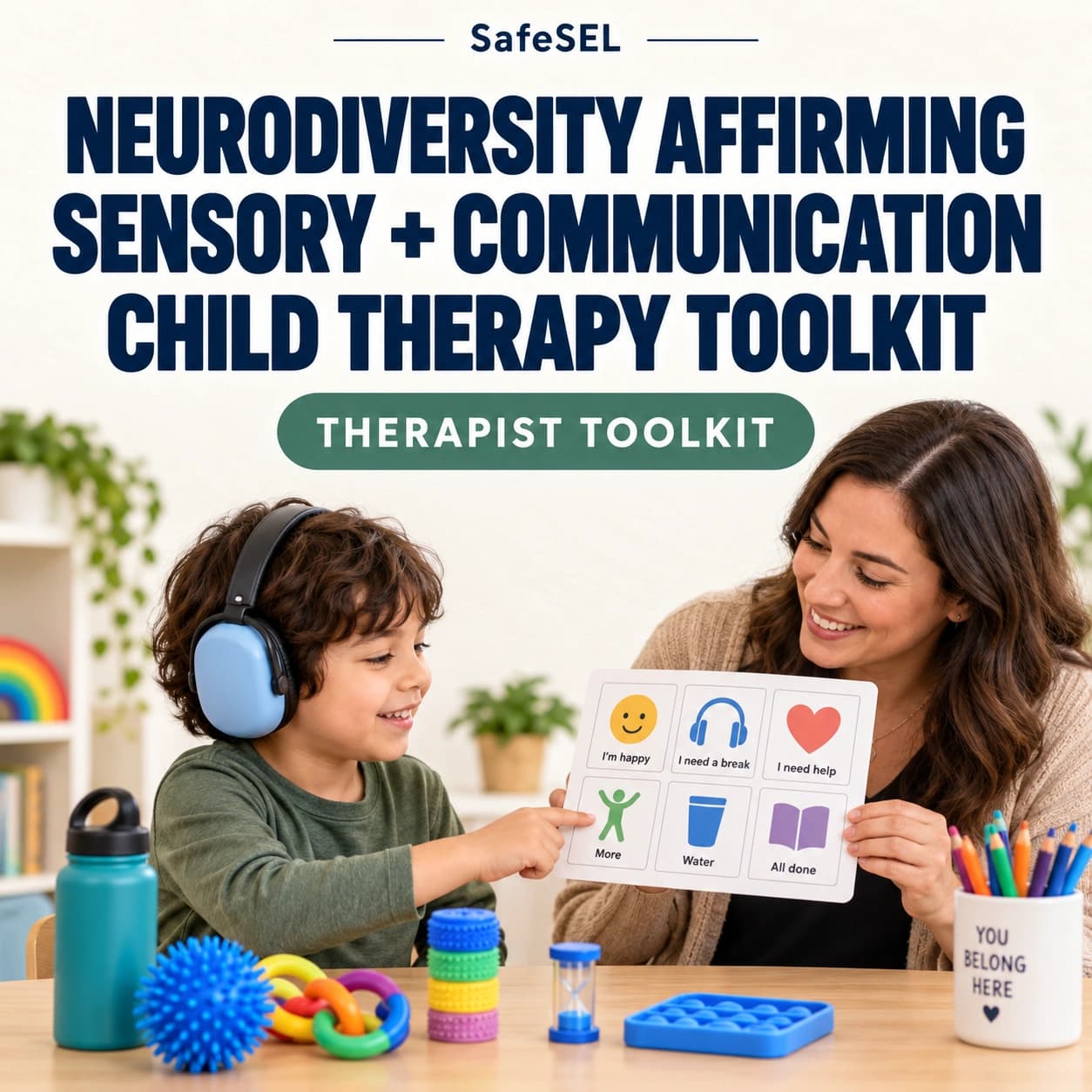
Use strengths, access needs and collaborative goals with the Neurodiversity-Affirming Child Therapy Toolkit.
Browse the complete child therapist resource library.
Sources and further reading
- Health Care for Youth With Neurodevelopmental Disabilities: A Consensus Statement — American Academy of Pediatrics (2024)
- Encouraging Strengths in Parents and Youth to Promote Positive Childhood Experiences — American Academy of Pediatrics (2023)
- Priorities and Perspectives Regarding Goals and Outcomes of Support for Autistic Children Under 12 Years: A Systematic Review — Autism (PubMed) (2026)