Loneliness is the painful gap between the connection a child wants and what they experience. Solitude can be chosen, restorative and compatible with wellbeing. Assessment should ask about the child’s preference, sense of belonging, relationship quality, exclusion, safety and access—not use the number of friends or time alone as the only measure.
Start with the child’s experience
A child may enjoy solitary interests, want one close friend or need recovery time after social contact. Another child may appear socially busy while feeling unseen or excluded. Ask what connection they want and what gets in the way.
Map context and access
- Where the child feels included or peripheral
- Whether communication and sensory demands limit access
- Bullying, discrimination or unstable friendships
- Online and offline sources of connection
- Opportunities organized around genuine interests
Avoid forced sociability
Goals should not require a child to perform extroversion, make eye contact or maintain many friendships. Focus on safe access, communication, boundaries, shared interests and relationships the child values.
Assess associated distress
Explore mood, anxiety, self-worth, sleep, school attendance and safety when loneliness is persistent. Social disconnection may be both a consequence and a contributor to other difficulties.
Build belonging at more than one level
Individual skills may help, but belonging also depends on peer culture, adult responses, accessibility and protection from bullying. Coordinate environmental change when the setting is part of the problem.
Being alone is an observation; loneliness describes an experience
A child may choose solitude and feel restored, absorbed or content. Another may spend time alone because of rejection, anxiety, communication barriers or lack of access while wishing for connection. Time alone cannot tell you which experience is present. Ask about choice, satisfaction, flexibility, relationships and change over time.
Use a four-part comparison
- Choice: Is solitude selected, tolerated or imposed?
- Experience: Does the child feel content, bored, anxious, rejected or numb?
- Flexibility: Can the child join valued activities when they want to?
- Impact: Are mood, sleep, school, self-worth or help-seeking changing?
Avoid making sociability the treatment target
A child does not need a large friendship group to be healthy. Goals should reflect the child’s desired relationships and access, not an adult preference for extroversion. Support may focus on one safe connection, navigating a specific peer context, addressing bullying, reducing anxiety or protecting restorative alone time.
Example: similar behavior, different needs
Two twelve-year-olds spend lunch in the library. One chooses it several days a week, has close friends after school and enjoys reading. The other was excluded from a group chat, wants company and reports stomachaches before lunch. The visible behavior is the same; the formulation and next step are not.
Related SafeSEL guides
Digital Friendship Boundaries for Ages 9–12 — explore online peer context
Child Therapist Resources & Clinical Tools — browse the clinician resource hub
Assess change and discrepancy
A long-standing preference for a small social world is different from a sudden withdrawal after conflict, loss, bullying or mood change. Also compare what the child says they want with what is available. A child may report “I like being alone” because attempts to join have repeatedly failed. Accept the statement while gently exploring whether solitude feels chosen, safe and satisfying.
Caregiver and school reports can add context but may reflect different values about sociability. One adult may worry about quiet lunch periods while another sees close online friendships. Bring the observations together without voting on the child’s personality. The most important questions are whether the child has access to desired connection and whether distress or functioning is changing.
Therapy Printables for Kids — browse the clinician resource hub
Being alone and feeling alone require different questions
For childhood loneliness, ask what kind of contact the child would actually welcome. It might be one person to sit beside, a shared-interest activity or a reliable way to stay in touch. Do not assume that a larger group is the desired solution. Check what makes that particular connection difficult to access.
Loneliness resources are most useful when they help identify a workable next step and the adult support it requires. A conversation prompt cannot fix exclusion or an inaccessible club on its own. If the child prefers quiet time and has satisfying connections, protect that choice rather than using the worksheet to persuade them to become more sociable.
A practical next step
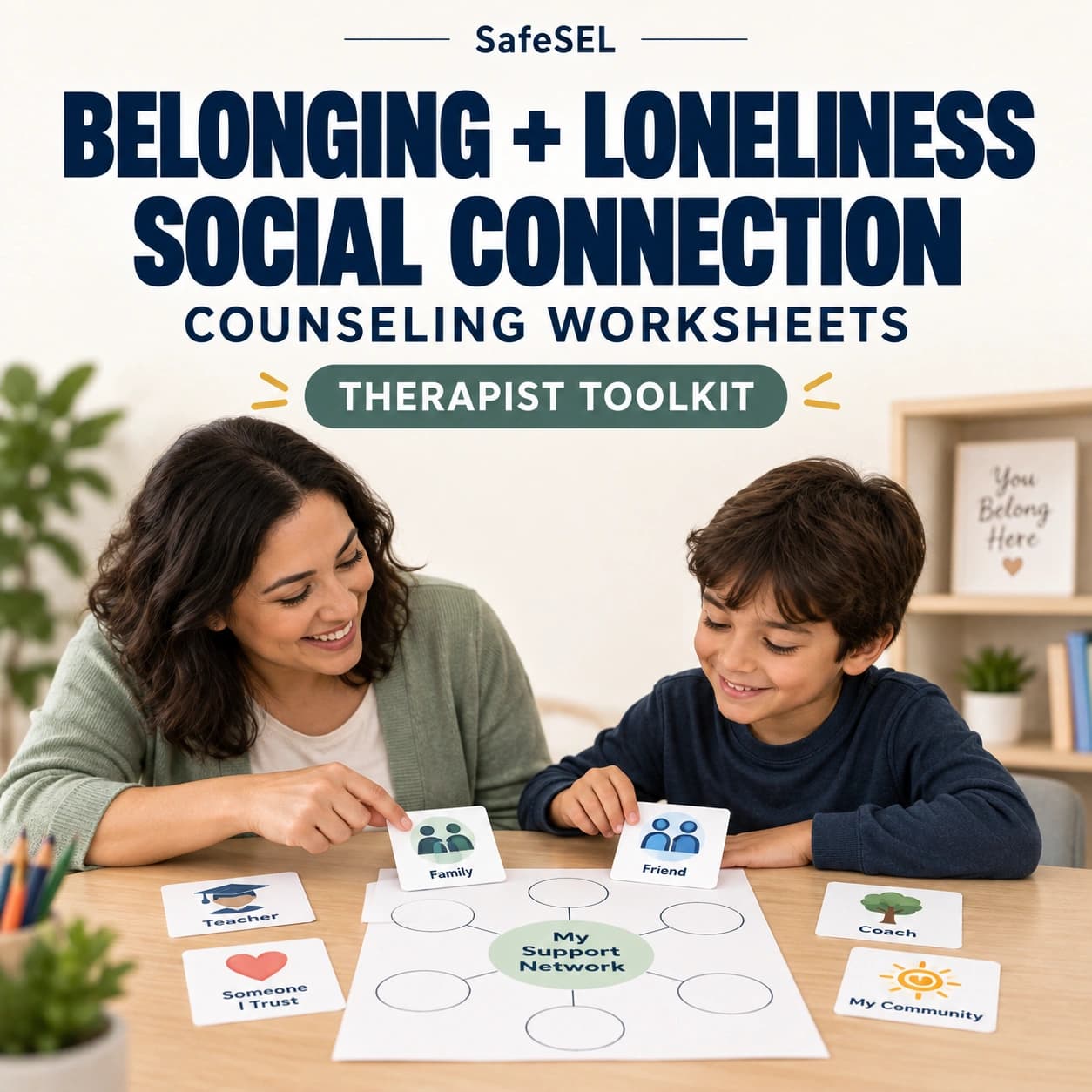
Map belonging, loneliness, relationships and access with the Belonging, Loneliness & Social Disconnection Therapist Toolkit.
Browse the complete child therapist resource library.
Sources and further reading
- About Children's Mental Health — Centers for Disease Control and Prevention (2025)
- Encouraging Strengths in Parents and Youth to Promote Positive Childhood Experiences — American Academy of Pediatrics (2023)
- Health Care for Youth With Neurodevelopmental Disabilities: A Consensus Statement — American Academy of Pediatrics (2024)
- Are you alone? Measuring solitude in childhood, adolescence, and emerging adulthood — International Journal of Behavioral Development (PMC) (2023)
- Perspectives on Social Withdrawal in Childhood: Past, Present, and Prospects — Child Development Perspectives (PMC) (2021)