← All guides
Social Skills

How to Investigate Repeated Peer Exclusion Without Forcing Reconciliation

Practical, developmentally respectful guidance on how to investigate repeated peer exclusion without forcing reconciliation. Use clear steps, supportive

Written bySafeSEL Editorial TeamEducational content team

Repeated exclusion requires careful investigation of patterns, power, group rules, and access. The goal is not to force friendship or a public reconciliation; it is to stop harmful behavior, restore safe participation, and identify what support each student needs. The goal is not to make every difficult moment disappear. It is to create a response that is predictable, respectful, proportionate, and usable by real adults during a real school or therapy day.

In brief

Start by defining the exact situation and the skill or access need involved. Choose one adult response that can be used consistently, one option the child or student can use, and one way to measure whether participation becomes safer or more independent. Avoid turning a support plan into a judgment about attitude, personality, or willingness.

A decision process for school teams

A broad label such as “anxious,” “defiant,” “unmotivated,” or “dysregulated” is not an intervention target. Translate the concern into an observable sequence: what the setting requires, what the student notices or does first, how adults respond, and what happens next. This protects the student from overlabelling and gives the team something that can actually be changed.

Ask whether the primary goal is safety, communication, access to instruction, emotional recovery, peer protection, skill practice, or a referral for more individualized support. Several goals may matter, but trying to solve all of them in one moment usually creates too many words and inconsistent expectations.

Questions that prevent premature conclusions

Do not assume that the same outward behavior has the same function in every setting. Leaving may create distance from overload, prevent embarrassment, access adult reassurance, or signal that the task is not currently accessible. Repeated apologizing may reflect social anxiety, fear of consequences, learned politeness, or a strategy for ending uncertainty. The plan should remain a working hypothesis that is updated with new information.

Use information from more than one context when possible. Include the student’s perspective in a developmentally appropriate way, and distinguish what adults directly observed from what they inferred. This does not require a lengthy assessment before offering support; it requires humility about what is not yet known.

Implementation steps

1. Document when, where, and how exclusion occurs

Plan for the first imperfect attempt instead of waiting for ideal conditions. Write down exactly what staff will do and what the student can do next. If different adults interpret the step differently, the plan is not yet specific enough.

2. Speak with students separately and protect reporting privacy

Make this step observable before expecting consistency. Remove unnecessary public attention. Privacy often reduces the social cost of using support and makes it easier for the student to return to participation.

3. Distinguish ordinary friendship choice from coordinated or repeated harm

Treat this as a small implementation decision, not a test of motivation. Review the response across several situations. One successful or difficult attempt should inform the next decision, but should not be treated as proof of a fixed trait.

4. Review adult supervision and activity structure

Define the adult action, the student option, and the point at which the plan will be reviewed. Write down exactly what staff will do and what the student can do next. If different adults interpret the step differently, the plan is not yet specific enough.

5. Create access and protection steps

Keep the step brief enough to use during a real school day. Remove unnecessary public attention. Privacy often reduces the social cost of using support and makes it easier for the student to return to participation.

6. Monitor the pattern over time

Use neutral language so the plan remains about access and safety rather than character. Review the response across several situations. One successful or difficult attempt should inform the next decision, but should not be treated as proof of a fixed trait.

Worked school or therapy example

A student is repeatedly told there is “no room” at lunch and recess. Staff observe that the rule changes when the student approaches and that peers coordinate messages. The plan increases supervision, creates safe seating options, addresses the group behavior, and checks in privately.

The team writes the plan in plain language. They identify the earliest cue, the adult’s first response, the student’s available option, and the return or follow-up step. They decide when the plan will be reviewed and which data are necessary. The review focuses on whether the student can participate more safely and effectively, not whether the student appears perfectly calm or agreeable.

A practical planning table

Planning question — What to record — Why it matters

--- — --- — ---

What happens immediately before the difficulty? — Setting, task, people, cue, and level of demand — Identifies preventable barriers and useful timing

What is the first observable sign? — Words, movement, silence, requests, leaving, or physical cues — Creates an earlier point for support

What does the adult do next? — Exact words, choices, changes, and consequences — Shows whether adult responses are consistent

What is the student able to do afterward? — Continue, pause, return, communicate, repair, or ask for help — Measures participation rather than compliance alone

What will be reviewed? — One or two indicators over a defined period — Prevents endless tracking without a decision

Helpful professional language

  • “You do not have to become friends, and you do have to follow safety and respect expectations.”
  • “We are looking at the repeated pattern, not only one lunch period.”
  • “Reporting will not require a face-to-face meeting.”
  • “We will check whether the plan is working.”

Short language is usually more usable during stress. It should communicate what is happening, what remains expected, and what option is available without inviting a public debate. Adults can be warm and validating while still protecting safety, learning time, privacy, and peer boundaries.

Common implementation mistakes

  • Forcing a friendship agreement. This can increase pressure, reduce useful information, or make support feel like a public consequence.
  • Treating all exclusion as accidental. This can increase pressure, reduce useful information, or make support feel like a public consequence.
  • Making the targeted student change groups as the only solution. This can increase pressure, reduce useful information, or make support feel like a public consequence.
  • Ending follow-up after one apology. This can increase pressure, reduce useful information, or make support feel like a public consequence.

Another common mistake is adding several new forms, scripts, rewards, and consequences at once. When the plan changes too many variables, the team cannot tell what helped. Start with the smallest change likely to improve access or safety, then review.

Accessibility and developmental adaptation

For younger children, use modeling, pictures, predictable routines, and one-step language. For ages 7–9, combine a visible sequence with brief rehearsal and limited choices. For ages 10–12, protect privacy, explain the purpose of the plan, and invite meaningful input about cues and supports.

Offer more than one way to receive information and show understanding. A student may point, select, draw, role-play, type, use augmentative communication, or answer orally. Changing the response mode does not necessarily change the learning goal. Avoid assuming that handwriting, eye contact, rapid verbal explanation, or public participation is the skill being taught unless it truly is.

Monitoring progress without turning the plan into surveillance

Choose two or three indicators:

  • Frequency and settings of exclusion
  • Access to activities and safe peers
  • Student-reported safety and adult observation

Review patterns across a defined period, such as two weeks or six opportunities. Record enough information to make a decision, but not every expression, movement, or emotional change. Share data only with adults who need it to support the student.

Progress may look like earlier communication, shorter disruption, safer behavior, a more successful return, less adult prompting, or improved participation. A student can still feel anxious, angry, or overwhelmed while making meaningful progress.

When additional support or urgent action is needed

Consider more individualized assessment when the pattern is persistent, worsening, appears across settings, or substantially interferes with attendance, learning, health, relationships, or daily functioning. Involve the appropriate school team and caregivers when physical symptoms, repeated school avoidance, significant aggression, prolonged shutdown, marked changes in functioning, or suspected bullying are present.

Immediate safety procedures are required for credible threats, access to weapons, serious physical aggression, suspected abuse, suicidal statements, or inability to maintain safety. Follow local school policy and emergency procedures rather than relying on an SEL worksheet or informal conversation.

Related SafeSEL resources

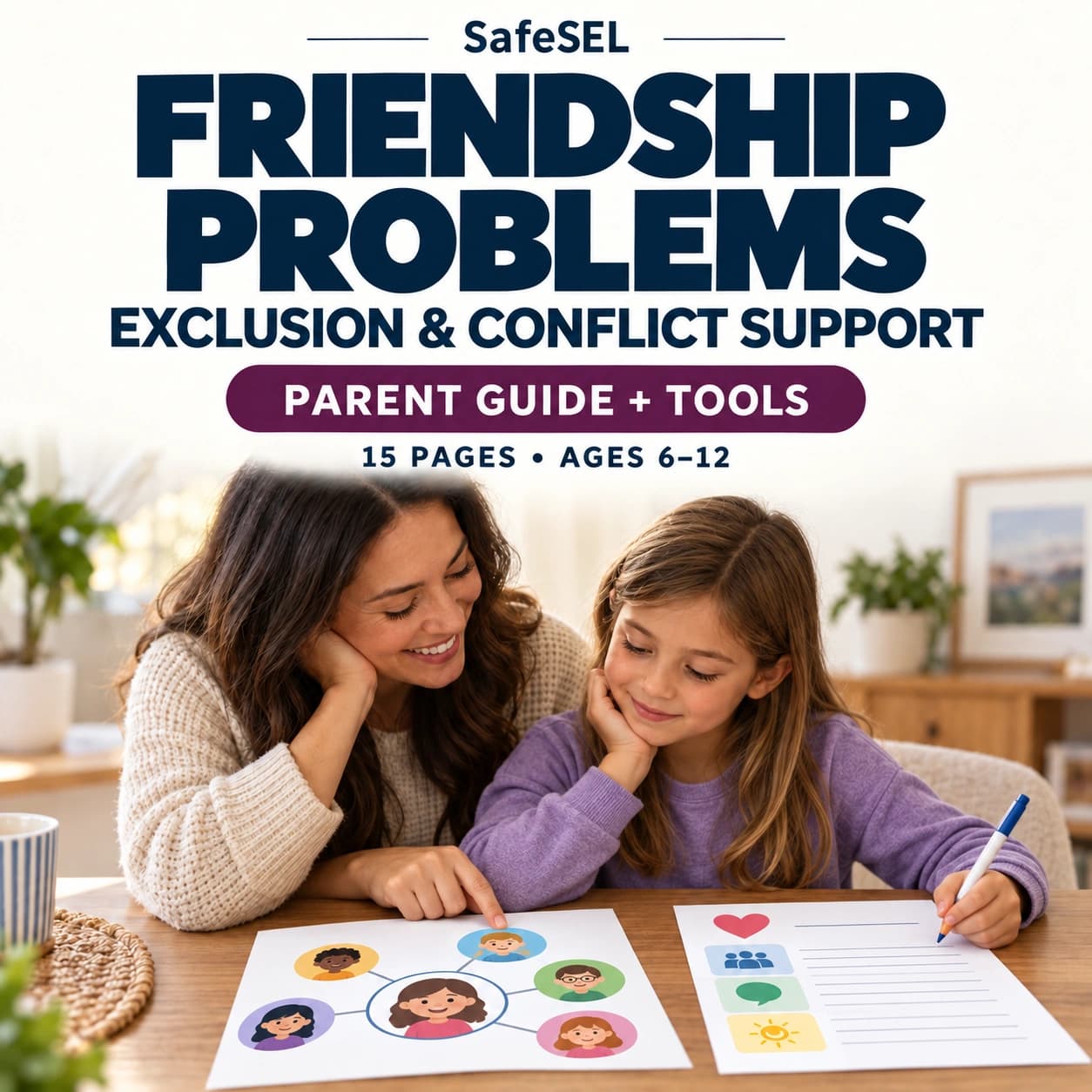
  • Parent or professional guide: Friendship and Peer Skills: Access, Boundaries, Conflict, and Belonging
  • Suggested product line: Friendship support plans / Social stories
  • Free practice resource: Peer Exclusion Investigation Sheet

Sources and further reading

  1. Support the Children Involved — StopBullying.gov
  2. Other Types of Aggressive Behavior — StopBullying.gov
  3. Multi-Tiered Prevention and Intervention — StopBullying.gov
  4. Violent Behavior in Children and Adolescents — AACAP
  5. A Supportive Classroom Environment — CASEL Schoolguide
SafeSEL printables

Related resources

View all Social Skills products →
Continue reading

Related articles

How Adults Can Mediate Peer Conflict Without Deciding Too Quickly Who Is “The Problem”

Practical, developmentally respectful guidance on how adults can mediate peer conflict without deciding too quickly who is “the problem”. Use clear steps,

Read guide →

How Teachers Can Form Groups Without Repeatedly Isolating the Same Students

Practical, developmentally respectful guidance on how teachers can form groups without repeatedly isolating the same students. Use clear steps, supportive

Read guide →

Behavior Reflection Sheets: When They Help and When They Become Punitive

Practical, developmentally respectful guidance on behavior reflection sheets: when they help and when they become punitive. Use clear steps, supportive

Read guide →