When a child fears mistakes, avoid debating whether they are “smart” or promising that the task will be easy. Name the pressure, define what finished means, narrow the next step and give accurate feedback about strategy, correction and recovery. Confidence grows from usable evidence—not from being told to feel confident.
Listen for the rule hiding under the reaction
Perfectionism can look like endless erasing, refusal to begin, checking, asking an adult to take over, abandoning work after one error or becoming furious when corrected. Underneath may be a rule: if it is not excellent, it is worthless; if I need help, I am incapable; if someone is disappointed, I have failed.
Respond to the rule rather than the volume. “It sounds as if one mistake is making the whole page feel ruined” is more useful than “You’re overreacting.” You are not agreeing that the page is ruined. You are showing that the child’s internal logic can be noticed and examined.
Do not turn reassurance into an argument about identity
When a child says “I’m stupid,” parents naturally say “No, you’re brilliant.” The child may produce counterexamples, and the conversation becomes a debate about the whole person. Narrow the statement: “This problem is hard, and you’re stuck on the second step.” A specific difficulty can be taught; a global verdict cannot.
Try language that keeps connection and action together: “That result hurt. Let’s find the part you can check.” Or, “You wanted this to be excellent. For this task, complete and readable is enough.” The child does not have to believe a positive slogan before taking the next step.
Define what done means before work begins
“Do your best” can sound like “use every drop of effort.” Set an observable finish line: ten minutes, three required ideas, one revision, then submit. Decide which quality matters and which imperfections are acceptable for this task.
A finish rule protects against endless checking and against adults quietly raising the standard after the child starts. If the purpose is practice, say so. If accuracy is essential, identify the small part that requires careful review instead of making the whole task high stakes.
Use accurate praise instead of bigger praise
Inflated praise can feel disconnected when the child knows the result is ordinary or incomplete. Accurate feedback gives evidence: “You noticed the calculation error and corrected it,” “You asked for clarification,” or “You stayed with the drawing after the line changed.” Recent research also suggests that praise and criticism that feel inaccurate may be linked with poorer adjustment.
Process praise should not become surveillance of every effort. Children also need privacy and intrinsic satisfaction. Use feedback when it helps the child understand a useful action, then let the activity belong to them. Silence can also communicate trust.
Practise imperfection where the stakes are low
Choose small behavioral experiments: send a family text with a harmless typo, draw with the non-dominant hand, stop a craft at the planned time, answer one practice question without checking twice or let a parent make and repair a visible mistake. Agree in advance what the child predicts and what you will observe.
The goal is not to embarrass the child or prove that standards never matter. It is to learn that an imperfect outcome can be noticed, tolerated and repaired without catastrophe. Start low enough that the child can participate willingly and review what actually happened.
Model repair without making a performance of failure
Parents can say, “I sent the wrong time. I corrected it,” or “I spoke too sharply. I’m going to try that again.” This shows that mistakes lead to information and repair, not a collapse of worth. Avoid staging exaggerated errors just to teach a lesson; children notice when an exercise is artificial.
Watch the family language around grades, sports, appearance and adult work. A child hears not only what adults say to them but what adults say about themselves. “I’m such an idiot” teaches a different lesson from “I missed that detail; I’ll fix it.”
Know when high standards need more support
Seek qualified help when fear of mistakes causes significant avoidance, distress, sleep problems, school impairment, repeated reassurance, compulsive checking, eating concerns, depression, self-harm or loss of ordinary activities. Perfectionistic behavior can occur alongside anxiety, obsessive-compulsive symptoms, learning differences and other needs.
Do not use a parent guide to diagnose the child. Bring concrete examples: what the child predicts, what they avoid, how long tasks take, what reassurance is requested and how functioning has changed. That record gives a clinician or school team something more useful than “they want everything perfect.”
School input can clarify whether the pattern appears across subjects, only during timed work, after correction, in social situations or when instructions are ambiguous. Appropriate teaching, accommodations or assessment may matter as much as confidence-building language at home. The aim is not to lower every standard; it is to make expectations accurate, visible and reachable while keeping the child’s worth separate from the result.
Turn guidance for parents into one shared response
For childhood perfectionism, compare what different adults mean by ‘finished.’ One caregiver may accept a readable draft while another expects a polished page. Agree on the requirement before the child begins, and explain which part is practice. Consistency should clarify the task, not require every adult to use a rigid script.
Parent handouts can hold two or three phrases you want to remember, such as ‘Which part needs correcting?’ and ‘What does this assignment actually ask for?’ Choose language that fits the child’s situation. A handout is a reminder for the adult, not a checklist the child must complete to earn reassurance, affection or a break.
A practical next step
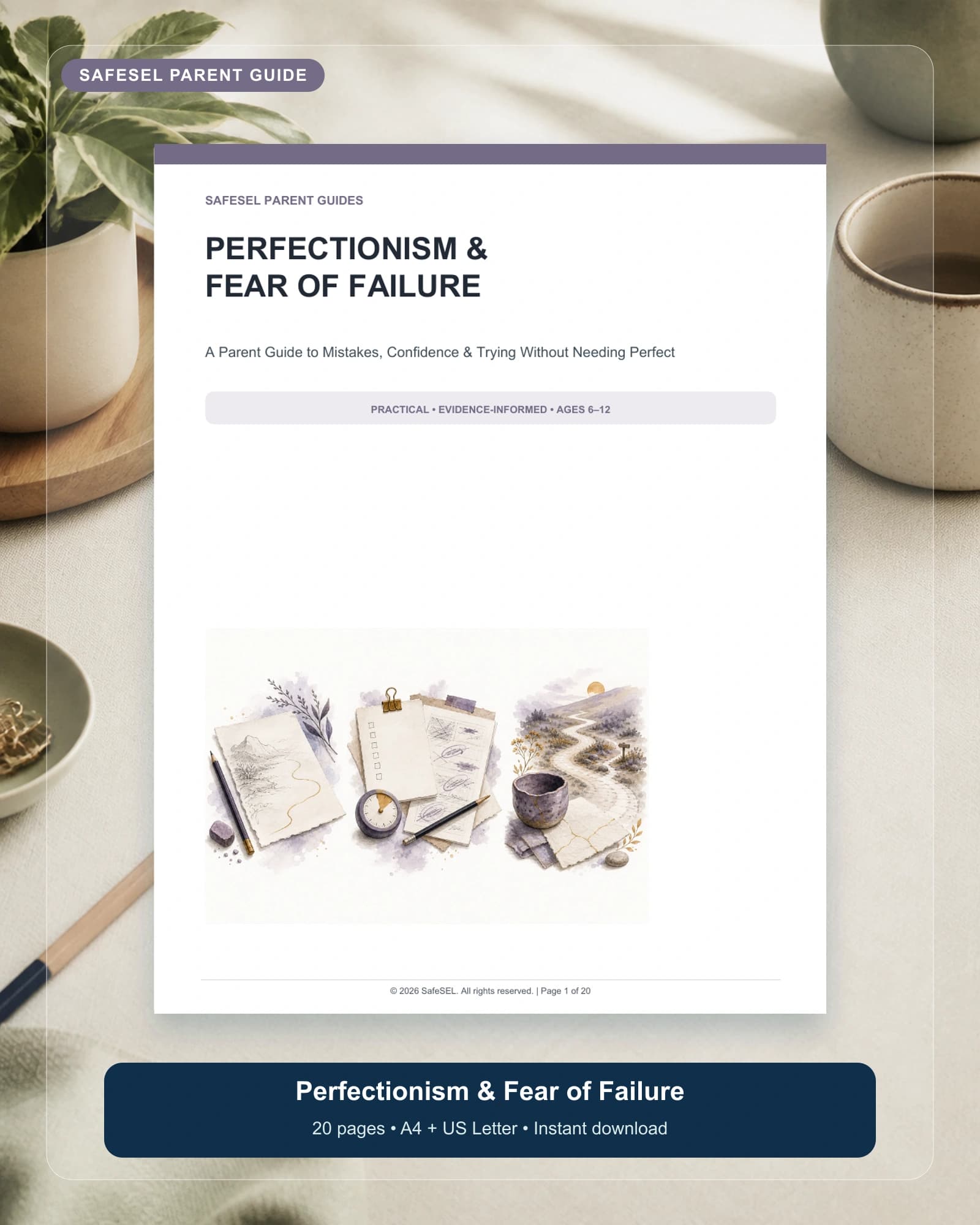
For the complete home-use framework, scripts and printable tracker, see the Perfectionism & Fear of Failure parent guide.
Browse more parent and caregiver resources.
Continue with perfectionism in children during homework.
Sources and further reading
- Perfectionism in Childhood and Adolescence — American Psychological Association (2022)
- Perfectionism: When Good Is Never Good Enough — American Psychological Association (2025)
- How Perceptions of the Accuracy of Parental Praise and Criticism Link With Child Adjustment — PubMed / Journal of Youth and Adolescence (2024)