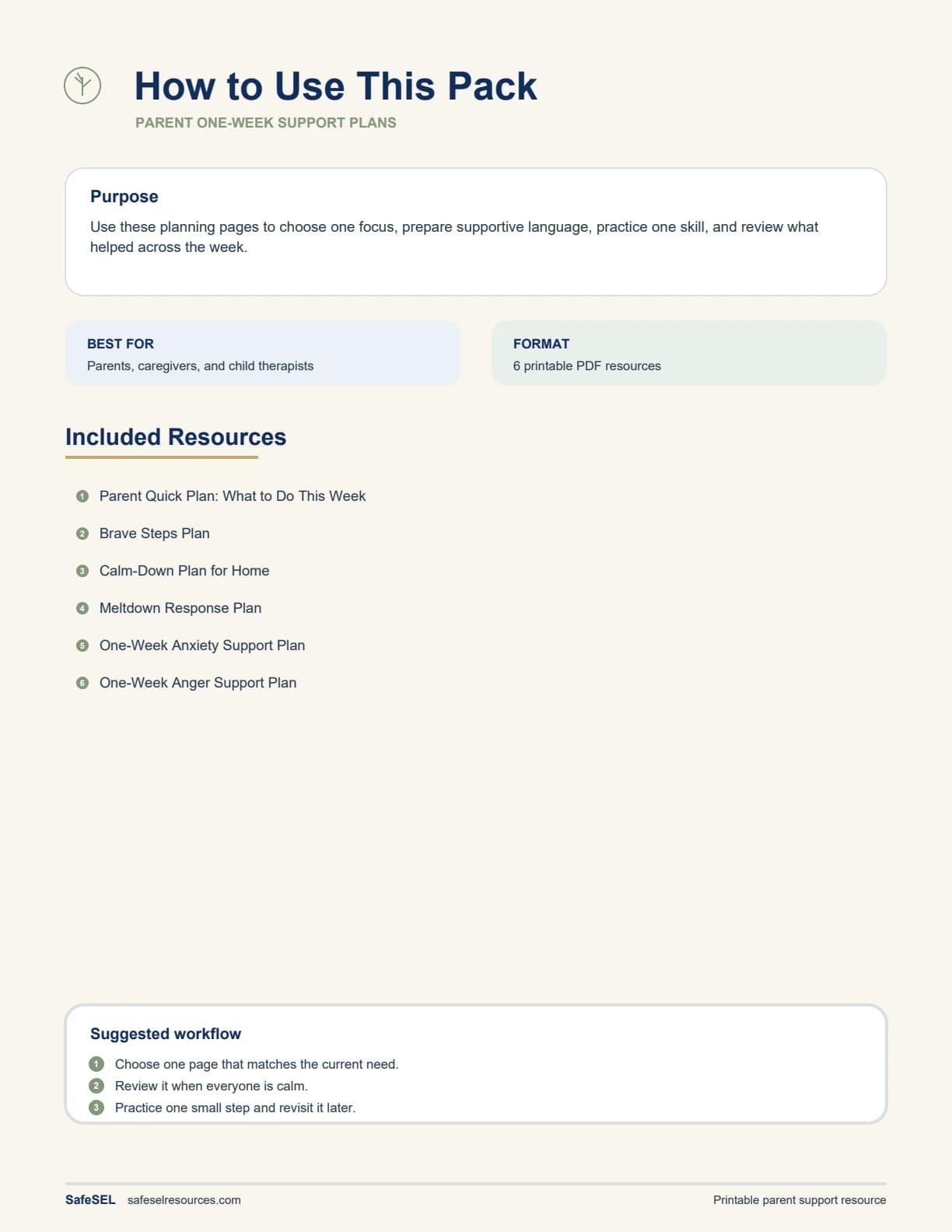
A one-week support plan is a short experiment around one meaningful, manageable goal. It defines the situation, the adult response, the child’s available choices, how practice will happen and what the family will review—without trying to fix every difficulty at once.
Choose a target small enough for seven days
Examples include one morning transition, one reassurance response, one calm-down routine or one manageable brave step. Avoid goals such as “control anger” or “stop anxiety,” which are too broad to guide daily action.
Define what adults will do
- Use one short phrase consistently
- Prepare materials or visual cues in advance
- Offer an agreed level of help
- Avoid adding new consequences during the experiment
- Notice effort without turning practice into a performance
Keep practice brief and predictable
Choose when practice will occur and what counts as enough. If the child is already overwhelmed, prioritize regulation and safety rather than forcing completion to protect the plan.
Record only useful information
A short note about context, support and recovery is usually enough. The aim is to learn whether the plan is usable, not produce a perfect streak.
Review and decide
At the end of the week, ask what helped, what was too hard and what should continue, change or stop. Coordinate with the child’s therapist or healthcare professional when the plan relates to treatment.
A one-week plan is a test, not a promise to fix everything
The purpose is to reduce chaos and learn what helps around one specific situation. Choose a target small enough to observe, such as the first ten minutes after school, bedtime separation or one homework transition. Broad goals such as “be less anxious” make it impossible to know what adults should do differently tomorrow.
Build the plan with five parts
- Target: one situation described in observable language.
- Adult response: one short phrase and one support used consistently.
- Child option: a realistic choice, communication method or coping step.
- Environment: one demand, timing or sensory adjustment.
- Review: a date and two indicators that will guide the next decision.
Example: after-school overload
For one week, the family stops asking detailed questions at pickup, offers a snack and twenty minutes of low-demand recovery, then uses one predictable check-in. They record whether conflict decreases and whether the child can rejoin the evening routine. The trial tests a transition hypothesis; it does not declare that every difficult afternoon has the same cause.
Know when a home plan is not enough
Pause and seek appropriate help when there are safety concerns, major functional decline, persistent physical symptoms, possible bullying or abuse, severe eating or sleeping changes, or a need for diagnostic or medical assessment. A short family plan can support care, but it should not delay it.
Related SafeSEL guides
How to Use a One-Week Parent Support Plan Without Trying to Fix Everything — read the companion implementation guide
How Parents Can Track Patterns Without Monitoring Everything — collect only the information the review needs
Parent & Caregiver Support Resources — browse the parent resource hub
Review the week without grading the child
At the review, ask what became easier, what support was actually available, what the child noticed and what surprised the adults. A plan can be informative even if the target behavior did not improve. Perhaps the chosen time was unrealistic, the trigger was different from what adults assumed or the child needed a communication option before a coping skill.
Choose one of four next decisions: keep the plan for another short period, make one small revision, stop because it is not useful, or bring the pattern to a qualified professional. Avoid adding several new strategies at once. A one-week plan works because it narrows attention and makes learning possible, not because seven days is a clinical deadline.
Parent & Caregiver Resources — browse the parent resource hub
Keep the parent plan focused on everyday emotional support
Here, child support means practical support for a child’s routines, coping and participation. This guide is not about financial child support, custody arrangements or legal obligations. Choose one everyday situation that the family can review together without treating seven days as a deadline for recovery.
At the review, separate whether the adult support was available from whether the child’s response changed. If the planned check-in never fitted the school pickup schedule, revise the timing before concluding that the idea failed. A useful trial helps the family choose its next step; it does not grade the child.
A practical next step
Turn one small home goal into a reviewable routine with Parent One-Week Support Plans.
Browse the complete Parent & Caregiver resource library.
Sources and further reading
- About Children's Mental Health — Centers for Disease Control and Prevention (2025)
- Encouraging Strengths in Parents and Youth to Promote Positive Childhood Experiences — American Academy of Pediatrics (2023)