When a routine repeatedly breaks down, start with the first point where the child cannot continue without escalating adult help. Check whether the sequence is visible, the task fits the child’s current skills, transitions are predictable and adults are giving one actionable cue. Fix the bottleneck before adding rewards, consequences or more reminders.
Observe one ordinary version of the routine
Write the steps that actually occur, including adult prompts, searching for materials, waiting and negotiation. A routine that looks like three steps to an adult may contain fifteen decisions for a child.
Mark the first point where progress stops. The later argument may be the most visible part, but the useful intervention often belongs several minutes earlier.
Check clarity, capacity and meaning
Ask whether the child knows what “get ready” means, can remember the sequence, can estimate time and can shift away from the current activity. Also ask what the destination or task means to the child. A school worry, difficult homework, sensory discomfort or fear at bedtime will not be solved by a prettier checklist alone.
Avoid choosing between “cannot” and “will not” too quickly. Capacity, motivation, stress and relationship dynamics can all contribute. Describe what happens before assigning a cause.
Externalize the sequence
Put essential steps where they are used, prepare materials in advance and remove optional decisions from the busiest moment. Give one cue that identifies the next action: “Shoes are next,” rather than a stream of reminders about the entire morning.
A visual routine should reduce adult language, not create a second system the adult must constantly explain. If nobody checks it without prompting, simplify it or move it.
Build flexibility without making the plan vague
Predictability helps, but real families need room for illness, late buses and difficult nights. Decide which steps are fixed, which can be shortened and how a change will be communicated.
Offer limited choices inside the structure: clothes from two options, homework before or after a snack, one of two calming activities. Too many choices can add load; no choice can create unnecessary power struggles.
Review the system, not the child’s character
After several days, compare how much adult help was needed, where delay occurred and whether conflict or recovery changed. Keep changes that improve function even if the routine is not perfect.
If routines remain extremely difficult across settings, or sleep, learning, anxiety, sensory needs or executive functioning appear to be involved, seek appropriate assessment and support. A home routine tool can organize the problem; it cannot diagnose it.
Family routine examples: adapt the bottleneck, not the whole day
In a homework routine, a child may be able to do the work but unable to find the assignment, choose what to start or understand an unclear instruction. Place the materials together and identify the first action. If the task itself is inaccessible, more reminders to begin will not solve that barrier; ask the school what teaching or adjustment is needed.
For changes in routine, name what stays the same as well as what changes: ‘The bus is late; your bag is ready, and we will wait here together.’ A backup version can remove optional steps while preserving supervision, essential care and a clear destination. Review whether the backup actually helped instead of expecting a disrupted day to look ordinary.
A practical next step
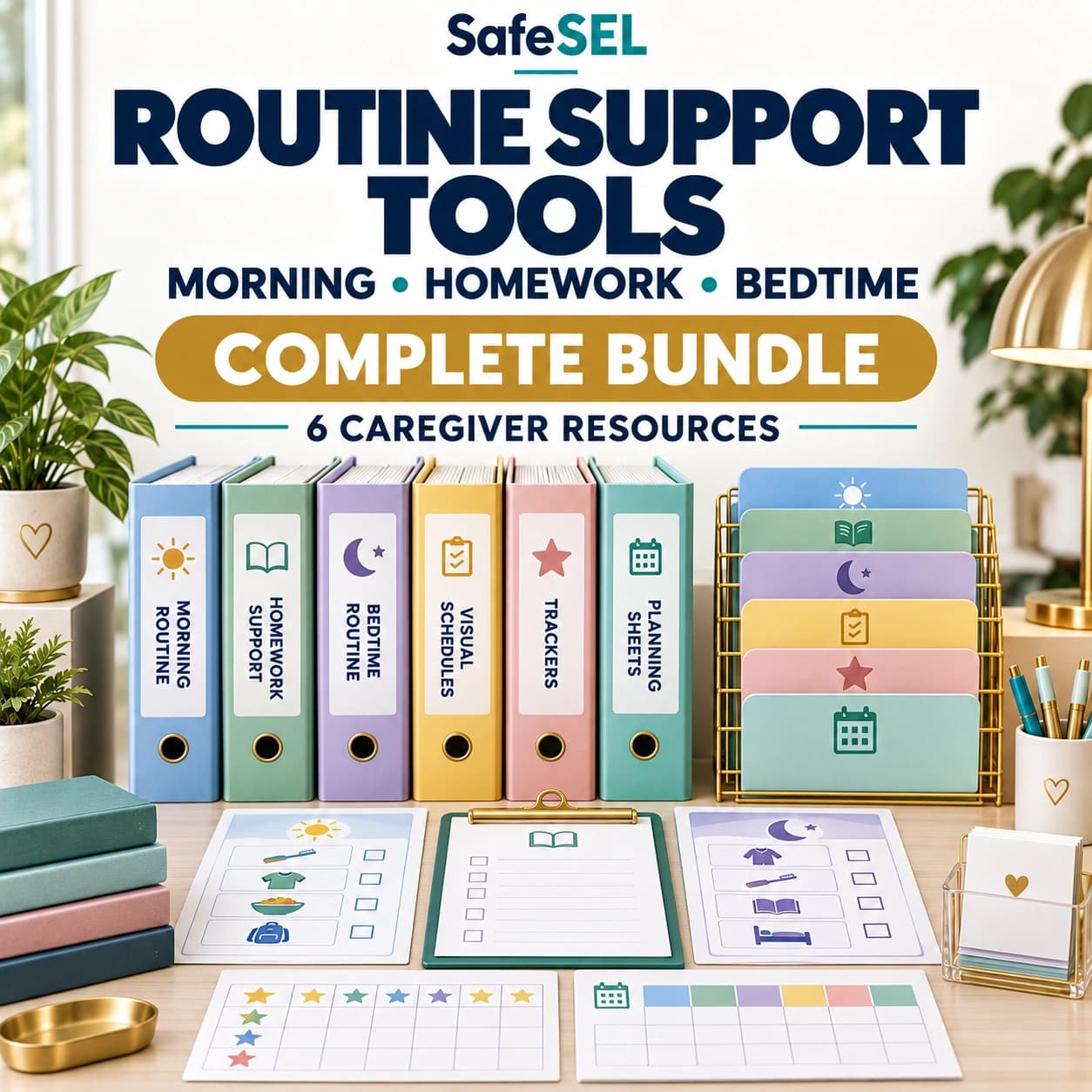
For a structured set of materials, see the Routines & Cooperation Parent Bundle.
You can also browse parent and caregiver resources or continue with our
morning routines and executive-function difficulties.
Sources and further reading
- The Importance of Family Routines — American Academy of Pediatrics / HealthyChildren.org (2024)
- Tips for Relying on Routines and Rules — Centers for Disease Control and Prevention (2026)