When a child refuses school, the first useful question is not “How do I make them go?” but “Where does the school day become unworkable?” Check immediate safety, health, bullying, learning demands, sensory load and the exact moment distress rises. Then coordinate a specific return plan with school and qualified support instead of turning every morning into a test of willpower.
School refusal describes a pattern, not a motive
A child who cries at the door, reports a stomachache, hides under the blanket or becomes aggressive during the morning may all be showing school refusal. The visible behavior tells you that attendance has become difficult; it does not tell you why. Anxiety is common, but so are bullying, an unsupported learning need, sensory overload, a frightening adult interaction, pain, sleep disruption and a recent family or school change.
This distinction matters because the wrong explanation produces the wrong intervention. Treating panic as defiance may increase threat. Treating a genuine safety problem as avoidance may send the child back into harm. Treating every complaint as proof that school is impossible can also strengthen a cycle in which staying home becomes the only reliable route to relief.
Find the first moment the day starts to go wrong
Do not begin with the peak. Reconstruct one recent morning from waking to arrival: getting dressed, eating, leaving home, the route, the gate, the hallway, a particular class, lunch, bathroom access and the trip home. Ask the child to point, draw or rate the parts if open questions produce “I don’t know.” Parents and school may notice different pieces, and both views can be useful.
A broad statement such as “school is awful” becomes more actionable when it is narrowed to “the bus is noisy,” “I cannot find the right work,” “they wait for me near the bathroom,” or “I think Mum will be hurt while I’m gone.” The aim is not an interrogation. It is to locate conditions that can be changed and predictions that may need supported practice.
Check safety and access before you call it anxiety
Ask directly about bullying, harassment, humiliating discipline, threats, discrimination and frightening peer contact. Review whether the child can access learning, communication, food, medication, toileting, sensory breaks and a trusted adult. New physical symptoms deserve appropriate medical attention rather than an automatic mental-health explanation.
If a setting is unsafe or inaccessible, the first plan is protection and accommodation—not exposure to more of the same. Document concrete incidents, dates, locations, people involved and previous reports. A child should not have to prove bravery by tolerating harm.
Understand the relief loop without blaming anyone
Staying home can bring immediate relief from fear, uncertainty or overload. That relief is real. It can also teach the nervous system that escape was necessary, so the next morning feels even more dangerous. Parents often respond with long negotiations, repeated reassurance or last-minute bargains because they are trying to get through the day. Those responses can accidentally make the decision feel open until the final minute.
The alternative is not coldness. It is a short, predictable plan: acknowledge distress, use the agreed words, move to the next supported step and save problem-solving for a calmer time. The child is allowed to feel afraid; adults keep responsibility for the plan.
Build a return step that is specific enough to test
“Go back to school” is not a step. A workable step names the place, duration, support and endpoint. For one child it may be meeting a named adult at a quiet entrance and attending the first lesson. For another it may be a shortened day while a medical or learning issue is addressed. The plan should say what happens if distress rises and when the team will review it.
Measure more than perfect attendance. Notice approach, recovery, use of help, time spent in the setting and whether the suspected obstacle was reduced. A difficult attempt can still provide valuable information. Repeated collapse without adjustment is not evidence that the child needs more pressure; it is evidence that the formulation or support plan needs review.
Keep home and school messages aligned
Children become more uncertain when one adult promises they can stay home, another threatens consequences and school has not been told what to expect. Agree on a small number of phrases, a named school contact, the arrival procedure and who communicates changes. Avoid discussing the entire plan in front of siblings or peers.
On a home day, keep the environment safe and caring but reasonably ordinary. The goal is not punishment, and it is not to create an unusually rewarding alternative to attendance. Support sleep, food, movement and the next planned contact with school.
Know when to seek more help
Seek qualified assessment when refusal persists, rapidly worsens or is linked with panic, depression, trauma, bullying, severe sleep disruption, significant physical symptoms, learning concerns or neurodevelopmental needs. Coordination among family, school, medical care and a licensed mental-health professional is often more effective than expecting one person to solve the pattern.
Urgent safety concerns require urgent local help. This includes suicidal talk, self-harm, credible threats, abuse, exploitation or a situation in which the child cannot be kept safe. A printable plan can organize observations and questions, but it cannot replace individualized assessment.
Use educational resources for parents to prepare the school conversation
Before discussing a back to school step, write down the exact difficulty and the support already tried. Ask who the trusted adult will be on arrival, how the child can reach them and how information will be shared if the plan changes. A name on paper is not enough if that person is unavailable at the difficult time.
Keep the plan focused on the barrier you identified. If the problem is the noisy entrance, discuss the entrance; if it is inaccessible work, discuss learning support. A general attendance target cannot replace those practical arrangements.
A practical next step
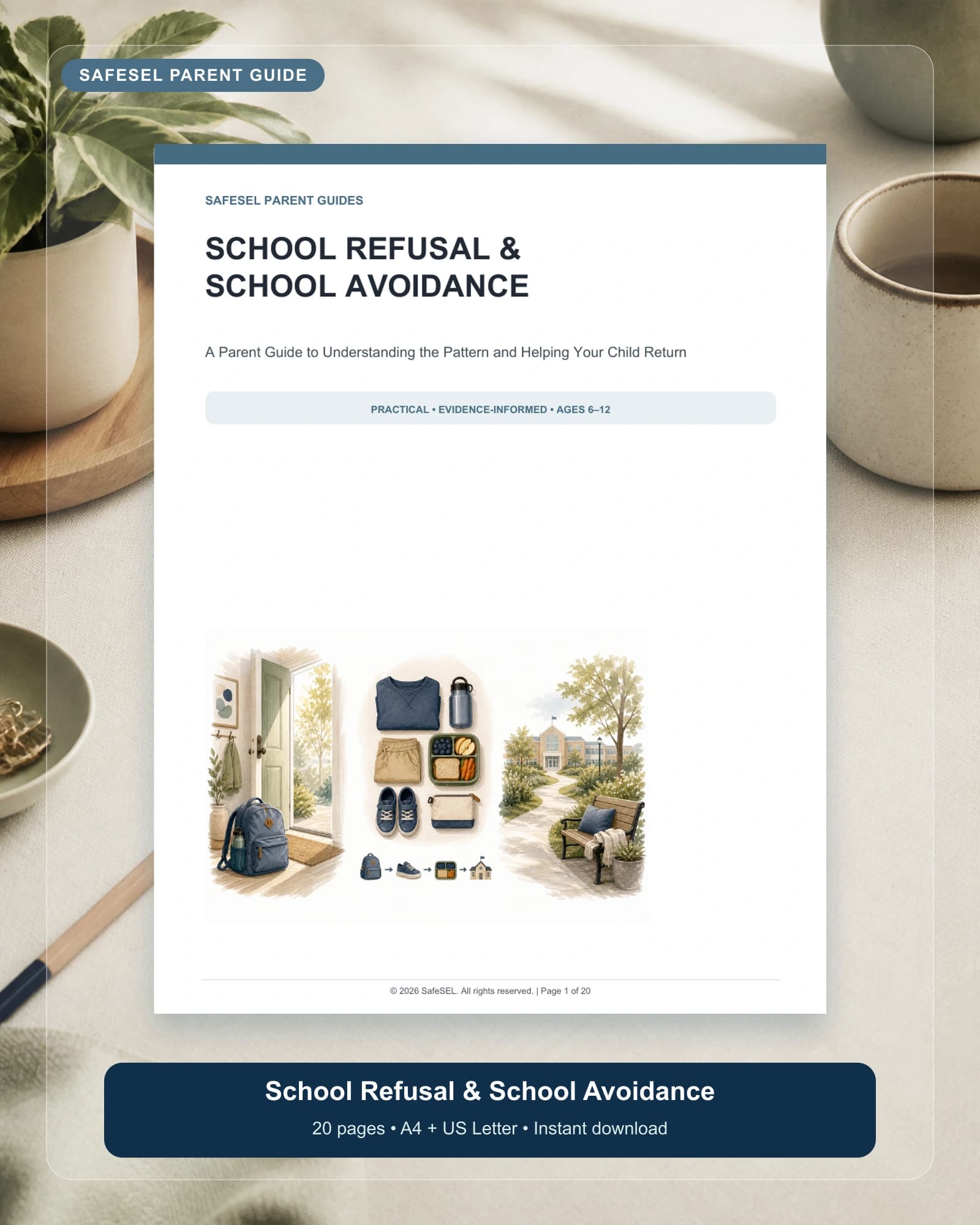
For the complete home-use framework, scripts and printable tracker, see the School Refusal & School Avoidance parent guide.
Browse more parent and caregiver resources.
Continue with school refusal support plan for parents and schools.
Sources and further reading
- School Refusal — American Academy of Child and Adolescent Psychiatry (2026)
- Anxiety and Children — American Academy of Child and Adolescent Psychiatry (2023)